Connect with us

உலகம்

Bolivia in crisis: Social unrest, demands for president to resign escalate

Published

on

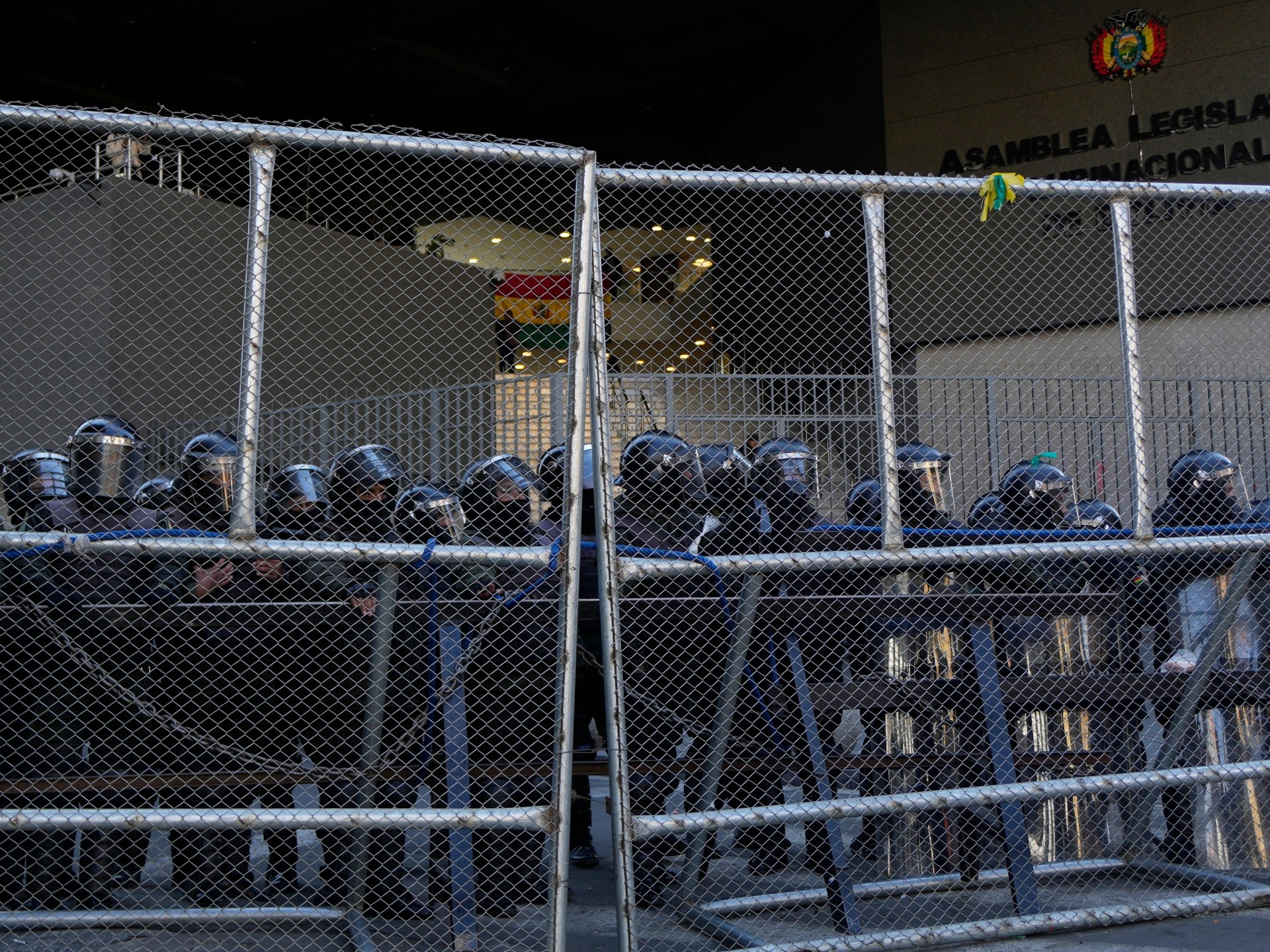
Protests have spiraled out of control and President Rodrigo Paz, who came into office only six months ago, is facing demands to resign.

Santa Cruz, Bolivia – A spiralling political conflict is threatening social stability in Bolivia.

Just six months after the new administration took office, President Rodrigo Paz is facing a wave of demonstrations, highway blockades and growing calls for his resignation.

The unrest began a little more than a month ago with the convergence of several sector-based demands. Some organisations were calling for wage increases, others complained about contaminated fuel that had damaged thousands of vehicles, while additional groups protested against a law authorising changes to land classifications, which, its critics said, favoured land concentration among big business owners.

Although the government managed to ease some of the disputes by conceding to certain demands, including repealing the land law and offering a financial bonus for teachers, as well as speeding up compensation for some vehicles damaged, Indigenous groups from the highlands decided to push the protests to the limit by blocking roads in an effort to force the president to step down.

On May 6, hundreds of protesters began erecting barricades that have since surrounded the city of La Paz, the seat of government, maintaining an average of 20 simultaneous pickets each day. They have also secured the support of other organisations that have historically exerted pressure over government decision-making, including the Bolivian Workers’ Union.

“The demand is for the president to resign due to his inability to solve the country’s structural problems; he is leading us adrift … he is mortgaging the country. What future awaits our children and grandchildren?” Mario Argollo, union leader of Central Obrera Boliviana, told reporters.

The Andean cities of La Paz and El Alto, two of the country’s most populous urban centers and that are adjacent to each other, are facing food shortages, the suspension of classes in some schools and disruptions to public transportation as hundreds of protesters block roads.

Although many residents affected by the protests have demanded a tougher response against demonstrators in order to restore order, the government has so far ruled out declaring a state of emergency.

Despite the differing motivations of the social groups taking part in the protests, many analysts believe there is a deeper issue behind the unrest: growing discontent among Indigenous and working-class sectors.

Rodrigo Paz was a centrist senator who, despite having a long political career, was not a nationally known figure and managed to present himself as a “new” candidate. He became Bolivia’s first president after the era of the Movement for Socialism (MAS), which governed the country for nearly 20 years with record-breaking electoral victories and congressional majorities. Due to poor administrative management and corruption, MAS left the country facing a deep economic crisis and received just 3 percent of the vote in the 2025 elections.

During the election campaign, Rodrigo Paz adopted a moderate, centrist discourse and rose to power largely thanks to former MAS voters.

Now, six months into the presidency, those voters are not only disenchanted, but also feeling excluded from the government, as Rodrigo Paz did not appoint Indigenous people or working-class individuals to the cabinet or to key positions within the government.

These groups, which had governed alongside MAS for the past two decades now perceive the administration as aligned with business elites and governing in their favour.

Some of the policy moves that added to the discontent include Paz eliminating a tax on large fortunes, appointing members of the business elite to his cabinet, approving laws favouring agribusiness – such as the use of genetically modified seeds – and aligning himself with the United States and Israel, countries with which Bolivia had no diplomatic relations. He also went from rejecting international loans during the campaign to seeking financing from organisations such as the International Monetary Fund.

“Rodrigo Paz won with a very different agenda, and halfway through, he carried out a political and strategic shift, both in the composition of his administration and in its orientation. Popular sectors, therefore, perceive not only exclusion, but also an outright betrayal,” political analyst Luciana Jauregui told Al Jazeera. It was the support of workers and rural communities that allowed Paz to win the election with 55 percent of the vote, she said.

Amid the protests, former President Evo Morales, who was in power from 2006 to 2019, escalated pressure further by mobilising his supporters for a 190-kilometre (118-mile) march towards La Paz to demand the president’s resignation and the suspension of judicial proceedings against the former leader. Morales is facing an arrest warrant and has been accused of abusing a teenage girl during his presidency.

Morales was the country’s first Indigenous president, governed Bolivia for three consecutive terms, and achieved unprecedented electoral support. He governed with virtually no opposition, and his administration was marked by policies of social inclusion, Indigenous recognition, and economic prosperity, driven by booming gas exports and a significant poverty reduction.

In recent years, however, the country has faced a gradual economic deterioration marked by the decline of the oil and gas industry, partly because of poor management, a consequent shortage of US dollars as that export fell, and rising inflation.

That economic downturn ultimately led MAS to lose power amid disputes between Morales and his successor, former President Luis Arce, who battled for control of the party.

Despite the power he held, Morales’s departure from government was chaotic: He ultimately resigned in 2019 amid protests after seeking an illegal fourth term.

Rodrigo Paz’s administration has accused the former president of orchestrating a “macabre plan” aimed at destabilising the government and returning to power. Officials have also claimed the protests are financed by drug trafficking, although no evidence has been presented to support those accusations.

“Our struggle is against those powers that receive money from drug trafficking and use the tools of terrorism to seize power by force,” presidential spokesperson Jose Luis Galvez said during a news conference.

Morales, far from addressing the accusations directly, criticised a government that he says “protects business owners, bankers and agro-industrial elites while ordinary people once again stand in lines, go into debt and endure hunger”.

“No speech is going to erase that reality,” he wrote on X.

In recent days, violence has intensified in La Paz amid the convergence of multiple marches around government offices in which miners armed with dynamite and explosive materials clashed with the police. Local media also reported attacks on public institutions and assaults on civilians. According to official sources, more than 120 people were detained during Monday’s unrest, while at least 11 injuries were reported.

For the government, the conflict has two distinct dimensions: legitimate demands and efforts aimed solely at overthrowing the president.

“We are going to act with two instruments: dialogue for the legitimate sectors and the full force of the law against those who are attacking democracy,” Presidency Minister Jose Luis Lupo said.

Without institutional representation, the social sectors that once governed alongside MAS are now seeking to reclaim a role in political decision-making.

Magdalena Choque, a woman protesting in the streets of La Paz, said she remained “in struggle against the government” because authorities “are not listening to the people”.

“They do not consult us. Everything is imposed by decrees, and nothing benefits our homeland. We are being discriminated [agains

📰 மூல செய்தி (Source): https://www.aljazeera.com/economy/2026/5/22/bolivia-in-crisis-social-unrest-demands-for-president-to-resign-escalate?traffic_source=rss

உலகம்

Protesters torch cars, buildings in Belfast after knife attack

Published

on

Unrest comes after a Sudanese man was arrested over a stabbing attack in north Belfast, UK.

Belfast plunged into chaos as vehicles set ablaze following stabbing attack

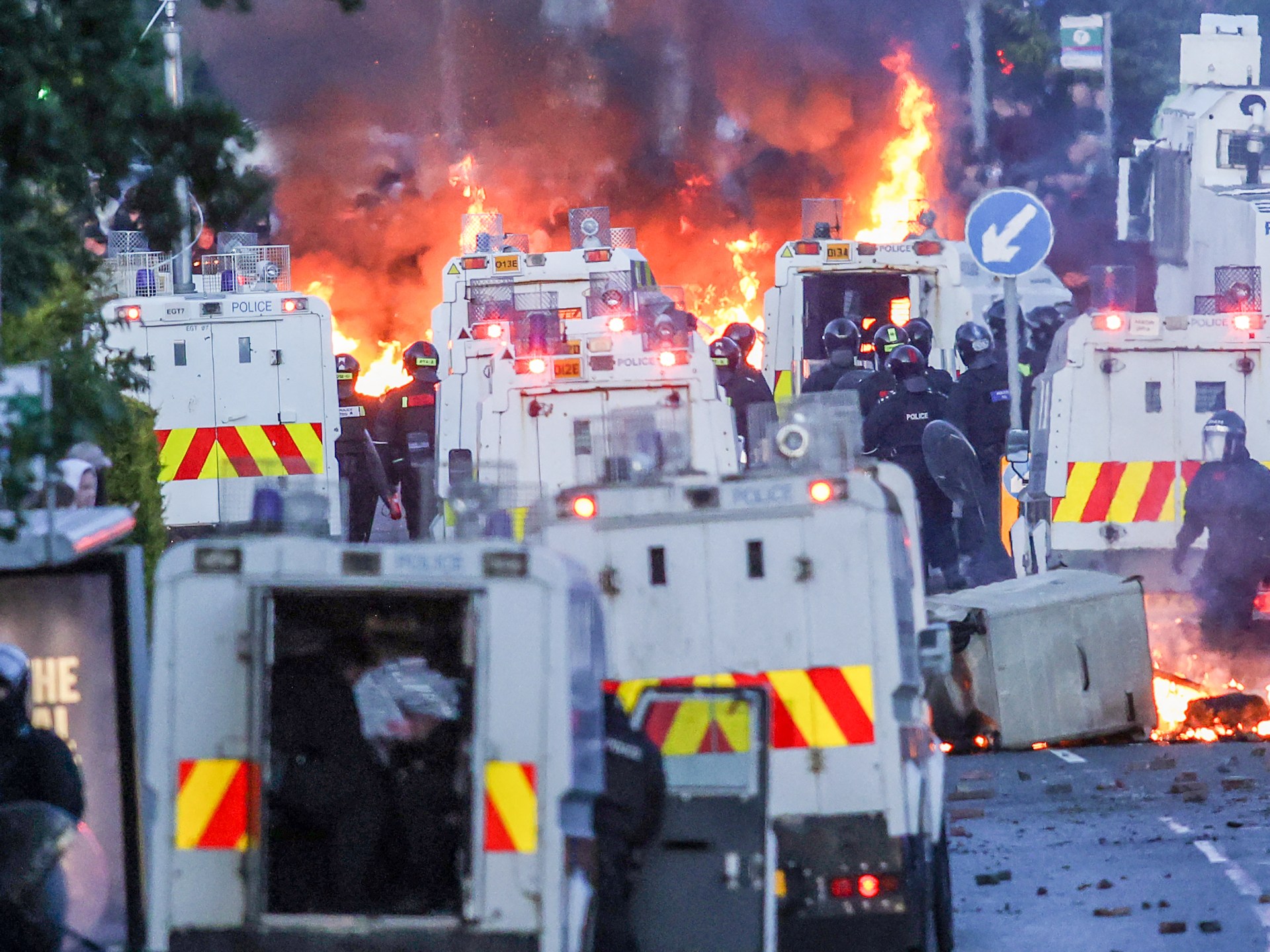
Anti-immigrant protesters in the city of Belfast in the United Kingdom have torched vehicles and buildings after a Sudanese man was arrested over a knife attack that left one person with serious injuries.

Hundreds of protesters, many of them masked, gathered at several locations across the city on Tuesday, setting fire to a bus and several cars.

A building near the city centre was also set alight, with residents telling the AFP news agency that the protesters started a fire in the bins and went on to throw petrol bombs.

Crowds also gathered in Antrim, about 25km (15 miles) west of Belfast.

Michelle O’Neill, the first minister of Northern Ireland, slammed the protests and urged calm.

“Groups of masked men burning families out of their homes is nothing less than disgusting cowardice,” she wrote on X.

“Racism, intimidation and violence are wrong wherever they occur. There can be no excuse and no justification for these attacks tonight. No one wants to see this on our streets and I again appeal for calm”.

The suspect in the knife attack, which took place in north Belfast late on Monday, was charged late on Tuesday with attempted murder, possession of a bladed weapon in a public place, and making threats to kill.

The 30-year-old man, whose name has not been released, is due to appear in court on Wednesday.

The victim, a man in his 40s, suffered significant injuries to his eyes and slash wounds to his face and back during the attack with a kitchen knife found at the scene, police said.

“I understand that last night’s attempted murder will leave people feeling a range of emotions, from fear to anger,” Northern Ireland’s Assistant Chief Constable Ryan Henderson told ⁠a news conference, as he declared the unrest a “critical incident”.

“I appeal for calm and the safety of all of our communities in ⁠response to this”, he said.

Footage of the knife attack in north Belfast showed several members of the public trying to fight off the ⁠attacker before police arrived, and they were credited by senior officers with saving the man’s life.

UK Prime Minister Keir Starmer called the attack “horrific” and “sickening” on X. “I have absolutely no tolerance for abhorrent scenes of violence like this on our streets,” he said.

His office said that “it is time for calm”, adding: “It’s important that police have the time and space to investigate appropriately.”

The attack, which is ⁠not being treated as terrorism, comes at a time of heightened tensions in the UK following the murder of a student in Southampton who was handcuffed by police as he lay dying from stab wounds after his killer, a Sikh man, had falsely alleged a racist attack.

Although the victim and convicted killer were both British, protesters on Tuesday stood outside a Southampton hotel that had housed asylum seekers, holding signs that read, “Illegal Migration Is Destroying Our Civilisation”.

The attack in Belfast, meanwhile, sparked immediate questions about the suspect’s immigration status, including from some politicians.

Gavin Robinson, the leader of the Democratic Unionist Party, urged authorities to curb “uncontrolled immigration”, while anti-immigration figures, including Reform UK party leader Nigel Farage and Restore Britain leader Rupert Lowe, demanded details about the attacker.

Northern Ireland’s chief constable, Jon Boutcher, told reporters that the suspect was living in the UK on a five-year visa granted in September 2023.

Boutcher said he was believed to have travelled from Sudan to Paris and Dublin before claiming asylum in Belfast.

“There is no trace of this suspect on any of our national security databases, and he was not known to the Police Service of Northern Ireland,” he added.

Northern ‌Ireland’s ‌main political party leaders jointly condemned the knife attack, calling it “horrific” and saying that “there is no place in our society for this kind of brutality”.

They also called for calm, saying that disturbances would only damage their communities.

📰 மூல செய்தி (Source): https://www.aljazeera.com/news/2026/6/10/protesters-torch-cars-buildings-in-belfast-after-knife-attack?traffic_source=rss

Continue Reading

உலகம்

Iran attacks Bahrain, Kuwait, Jordan in retaliation for US strikes

Published

on

Strikes come after US attacked Iranian ports and islands in the Strait of Hormuz over the downing of a helicopter.

Iran’s Islamic Revolutionary Guard Corps (IRGC) has claimed attacks on United States military bases in Bahrain, Kuwait and Jordan in retaliation for US strikes on Iranian ports and islands in the Strait of Hormuz.

In a statement carried by state media on Wednesday, the IRGC said it launched drone attacks on the US Fifth Fleet in Bahrain and the Ali Al Salem airbase in Kuwait, as well as a long-range missile strike on an airbase in Azraq, Jordan.

It said it attacked 21 US targets and destroyed four of them, including an F-35 fighter jet hangar at the base in Jordan.

It also claimed to have shot down a US MQ-9 drone in the skies over the Iranian city of Jam.

The latest flare-up comes after the US military attacked Qeshm Island and ports along the Iranian coast in the Strait of Hormuz after blaming Iran for downing a US Apache helicopter earlier on Tuesday.

The IRGC said the US’s attacks had caused damage to a telecommunications tower in the town of Sirik and destroyed two water tanks there.

It warned that its forces remain fully prepared to deliver a “crushing and decisive” response to any US military actions and that Washington would bear full responsibility for the consequences of further escalation.

There was no immediate comment from the US.

In Jordan, the military said it intercepted and shot down five missiles launched from Iran towards Azraq, adding that the operation “resulted in the fall of shrapnel without any human injuries or material damage”.

The attacks prompted air raid alarms in Bahrain and Kuwait.

The Kuwaiti military said earlier that it was intercepting “hostile aerial targets” in the country’s airspace, without elaborating further.

Trita Parsi, executive vice president of the Quincy Institute for Responsible Statecraft in the US, said Iran’s swift response to Washington’s attacks signalled a new doctrine.

“They believe they have to respond proportionately, but very harshly and swiftly, against any American attack. Because otherwise, a new normal is established, one in which the United States can strike at Iran with more or less impunity,” he said.

The Iranians, he said, were making clear that any attack on them would be responded to, regardless of the size and the scope.

“But at the end of the day, every time these different types of events have occurred, the sense I have gotten from both sides is that their confidence and their trust in the ability of reaching a deal is starting to diminish,” he added.

This new round of strikes came a day after Iran and Israel exchanged fire in their most serious escalation since a ceasefire took effect in April. The war began with US and Israeli strikes on Iran on February 28, and has shaken the global economy and driven up the cost of fuel and food.

Progress towards a peace deal remains slow, complicated further by Israel’s intensifying campaign in Lebanon against the Iranian-backed Hezbollah.

Al Jazeera’s Mohamed Vall, reporting from Tehran, said that despite the latest strikes, neither side wanted a return to full-scale war.

“Whether the Americans are going to absorb this latest retaliation from the Iranians and end their operation or whether there will be new attacks will become clear in the next few hours,” he said.

“But the understanding is that both sides would like to go back to negotiations, even though the Iranians say they don’t trust any American initiative with regards to peace.”

📰 மூல செய்தி (Source): https://www.aljazeera.com/news/2026/6/10/iran-strikes-bahrain-and-jordan-in-retaliation-for-us-attacks-in-hormuz?traffic_source=rss

Continue Reading

உலகம்

Bolivia approves military measures against nationwide protests

Published

on

Bolivia approves military measures against nationwide protests

Bolivian President Rodrigo Paz has authorised military force against protesters amid the country’s worst economic crisis in 40 years, after roadblocks paralysed the nation. At least 10 people have been killed since the unrest began.

📰 மூல செய்தி (Source): https://www.aljazeera.com/video/newsfeed/2026/6/10/bolivia-approves-military-measures-against-nationwide-protests?traffic_source=rss

Continue Reading

Trending

Copyright © 2024 by 7Tamil Media, All rights reserved.