Connect with us

முக்கியச் செய்திகள்

Aung San Suu Kyi: The Myanmar democracy icon detained for years

Published

on

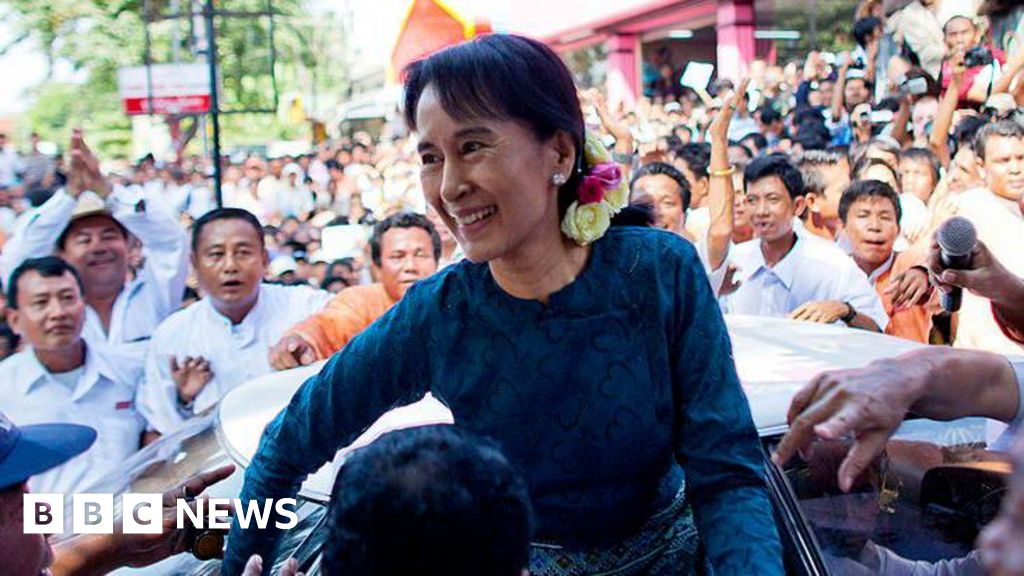
Former Myanmar leader Aung San Suu Kyi, who has been held in detention since a military coup in 2021, has been moved to house arrest, the country's state media reported.

Little has been heard from the 80-year-old Nobel laureate since she was arrested on the day the armed forces ousted her elected government more than five years ago.

She was charged with a raft of criminal offences, including corruption. She denies all of the accusations and rights groups have condemned the series of secret trials as a sham.

Having spent nearly15 years in detention between 1989 and 2010, Suu Kyi was once seen as a beacon for human rights, a principled activist who gave up her freedom to challenge the ruthless army generals who have ruled Myanmar for decades.

Her personal struggle to bring democracy to Myanmar (also known as Burma) made her an international symbol of peaceful resistance in the face of oppression.

But her decision later on to defend Myanmar against charges of genocide over the military's atrocities against Muslim Rohingyas badly tarnished her saint-like international image.

Suu Kyi is the daughter of Myanmar's independence hero, General Aung San.

He was assassinated when she was only two years old, just before Myanmar gained independence from British colonial rule in 1948.

In 1960 she went to India with her mother Daw Khin Kyi, who had been appointed Myanmar's ambassador in Delhi.

Four years later she went to Oxford University in the UK, where she studied philosophy, politics and economics. There she met her future husband, academic Michael Aris.

After stints of living and working in Japan and Bhutan, she settled in the UK to raise their two children, Alexander and Kim, but Myanmar was never far from her thoughts.

When she arrived back in Yangon in 1988 – to look after her critically ill mother – Myanmar was in the midst of major political upheaval.

Thousands of students, office workers and monks took to the streets demanding democratic reform.

"I could not as my father's daughter remain indifferent to all that was going on," she said in a speech in Yangon on 26 August 1988. She went on to lead the revolt against the then-dictator, General Ne Win.

Inspired by the non-violent campaigns of US civil rights leader Martin Luther King and India's Mahatma Gandhi, she organised rallies and travelled around the country, calling for peaceful democratic reform and free elections.

But the demonstrations were brutally suppressed by the army, which seized power in a coup on 18 September 1988. Suu Kyi was placed under house arrest the following year.

The military government called national elections in May 1990, which Suu Kyi's NLD convincingly won – but the junta refused to hand over control.

Suu Kyi remained under house arrest in Yangon for six years, until she was released in July 1995.

She was again put under house arrest in September 2000, when she tried to travel to the city of Mandalay in defiance of travel restrictions.

She was released unconditionally in May 2002, but just over a year later was imprisoned after a government-backed mob set upon her entourage in the north of the country.

She was later allowed to return home – but again under effective house arrest.

At times she was able to meet other NLD officials and selected diplomats, but during the early years she was often in solitary confinement. She was not allowed to see her two sons or her husband, who died of cancer in March 1999.

The military authorities had offered to allow her to travel to the UK to see him when he was gravely ill, but she felt compelled to refuse for fear she would not be allowed back into the country.

During this period, her international stature grew amid widespread sympathy for her predicament and admiration for her advocacy for non-violent protest.

In 1991, Suu Kyi was awarded the Nobel Peace Prize, while still under house arrest, and hailed as "an outstanding example of the power of the powerless".

A film was made about her life by French director Luc Besson, while songs were written in tribute to her courage by bands such as U2.

Suu Kyi was sidelined from Myanmar's first elections in two decades on 7 November 2010.

But six days later the government released her from house arrest, in a move hailed by the international community. Thousands of jubilant supporters celebrated at the gates of her house, where she addressed the crowd calling for unity in Myanmar. Her son Kim was allowed to visit her for the first time in a decade.

As the military-backed government embarked on a process of reform, Suu Kyi and her party re-joined the political process.

They won 43 of the 45 seats contested in April 2012 by-elections, in an emphatic statement of support. Suu Kyi was sworn in as an MP and leader of the opposition.

The following May, she left Myanmar for the first time in 24 years, in a sign of apparent confidence that its new leaders would allow her to return.

In 2015, Suu Kyi led her National League for Democracy (NLD) to a landslide victory in Myanmar's first openly contested election in 25 years, ending decades of military-backed rule.

The landmark win sparked hopes of further reform under the NLD steered by Suu Kyi, who took on the title of state counsellor as she was barred by the constitution from becoming president.

When she was Myanmar's state counsellor, her leadership was partly defined by the treatment of the country's mostly Muslim Rohingya minority.

In 2017 hundreds of thousands of Rohingya fled to neighbouring Bangladesh due to an army crackdown sparked by deadly attacks on police stations in Rakhine state.

Myanmar is now facing a lawsuit accusing it of genocide at the International Court of Justice (ICJ), while the International Criminal Court has investigated the country for crimes against humanity.

Suu Kyi's former international supporters accused her of doing nothing to stop rape, murder and possible genocide by refusing to condemn the still powerful military or acknowledge accounts of atrocities.

A few initially argued that she was a pragmatic politician, trying to govern a multi-ethnic country with a complex history.

But her personal defence of the army's actions at the ICJ hearing in the Hague was seen as a new turning point for her international reputation.

At home, however, "the Lady", as Suu Kyi is known, remains wildly popular among the Buddhist majority who hold little sympathy for the Rohingya.

During her time in power Suu Kyi and the NLD government also faced criticism for prosecuting journalists and activists using colonial-era laws.

While there was progress in some areas, the military continued to hold a quarter of parliamentary seats and controlled key ministries including defence, home affairs and border affairs.

In August 2018, Suu Kyi described the generals in her cabinet as "rather sweet" and Myanmar's democratic transition, analysts said, appeared to have stalled.

Despite some criticism of their performance in government, the NLD remained hugely popular with the people and clinched yet another decisive victory in the 2020 election.

In the early hours of 1 February 2021, just hours before the NLD was due to begin its second term in office, Suu Kyi, along with President Win Myint and other party leaders, was arrested in a military coup.

It triggered widespread demonstrations, leading to a crackdown by Myanmar's military on pro-democracy protesters, activists and journalists. A civil war erupted, which continues to be bitterly fought to this day.

At that time, Suu Kyi faced a series of charges ranging from violating Covid restrictions and illegally importing communications equipment such as walkie-talkies, to voter fraud and corruption, all of which she denied.

The UN called her trial a "sham" that would only "deepen rejection of the coup".

She was found guilty and sentenced to a total of 33 years, which since then has been reduced several times.

On 30 April 2026, the military showed an undated picture

📰 மூல செய்தி (Source): https://www.bbc.com/news/articles/crmp2yw0jkgo?at_medium=RSS&at_campaign=rss

முக்கியச் செய்திகள்

Estonia says Nato jet shot down drone over its territory

Published

on

Estonia has said a Nato fighter jet shot down a drone, which it suspects was a Ukrainian projectile knocked off course by Russian electronic jamming, over its territory.

Defence Minister Hanno Pevkur said a Romanian F-16 fired a missile and drone debris fell in a marshy area in central Estonia on Tuesday. No damage was reported.

Ukraine reacted by accusing Russia of deliberately redirecting Ukrainian drones launched at "legitimate military targets" in Russia, apologising to "Estonia and all of our Baltic friends for such unintended incidents".

Russia has not commented on the latest in a series of recent drone incursions over Nato members Estonia, Latvia and Lithuania.

Last week, Latvian Prime Minister Evika Silina resigned following a political crisis over Russia-bound Ukrainian drones straying into Latvian territory.

Earlier this month, two Ukrainian drones hit an empty oil storage site in Latvia. Ukraine said this was the result of electronic jamming by Russia.

A similar incursion was reported by Estonia and Latvia in March.

Moscow has accused the three Baltic states of allowing Ukraine to use their "air corridors" to strike targets inside Russia – a claimed denied by Tallinn, Riga and Vilnius.

Ukraine has recently intensified its drone and missile attacks against targets in Russia, including oil and gas facilities near the Baltic states.

Russian President Vladimir Putin launched a full-scale invasion of Ukraine in 2022.

At Tuesday's news conference, Pevkur said the drone was shot down shortly after 12:00 local time (09:00 GMT) between the lake of Võrtsjärv and the town of Põltsamaa.

He said the projectile had been identified as a potential threat even before it entered Estonia's air space.

"We received early information from Latvia about a drone that had strayed off course, and Estonia tracked the drone until Romanian fighter jets participating in the Baltic air policing mission shot it down," the Estonian defence ministry said in a statement.

Pevkur added he had "immediately" discussed the incident with his Ukrainian counterpart, who apologised for the incident.

"Estonia has not granted permission to use its airspace to anyone other than its allies, and the Ukrainians have not asked for this permission," the Estonian defence minister said.

Local media outlets later published photos of what they said were drone fragments on the ground.

The drone crashed into a forest, about 30m (98ft) from the nearest residential building, Estonia's ERR public broadcaster reported.

It quoted a local resident as saying: "There was a loud bang and I saw the drone fall from the sky."

In Ukraine, Foreign Ministry spokesman Heorhii Tykhyi said "Russia continues to redirect Ukrainian drones into the Baltics" and did this "on purpose, together with intensified propaganda".

In a statement, he said: "We apologise to Estonia and all of our Baltic friends for such unintended incidents," stressing "we use the Russian airspace to get to them".

His comments came just hours after Russia's foreign intelligence agency SVR said that Ukraine was planning to launch its drones against Russian targets from Estonia, Latvia and Lithuania.

SVR reported that Ukrainian drone military personnel had already been deployed at military bases in Latvia.

Latvia dismissed the claim as Russian "disinformation", with the foreign ministry saying Riga "has not given its consent for its territory and airspace to be used to carry out attacks against targets in the Russian Federation".

And Ukraine's Tykhyi said "there is no truth in Moscow's latest set of falsehoods accusing Ukraine of preparing attacks against Russia from the territory of Latvia".

There is growing concern in the three Baltic states on the easternmost flank of Nato that Moscow is planning major provocations to test the resolve of the military alliance.

Last year, more Nato countries agreed to move troops and fighter jets eastwards after more than a dozen drones had entered the airspace of Poland, another member of the alliance.

📰 மூல செய்தி (Source): https://www.bbc.com/news/articles/c302jy8z4vro?at_medium=RSS&at_campaign=rss
Continue Reading

முக்கியச் செய்திகள்

Southampton expelled from play-offs for spying

Published

on

Spygate is alleged to have taken place two days before Middlesbrough play-off semi-final first leg against Southampton

Southampton have been thrown out of the play-offs after admitting they spied on three clubs in the Championship season.

Middlesbrough, beaten by Southampton in the semi-final, have been reinstated and will now play Hull City for a place in the Premier League.

The EFL charged Saints with watching training sessions involving Oxford United and Ipswich Town, in addition to filming Middlesbrough as they prepared for the first leg of their play-off semi-final on 7 May.

The independent disciplinary commission also handed Southampton a four-point deduction in the Championship for next season.

Saints will now miss out on a game dubbed the richest in world football, with the winners of the play-off final guaranteed a minimum £110m in Premier League broadcast revenue.

The final will remain on Saturday at Wembley with the kick-off time to be confirmed.

Southampton admitted to "multiple breaches of EFL regulations related to the unauthorised filming of other clubs' training", the EFL said.

The club have also received a reprimand in respect of all the charges.

Sources have confirmed to BBC Sport that Southampton will lodge an appeal on Wednesday and will argue that the punishment is disproportionate.

The EFL said it would be "working to try and resolve any appeal on Wednesday 20 May".

It added that "subject to the outcome, it could result in a further change to Saturday's fixture".

The appeal will be heard by an Independent League Arbitration panel with three new members.

The EFL said in a statement: "Southampton was first charged on Friday 8 May, with further charges issued on Sunday 17 May in relation to additional breaches during the 2025-26 season.

"Those additional charges arose from matters identified after the initial proceedings involving Middlesbrough were initiated.

"Southampton admitted breaches of regulations requiring clubs to act with the utmost good faith and prohibiting the observation of another club's training session within 72 hours of a scheduled match.

"The admitted breaches concern fixtures against Oxford United in December 2025, Ipswich Town in April 2026 and Middlesbrough in May 2026."

Southampton did not win any of the three games – they lost 2-1 at Oxford, drew 2-2 at home to Ipswich and claimed a 0-0 draw at Boro.

The statement continued: "The EFL is now in discussion with all three clubs regarding the implications of today's decision and will make a further announcement in due course."

Middlesbrough issued a statement which said they "welcome the outcome".

"We believe this sends out a clear message for the future of our game regarding sporting integrity and conduct," it added.

"As a club, we are now focused on our game against Hull City at Wembley on Saturday. Ticket information for our supporters will be available shortly."

Southampton had already sold tickets for Saturday's game, and their supporters will receive a full refund.

They must now wait to see if the Football Association issues any charges for individuals involved in the spying. The EFL can only apply sanctions against its member clubs.

After a spying case at the 2024 Olympic Games, three members of Canada's staff, including the head coach, were banned from all football by Fifa for a year.

Middlesbrough were at their Rockliffe Park training base preparing for the game against Southampton 48 hours later.

The spy, Southampton analyst intern William Salt, is said to have parked at the golf club, then walked a couple of hundred yards down a road which leads to a raised area of ground.

Sources told the BBC that the accused simply stood pointing his mobile at the training session, while wearing in-ear headphones.

Middlesbrough staff believe he may have been live-streaming the session via a video call.

A member of Middlesbrough's staff approached, say BBC sources, but the person would not identify himself. Then, he quickly deleted some content off his phone before running off into the golf club.

He jogged into the toilets, changed his clothes and hurriedly left the site.

Middlesbrough's photographer took photos and matched him to a photo on the Southampton website. One of those pictures was subsequently made public last week.

Boro were furious and quickly reported it to the EFL.

The EFL charged Southampton with breaking two regulations.

EFL Regulation 3.4, which requires clubs to act towards each other with the utmost good faith; and

EFL Regulation 127, which prohibits any club from observing, or attempting to observe, another club's training session within 72 hours of a scheduled match between the two clubs.

Could Southampton be kicked out of play-offs over Spygate?

Boro want Southampton out of play-offs over Spygate

How Southampton allegedly spied on Middlesbrough

📰 மூல செய்தி (Source): https://www.bbc.com/sport/football/articles/cwy2pnpqjl7o?at_medium=RSS&at_campaign=rss

Continue Reading

முக்கியச் செய்திகள்

Grant Shapps quits aerospace firm after watchdog probe

Published

on

A former Conservative defence secretary has quit his job with a missile manufacturer over concerns he broke the rules governing the employment of former ministers.

Sir Grant Shapps resigned as chairman of Cambridge Aerospace on 30 April "to simplify matters" and after the firm secured a multimillion-pound government missile contract.

He said he had had no involvement in the deal or the company's military work and, despite a title of "chairman", had not chaired its board or been a director, but was "one of several co-founders".

Ministerial ethics watchdog Sir Laurie Magnus said he had "allowed a perception of impropriety to develop" and "failed to uphold the standards expected in the rules".

Sir Grant served as defence secretary under Rishi Sunak and has held a number of ministerial posts in government.

He was the Conservative MP for Welwyn Hatfield in Hertfordshire from 2005 to 2024, when he lost his seat in the general election.

The now defunct Advisory Committee on Business Appointments (Acoba) approved his role with the company in 2025 on condition that he play no part in its defence-related work until two years after he left office.

Acoba's decision was criticised by anti-corruption campaigners at the time, including Labour MP Phil Brickell, who said Sir Grant's claim the company was focused on "civilian aerospace" was "stretching credulity" given the firm's own description of itself as involved in "defence tech".

In correspondence with Sir Grant, Sir Laurie questioned whether he had complied with this condition, noting the company "seems publicly to have only one project, which is defence-related".

The watchdog initially contacted Sir Grant following the announcement on 10 April of a contract for Cambridge Aerospace to supply the UK and its Gulf allies with "Skyhammer" interceptor missiles.

Sir Laurie said the announcement "appears to be at direct variance with your original description of the role".

He added: "It is, on the face of it, difficult to reconcile the current scope of Cambridge Aerospace's operations with the restriction that you avoid defence matters entirely, and in the absence of a fresh application for advice in view of changes to the nature of the business of Cambridge Aerospace under your chairship."

In response to Sir Laurie's letters, Sir Grant said he had "scrupulously" followed Acoba's rules and was not involved "in any way, at any time, in any capacity" in the contract between Cambridge Aerospace and the Ministry of Defence.

But he apologised for not seeking further advice as the company began working on defence matters, saying this was "an oversight for which the excessive speed of events is the only mitigating circumstance".

Sir Grant also declined to answer a series of detailed questions from Sir Laurie, citing "legal obligations of confidentiality which I cannot unilaterally waive".

Brickell said he welcomed Sir Grant's resignation, but called for tougher sanctions for former ministers who broke the rules.

Do you have a story suggestion for Cambridgeshire? Contact us below.

Follow Cambridgeshire news on BBC Sounds, Facebook, Instagram and X.

📰 மூல செய்தி (Source): https://www.bbc.com/news/articles/cvgzjlqv1q9o?at_medium=RSS&at_campaign=rss
Continue Reading

Trending

Copyright © 2024 by 7Tamil Media, All rights reserved.