உலகம்
After Nagorno-Karabakh, Armenians vote for peace over nationalism
Published
4 hours agoon
Nikol Pashinyan’s victory suggests Russia’s influence in the country is waning.
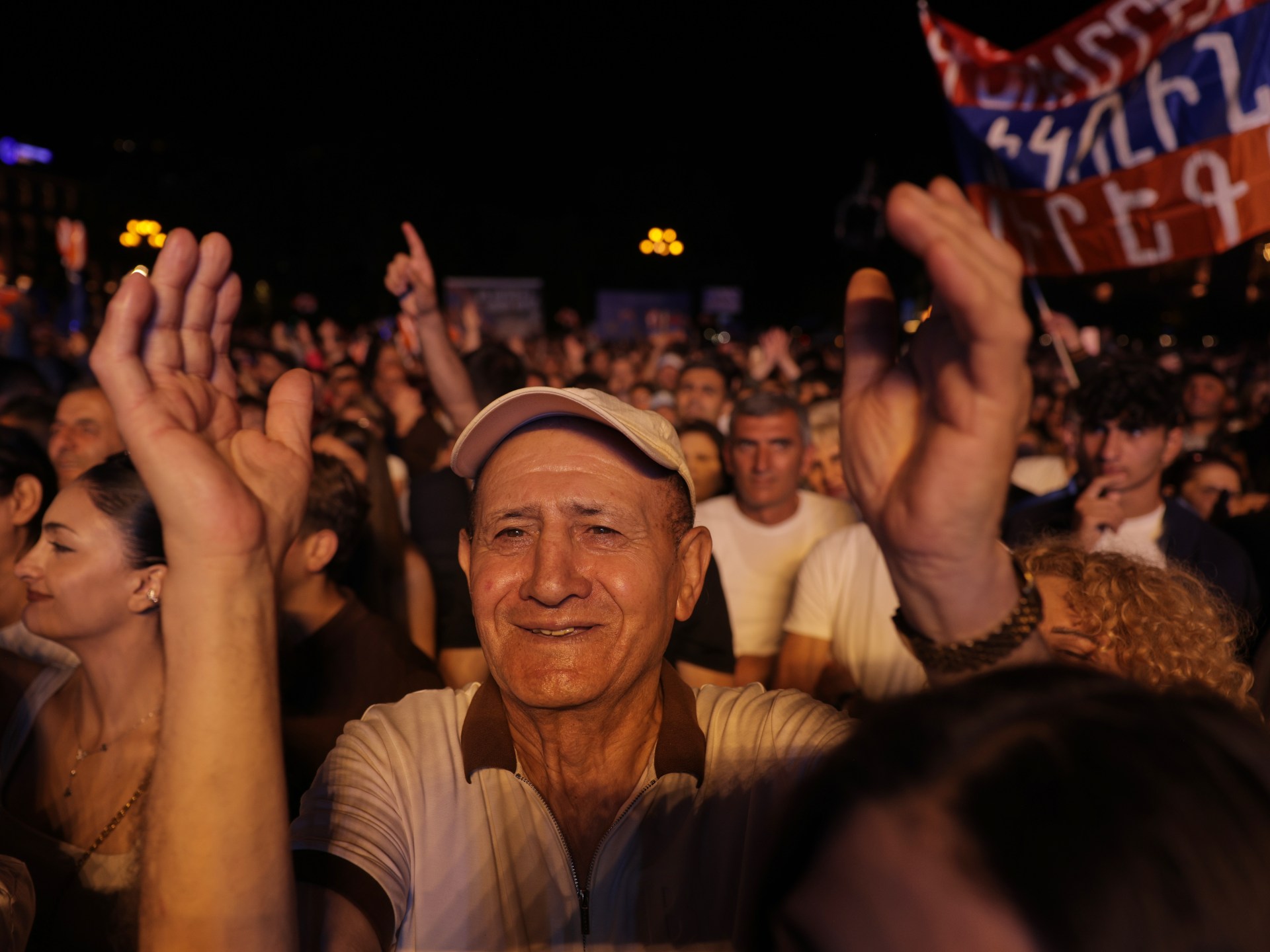
At a campaign rally in Armenia’s capital, Yerevan, on Saturday, one day before Armenia’s election, Prime Minister Nikol Pashinyan, outfitted in a white button-up shirt and a red-brimmed baseball cap, held a look of determination.
Flanked by supporters waving their arms and flashing his campaign’s signature heart-shaped hand gesture, Pashinyan was perched centre stage, pounding away on a drum kit for the crowds – literally drumming up support.
By election day, his governing Civil Contract party appeared to have drummed up something more consequential: public backing for his vision of Armenia’s future following the loss of the disputed region of Nagorno-Karabakh to a crushing military defeat by Azerbaijan in 2023.
Pashinyan, who formed a band earlier this year and campaigned with a series of concerts around the country, secured 49.8 percent of the vote in Sunday’s ballot, enough to retain a parliamentary majority.
His victory is seen as a test of his handling of the loss of the Nagorno-Karabakh region and his ability to steer the country away from Russian influence.
He has ultimately prevailed despite Russian meddling in Armenian politics, and the country now looks set to reorient itself away from its former ruler – signalling Armenians’ willingness to embrace a new direction, analysts say.
“Many Armenians are prepared to give his new vision a chance: an Armenia less defined by conflict, more open to normalising relations with Azerbaijan and Turkiye, and increasingly focused on building its future within its internationally recognised borders,” Zaur Shiriyev, an analyst at the Carnegie Russia Eurasia Center, told Al Jazeera.
The loss of Nagorno-Karabakh could have spelled political doom for Pashinyan. By handing him a second term, Armenians have signalled that they are ready to put the conflict that has intermittently reared its head for decades behind them, analysts say.
“Nationalism no longer resonates among the public, which is demonstrably tired of conflict and war,” Richard Giragosian, director of the Yerevan-based Regional Studies Center, told Al Jazeera, even if the loss of the region remains an “open wound”, he said.
Nagorno-Karabakh, meanwhile, no longer features at all in the Armenian government’s defence reform, nor in its national security strategy, “a final confirmation of the new strategy of diversification”, Giragosian explained.
Peace efforts instead took centre stage in Pashinyan’s campaign, including the agreement he signed at the White House last August with Azerbaijan, finally ending the on-again-off-again war that had raged since the late 1980s.
Unlike in 2021, when Pashinyan’s campaign was shaped by the immediate aftermath of war and questions of political survival, Sunday’s vote became a clearer test of public support for his peace agenda, Shiriyev said.
The result also demonstrates that the nationalist mantras peddled by opposition leaders have not been able to sway the majority of Armenians, said Svante Cornell, director of the Institute for Security and Development Policy and its Central Asia-Caucasus programme.
“The opposition represented a return to oligarchy, nationalism and forever conflict,” Cornell told Al Jazeera.
“While the Pashinyan government has its flaws, it represents something different than the past.”
The election saw the two main opposition forces – Strong Armenia and Armenia Alliance – win 41 seats combined in the new parliament, against the 64 seats the government holds, out of a total 105.
But Giragosian cautioned against overstating the opposition’s strength as, he said, the two opposition parties are unlikely to cooperate given the friction between their leaders – Russian-Armenian oligarch Samvel Karapetyan, whose Strong Armenia took 29 seats, and former President Robert Kocharian, whose Armenia Alliance won just 12.
“The division and dissent within the opposition will present a profound obstacle,” he said.
Although united in their shared pro-Russian leanings, Karapetyan is seen by Kocharian as an “interfering interloper”, with Kocharian himself resenting his third-place position behind Karapetyan, the analyst said.
“This is further exacerbated by Kocharian’s sense of entitlement, and his frustration of being rebuffed by Moscow in his prior attempts to gain direct Russian backing and support,” Giragosian added.
Still, Cornell said, the persistence of pro-Russian, nationalist sentiment in Armenia generally should not be taken lightly.
Until 2020, Armenia was governed by successive administrations that spent three decades pushing a nationalist identity, he said.
“To expect such views, such sentiments would just disappear – would be unrealistic,” Cornell noted.
In the lead-up to Sunday’s election, international observers had accused Russia of attempting to interfere – but its inability to change the result reflects Moscow’s limited reach in the country today, analysts say.
“Moscow still has tools in Armenia, but it no longer has the authority it once had,” Shiriyev said.
“In today’s Armenia, being seen as Russia’s preferred candidate can mobilise voters against you as much as for you.”
As Armenia strives to resist what Shiriyev refers to as the “gravitational pull” of the “Russian orbit”, a window of opportunity has been created by Moscow’s preoccupation with its invasion of Ukraine and a new openness from Western partners.
“The larger risk is from not altering strategy, and the benefits of a pivot to the West are both demonstrable and popular in Armenia today,” Giragosian said.
Russia, he added, is now increasingly viewed in Armenia as a “dangerously undependable so-called partner”.
Benyamin Poghosyan, an Armenia analyst at the Italian Institute for International Political Studies, argues that the primary foreign policy drivers of the election, however, were regional actors – not Russia or the West.
“The reality on the ground is far more nuanced,” Poghosyan told Al Jazeera. Armenia’s future relations with Azerbaijan and Turkiye, as well as the regional fallout from the conflict in Iran, are far greater influences, he said.
There are good reasons not to count Moscow out completely, however. While pro-Russian forces did not prevail this time, they will continue to assert their influence, Cornell said. He referred to the cautionary tale of another Caucasus country.
“In Georgia, the work of undermining a reformist and pro-Western government and turning the country around to a more pro-Russian line took over 15 years,” he said.
At the same time, Moscow still holds massive economic leverage over Yerevan, said the analysts.
Russia remains the primary export destination for Armenian agriculture and wine, is the main source of critical imports like wheat, and supplies the country with heavily discounted gas, Poghosyan noted.
“Because Russia has the capacity to inflict severe economic pain, Yerevan must tread carefully to protect its core interests without completely rupturing its relationship with Moscow,” he said.
Shiriyev added that many Armenians work in Russia, with families depending on remittances, and business ties running deep.
“By contrast, Western integration can still feel abstract and uncertain to many voters. That is why pro-Russian forces can still gain traction, even as Russia’s political image in Armenia has weakened,” he said.
But while Pashinyan’s re-election has strengthened his hand in the country’s peace process, it has not resolved one key sticking point for constitutional change to ensure it, said Shiriyev.
Azerbaijan has demanded a change to Yerevan’s constitution as a means of guaranteeing that no future Armenian government might revive claims related to Nagorno-Karabakh or Azerbaijan’s territorial integrity.
“But Pashinyan lacks the two-thirds majority needed to move easily toward a referendum, and even a referendum would be politically uncertain,” said Shiriyev.
This
📰 மூல செய்தி (Source): https://www.aljazeera.com/features/2026/6/9/after-karabakh-armenians-vote-for-peace-over-nationalism?traffic_source=rss

You may like
-
Iranian group could be labelled national threat under proposed new law
-
Construction on fire site by Glasgow Central Station might not start for several years
-
Hidden camera found in government building
-
Scrap legal equality duty for public services, says Badenoch
-
Two reportedly killed as women take part in rare protest in Afghanistan
-
Men jailed for violence at Henry Nowak police protest
உலகம்
Shackled, bleeding, raped: Palestinians describe abuse in Israel’s prisons
Published
4 hours agoon
June 9, 2026
Former detainees tell Al Jazeera they were chained, stripped, sexually abused and filmed, with repeated allegations involving dogs.
Warning: This story contains descriptions of sexual assault that some readers may find disturbing.
He does not begin with the name of the prison. He begins with the dog. In testimony gathered for Bodies of Evidence: Israel’s Darkest Weapon, an Al Jazeera original documentary I directed and executive produced, Mohammed Zaki al-Bakri describes being stripped, restrained and left powerless while Israeli soldiers laughed and filmed.
Al-Bakri, a survivor of the Israeli genocide in Gaza and a former detainee from Khan Younis, says he was held for 20 months and moved through five Israeli prisons.
“They stripped us of our clothes,” he says in the interview. “We are handcuffed … our hands were behind our backs and our legs were bound and we were blindfolded.”
Then came the allegation of violence, almost impossible to describe in words. “I was raped after being stripped of my clothes,” he says, “by a large dog.” In a separate part of the interview, he adds: “The seven of us were sexually assaulted by the dog.”
His was far from the only such allegation.
Across months of reporting, Al Jazeera’s documentary team gathered accounts from former Palestinian detainees who described dogs used not only as instruments of fear, but as part of a ritual of sexualised humiliation: prisoners stripped, blindfolded, handcuffed, forced to lie on their stomachs, beaten, threatened, filmed and attacked. These testimonies form the basis of AL Jazeera’s investigative documentary, Bodies of Evidence: Israel’s Darkest Weapon.
One former detainee from Gaza – we identify him with the pseudonym Job – who moved through eight Israeli detention facilities, describes how dogs were unleashed on prisoners in the same ritualised way when he was held at Israel’s Sde Teiman prison. A third Palestinian survivor from Gaza also describes a dog assault.
The pattern extends beyond the prison wall. Kifaya Khraim, international advocacy coordinator at the Ramallah-based Women’s Centre for Legal Aid and Counselling (WCLAC), tells Al Jazeera about what one family – the Ajlounis – in Hebron faced in July 2023. Israeli forces, she says, forced their way into their home “under the threat of large dogs,” ordered the women to undress and walk naked around the house in front of female soldiers.
Aside from the use of dogs, Shereen, a former detainee and activist whose identity we are concealing, describes repeated stripping and invasive searches. Adnan Hassan, a former child detainee from Jenin in the occupied West Bank, says he was arrested at 17 and held for five months. Mays Abu Ghosh, a former detainee from Jerusalem, describes the prison as a place where humiliation became routine.
Their testimonies do not describe one prison, one guard or one isolated act.
Since 1967, Palestinian official sources estimate that more than 750,000 Palestinians have been detained by Israel. A United Nations-cited figure says more than 800,000 Palestinians were imprisoned between 1967 and 2006. In April 2026, Addameer Prisoner Support and Human Rights Association reported 9,600 Palestinian political prisoners were in Israeli custody, including 3,532 held under administrative detention – imprisonment without charge or trial – alongside another 342 children and 84 women.
For Palestinians, prison is not a marginal experience. It is a generational one.
A detainee can be arrested at home, at a checkpoint, inside a hospital, at a shelter or during a military raid. He or she may then be moved between soldiers, intelligence officers, military detention sites, police custody, military courts and prisons run by the Israel Prison Service.
The names of the facilities change: Sde Teiman, Ofer, Negev, Ashkelon, interrogation centres, checkpoints and military camps.
The details recur. A name becomes a number. Clothes are removed. Eyes are covered. Hands and legs are tied. Food is restricted. Sleep is denied. Dogs are brought in. Prisoners are threatened with rape. Many are raped. Some say they are filmed. Many say complaints go nowhere.
In al-Bakri’s case, he said, the dog was not merely present. It was part of the assault itself. “They walk dogs at you, and then they start kicking you,” he said. “They attacked us from behind using dogs… They attacked us with dogs in a crazy way,” he added in another section of the interview.
Then: “We are all powerless to do anything. They are laughing. And of course they are filming us.” Al Jazeera is not publishing every graphic detail of the testimony. But the pattern is clear: dogs appear repeatedly in accounts of nakedness, restraint, sexual violence and degradation.
Job, the second Palestinian survivor identified in Bodies of Evidence: Israel’s Darkest Weapon by a pseudonym, his face and voice concealed for his safety, points to how the dogs attacked under verbal instructions from soldiers. “I don’t think it’s a dog. It’s a human being.”
“They unleash the dogs. There’s no way around it; the dog must pass. He [the dog] will either rape you, or he will smash your head with an iron bar in his mouth,” he says. The dog, he tells Al Jazeera, “doesn’t just bark and howl”, it acts on signals from its handler. “The word you give the dog, it will do.”
The allegation that dogs were used in sexual assault has recently entered wider international debate after new reporting on sexual abuse of Palestinian detainees triggered a barrage of Israeli denials and attacks by pro-Israeli commentators. Israeli officials and allied media figures have called the reporting a “blood libel”, focusing especially on claims involving dogs.
But for Palestinians and the organisations that document prisoner abuse, these allegations did not appear overnight.
Francesca Albanese, the UN’s special rapporteur on human rights in the occupied Palestinian territory, says in an interview for the film that Palestinians have long been subjected to “the use of animals, the use of dogs to attack, to abuse, and even to inflict sexual abuse”.
“These are facts that were known,” she says. Albanese describes a broader pattern reported by prisoners: “Shackling until bleeding, beating, dragging, starvation, exposure to cold, denial of medical care, attacks by dogs, solitary confinement, sexual abuse, forced stripping, and threats to rape and kill family members.”
Khraim, the advocacy partner at WCLAC, said sexual humiliation and threats were used to produce silence. Men and boys often do not speak because of stigma. Women fear social punishment. Children carry shame that they do not have the language to explain.
That’s why the testimonies shared by survivors with Al Jazeera matter. These are not lawsuits. They are damaged memories, communicated through fear, anger and survival.
Sde Teiman, the Israeli military detention facility in the Naqab/Negev desert, became a symbol of Israel’s post-October 7 detention regime after reports of blindfolded and shackled Palestinians, medical neglect, torture allegations and sexual abuse emerged.
Five Israeli soldiers were accused of sexually abusing a Palestinian detainee at Sde Teiman. In March 2026, Israeli authorities dropped the charges. But Bodies of Evidence: Israel’s Darkest Weapon shows that Sde Teiman is no exception.
Palestinian detainees can pass through multiple systems: military detention, intelligence interrogation, police custody, military courts and formal prisons. The Israel Prison Service and police fall under the Ministry of National Security, headed by Itamar Ben-Gvir. Military detention sites such as Sde Teiman fall under the Israeli military chain of command. The Shin Bet, Israel’s internal security agency, operates under the authority of the Prime Minister’s Office. The Ministry of Justice oversees state legal policy, prosecutions and government legal defence. Responsibility is fragmented.
A prisoner may be arrested by soldiers, interrog
📰 மூல செய்தி (Source): https://www.aljazeera.com/features/2026/6/9/shackled-bleeding-raped-palestinians-describe-abuse-in-israels-prisons?traffic_source=rss

உலகம்
Trump says in ‘final throes’ of peace deal but at least 8 killed in Lebanon
Published
4 hours agoon
June 9, 2026
The US president warned Netanyahu he would be on his own if attacks continue after Israel and Iran paused fighting.
Israeli attacks on Tyre in southern Lebanon have killed at least eight people and forced thousands to flee, just hours after United States President Donald Trump insisted a peace deal with Iran was imminent.
The Israeli military issued yet another forced displacement order for Tyre on Tuesday, telling the entire city – including, for the first time, the Christian quarter where many displaced people are sheltering – to leave immediately, before launching its deadly attack.
Tyre has been repeatedly attacked in recent days, with five killed on Monday and four paramedics among those wounded. At least nine people were killed by Israeli attacks elsewhere in Lebanon on Monday.
Trump has said he is in the “final throes of what will be a very, very good deal”, which comes in the wake of a significant escalation between Israel and Iran that ended on Monday.
Trump told reporters late on Monday that the Strait of Hormuz would open “immediately upon signing”, which he said could be in two or three days.
He added that the US could “very easily” spend another two or three weeks bombing, leaving Iran with nothing, but that would delay the strait opening. He claimed that the US naval blockade on Iran had “turned out to be much stronger than bombing” in making Iran want a deal.
The latest escalation was prompted by Israel’s bombardment of Beirut on Sunday, which prompted Iran to launch missiles at northern Israel. Trump reportedly called Netanyahu to ask him not to retaliate, but Israel launched its attacks on Iran early on Monday. The US president said the missiles were “already on their way” when he spoke to the Israeli prime minister.
Israeli forces struck Iranian air defence systems and a petrochemical plant, while Iran retaliated by hitting a similar facility in Haifa and targeting two Israeli airbases.
Trump told Axios that he had warned Netanyahu: “You better be careful or you will be on your own very soon.”
Netanyahu said in a televised statement on Monday that he had told Trump that “Israel has a full right to self-defence, and we are exercising it as required.”
While both Iran and Israel said they would halt their attacks on Monday, Israel said it would continue to target southern Lebanon. Defence Minister Israel Katz said forces would carry on fighting Hezbollah and would attack Beirut’s southern suburbs in response to any strikes on northern Israel.
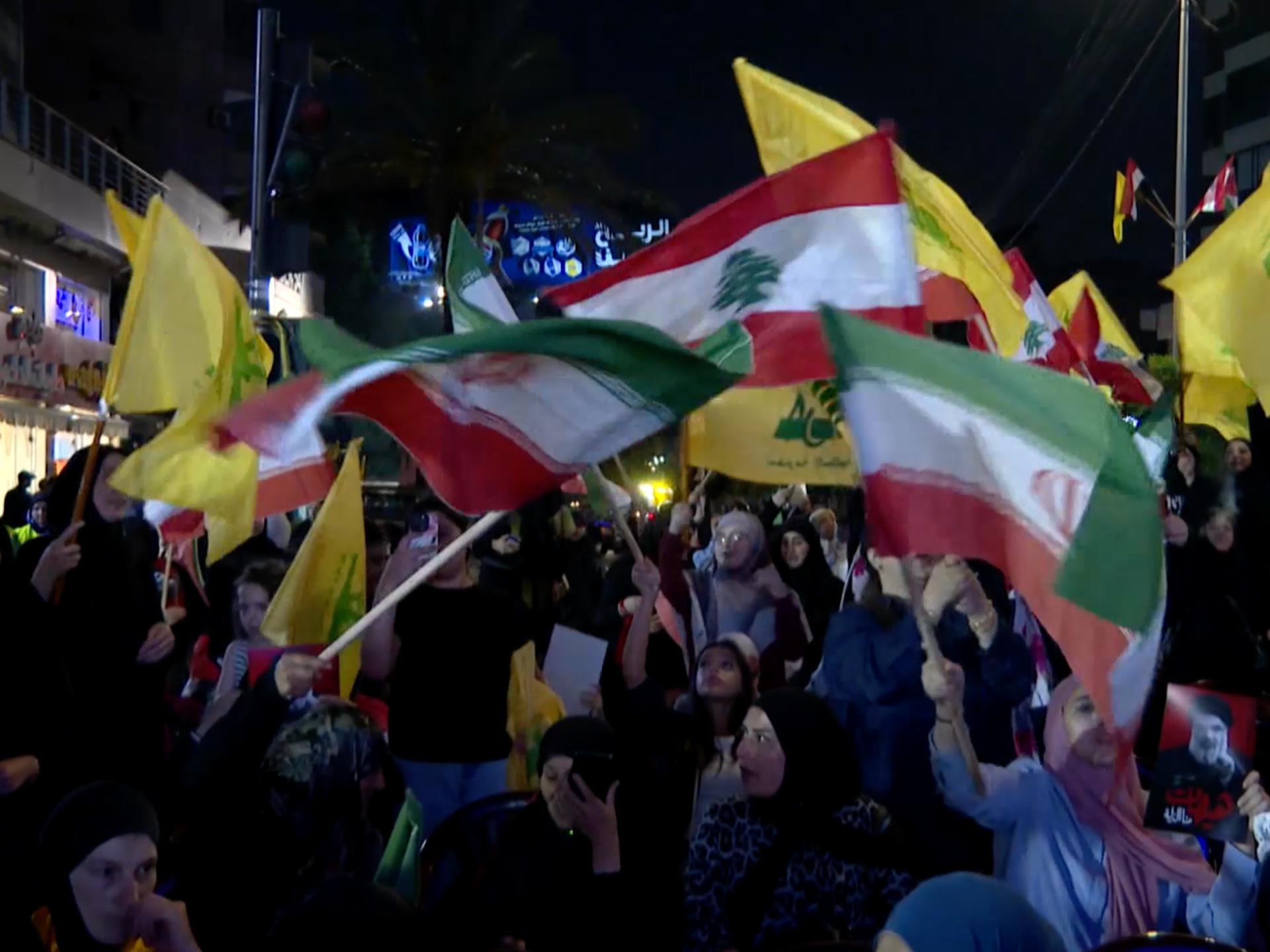
Hezbollah said it had carried out operations against the invading Israeli forces in the country, including near Beaufort Castle.
Iran has made clear that any deal with the US must include an end to fighting in Lebanon. On Monday, it warned that continued aggression would be met with “more severe and crushing measures”.
Iran’s Ministry of Foreign Affairs spokesperson, Esmaeil Baghaei, said Washington was “directly responsible” for the escalation.
“They are party to the ceasefire negotiations. Therefore, any act in violation of the ceasefire, be it through the interception of vessels, the targeting of southern Lebanon by Israel, or any other event, will cause the United States to be directly responsible for the escalation in the region.”
Iranian President Masoud Pezeshkian posted on X that Tehran was still “at the negotiating table”, while Iran’s ambassador to the United Nations, Amir Saeid Iravani, said Washington and Tehran, through Pakistan as an intermediary, are “presenting and exchanging views” towards an agreement.
The Lebanese Ministry of Health said on Tuesday that the overall death toll from the Israeli offensive has risen to 3,666 since March 2, with a further 11,321 injured.
Lebanese Prime Minister Nawaf Salam said on Monday that Israel has carried out nearly 3,500 air attacks, 407 demolitions, and six “razing” operations – which have flattened entire villages – since April 16, when a so-called ceasefire was agreed between Israel and Lebanon.
📰 மூல செய்தி (Source): https://www.aljazeera.com/news/2026/6/9/trump-says-in-final-throes-of-peace-deal-but-at-least-8-killed-in-tyre?traffic_source=rss
A student parody account has rattled India’s most powerful man and exposed just how thin his skin has become.
In recent weeks in India, Prime Minister Narendra Modi’s government’s profound insecurity has resulted in the deplatforming of college students who came together to form a satirical parody account called “Cockroach Janta Party”.
The Cockroach Janta Party (CJP) came to be after India’s Chief Justice Surya Kant compared unemployed young people drifting towards journalism and activism to cockroaches and parasites. The harmless joke quickly attracted millions of online followers across Instagram and X, formerly Twitter, which resulted in even more media coverage from BBC, CNN, The Guardian and France 24, making India’s geriatric government pay attention.
Instead of engaging with the discontent meaningfully, the Modi administration has framed it as jeopardising the country’s “national security” and “posing a threat to the sovereignty of India”. The group’s page is no longer accessible in the country. In fact, the government began a multiplatform pressure campaign against the satirical account to push it into oblivion. Its website was taken down, ministers accused the founder of being under “foreign” influence, and a petition was filed in the Supreme Court seeking action against the CJP founder, Abhijeet Dipke.
Going after online accounts with such fierce indignation is like using a cannon to kill a mosquito.
The imaginative prank signals the distress among India’s youth, who enter a market with no jobs, survive extreme weather ranging from heatwaves to unbreathable air, and are constantly lectured about the sacrifices demanded of them. Last month alone, the national entrance exam for undergraduate medical students was found to have been compromised after papers were leaked, while school students were hit by a separate marking scandal. Students who expressed their disappointment on social media were termed “Pakistanis” by our state-sponsored television channel, Doordarshan. We are now a country that accuses our own children of treachery when they express genuine concern. The exam scandals have resulted in a spate of suicides among students, but did not move Prime Minister Narendra Modi to offer a few words of solace.
The same indifference is visible elsewhere. One of the patterns of Modi’s leadership is that his sympathy for the sufferings of humanity tends to increase in direct proportion to the distance of those suffering from Indian borders. He has not acknowledged the alarming deaths from heatwaves – 67 people died in Telangana in a single day – but has taken the time to grieve for the lives lost in China’s Shanxi province in a mining accident.
Modi rules India like a cruel taskmaster, and every task is also a test of loyalty.
His latest order is to work from home, not spend fuel unnecessarily, avoid foreign travel, reduce consumption of cooking oil, abstain from buying gold, work longer, consume less, and be patient. At this point, if you have a job, own a fridge, can afford an air conditioner as well as a foreign trip, the Modi administration considers you to be living in an abyss of decadence. None of it would pinch as much if he did not jet off to Europe right after his sermon about our patriotic duty to tighten our belts.
This time, Modi went on a European tour while refusing to engage with Europe’s free press. In Norway, Helle Lyng Svendsen, a journalist, dared to ask him why he did not take questions from the “freest press in the world”. Modi avoided eye contact and walked away without responding, his body language noticeably sheepish. Watching from India, it seemed absurd that such a person existed in the world who could shout a question at Modi. After 13 years, watching her ask a simple question and expect an answer felt like watching a whole new species that knew how to breathe underwater. It was exhilarating and humiliating at the same time. It does not help that Norway is rated number one while India is ranked 157 in the World Press Freedom Index.
The Indian embassy in Oslo then took to X, announcing a news conference out of spite, in which Sibi George, a diplomat, had a 13-minute outburst filled with boilerplate responses to almost any question about India’s declining freedoms, with a word salad of “140 crore people”, “5,000-year-old civilisation”, “yoga” and “Gandhi”.
For Svendsen, this experience ended with a dose of reality the Indian press has to deal with. She was called a foreign spy and doxxed by Indian right-wing troll armies. Her address and phone number were made public, and, finally, she was deplatformed from Instagram.
Faced with the free mind – be it online with the CJP or with the free press in Norway – Modi, his administration and his trolls tend to go into a physiological, existential shock, and lash out like a toddler throwing a temper tantrum in the chocolate aisle of the supermarket.
A regime that gets so terrified of simple questions or prank tweets by young people tells us very little about the questioner and a lot more about the ruling government. The truth is, the sheen maintained by a formidable propaganda machine has been wiped clean by world events. As war, inflation, H-1B visa restrictions, and tariffs imposed by the United States expose Modi’s ineptitude, his skin grows thinner.
The last few years have been a time of pervasive tragedy.
Modi’s policy misadventures have left deep, gaping wounds in the country – demonetisation, the abrogation of Article 370 in Kashmir, and the handling of COVID-19 may be the big failures, but the everyday failures: Bridges falling, communities running out of water, paper leaks that damage students’ academic prospects, are what have jolted the youth more. All of them reflect how much this government has failed the common people. Despite a lot of well-financed publicity, it has become difficult to mask this loss of hope in India.
Every nation requires a modicum of material prosperity, hope and confidence in the future. Today, we live in a country where no one trusts what the prime minister says. He is as unpopular as he has ever been, and is running a government with no mandate – the last two election results have been contested by opposition parties, journalists and transparency activists. India has been declared an “electoral autocracy”.
At this point, the BJP is an election-winning machine with no capacity for any other form of political work, much less skilful governance. Pierced by every meme, tweet or question from a journalist, the giant balloon that is Modi’s self-esteem is leaking from a thousand cuts. Agitated, he and his bureaucrats, like George, make increasingly incoherent statements which even his lapdogs cannot spin to make him look good.
Satire has long been a pressure valve in democracies, and suppressing the grievances of India’s youth will not eliminate dissent; it will radicalise them. The government has reasons to be rattled, as regimes across South Asia have fallen after waves of Gen Z protests that began just as innocuously as CJP.
The only joy in this misery is that the intoxication of Modi’s success has evaporated. In the teeth of so many things that might prevent it, the CJP thrives. So do other forms of dissent. In contrast to the temporary balloon of the last two terms, this one, likely to be his final term as prime minister, is already unprecedentedly heavier. One day, soon enough, his government will fall — outlived by India’s ‘cockroaches’.
The views expressed in this article are the author’s own and do not necessarily reflect Al Jazeera’s editorial stance.
📰 மூல செய்தி (Source): https://www.aljazeera.com/opinions/2026/6/9/modi-is-using-a-cannon-to-kill-a-cockroach?traffic_source=rss
Iranian group could be labelled national threat under proposed new law
Hidden camera found in government building
Construction on fire site by Glasgow Central Station might not start for several years
Trending
-
உலகம்9 years agoThese ’90s fashion trends are making a comeback in 2017
-
உலகம்9 years agoAccording to Dior Couture, this taboo fashion accessory is back
-
சினிமா9 years agoThe old and New Edition cast comes together to perform
-
சினிமா9 years agoThe final 6 ‘Game of Thrones’ episodes might feel like a full season
-
விளையாட்டு9 years agoPhillies’ Aaron Altherr makes mind-boggling barehanded play
-
முக்கியச் செய்திகள்2 years ago
வணக்கம் தமிழ்
-
சினிமா9 years agoDisney’s live-action Aladdin finally finds its stars
-
விளையாட்டு9 years agoSteph Curry finally got the contract he deserves from the Warriors