Connect with us

முக்கியச் செய்திகள்

Britain's youngest F1 driver on his debut season so far – and learning to skateboard

Published

on

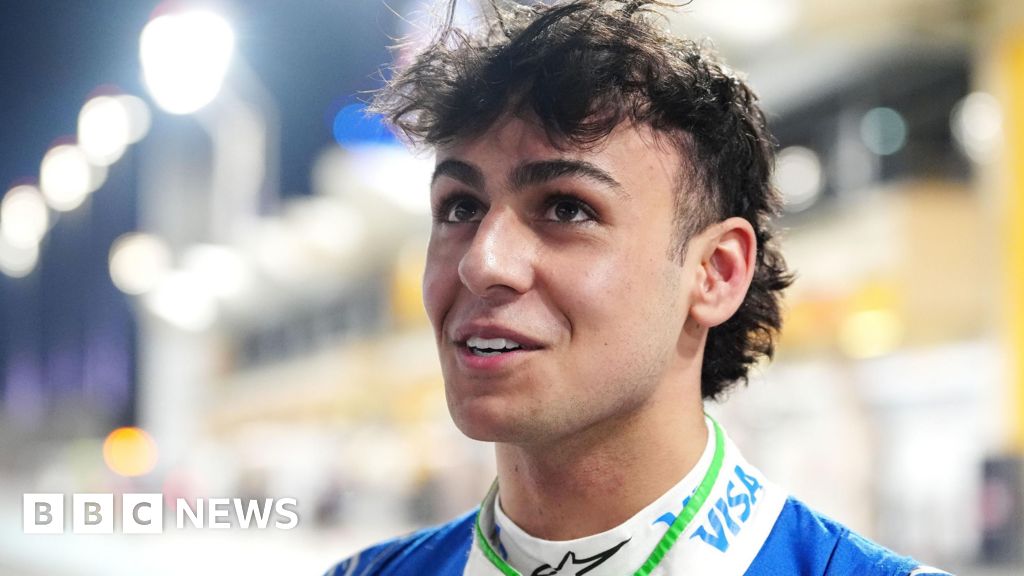
Arvid Lindblad was supposed to be driving at 200mph around the streets of Jeddah in the Saudi Arabian Grand Prix this weekend.

But Britain's youngest Formula 1 driver's had an unexpected month off just three races into his debut season.

The 18-year-old tells BBC Newsbeat he's been reflecting on how he's done so far, as well as hanging out with friends and learning to skateboard.

But he says he's looking forward to getting back on the grid, having his Drive to Survive moment and competing in a home Grand Prix at Silverstone.

Lindblad made his debut at the Australian GP in Melbourne last month, scoring points for his Racing Bulls team by finishing eighth.

He then competed in China and Japan before the following races in Bahrain and Saudi Arabia were cancelled because of the war in the Middle East.

So with only three races under his belt, Lindblad tells Newsbeat he's not got used to describing himself as an F1 driver yet.

"I don't think it's fully sunk in," he says.

"This is something I've been working towards my whole life. So the fact it's come true is extremely special, extremely cool."

And Lindblad says he can't wait to get back to racing again in the US in a fortnight.

"What I'm most looking forward to is getting back into the car in Miami," he says.

"I've enjoyed the break but racing is my passion. It's probably what makes me happiest."

Eagled-eye fans have noticed Lindblad's racing helmet has three flags on the back – for England, Sweden and India.

He grew up in Virginia Water in Surrey but his dad's Swedish and his family's Indian heritage comes from his mum's side.

"I've really been surrounded by all three cultures. It's shaped me into the person and driver I am today," he says.

Lindblad has a few months to wait until his first home Grand Prix – at Silverstone in July – something he says will "be really special".

"My whole family will be there. I think racing at home, there's no real feeling like it."

But somewhere he won't be able to race this season is another place that means a lot to him – India.

The Buddh International Circuit hosted races in in Uttar Pradesh for three seasons but ended in 2013.

It didn't return after a tax dispute with the local authorities, with F1 bosses stating at the time the reasons behind it were "very political".

Lindblad went to Delhi with Racing Bulls in pre-season and says getting the chance to race there would be "really cool".

"I race under the British flag so having one home race is pretty cool, if there were to be a second one that'd be really special as well," he says.

"I don't know the ins and outs of it, or how realistic it is, but it would mean a lot to me."

Earlier this week, an Indian government minister claimed there would be an India Grand Prix next year.

But F1 bosses told The Independent that wasn't true, saying "we won't be racing there in 2027".

Lindblad's so new to the sport that he hasn't even taken part in what's become a rite of passage for F1 drivers – introducing himself to the Drive to Survive cameras.

The Netflix documentary series follows F1 every season and Lindblad says he's looking forward to his moment in the spotlight.

"Drive to Survive started when I was 10, when I was in the beginning of my karting journey," he says.

"So I've watched loads of those clips and to be able to sit in that chair will be really cool at some point."

Lindblad says the "vibes are good" in the garage alongside teammate Liam Lawson, but it's four-time world champion Max Verstappen he's clicked with.

"His journey to F1 was quite similar to mine, we both came in at a young age and rose through the ranks quite quickly," he says.

"He's been really good on that side if I needed some advice or had a question."

Whatever happens this season, it doesn't seem like Lindblad's going to be swapping the cockpit for something slower like his skateboard any time soon.

"I can ride on the board very comfortably now, I can go on ramps, I can't go all the way up but I am pretty decent," he says.

"I said by the end of the year if I could learn how to do a kickflip that would be pretty cool."

Listen to Newsbeat live at 12:45 and 17:45 weekdays – or listen back here.

📰 மூல செய்தி (Source): https://www.bbc.com/news/articles/c0kr27j6z2vo?at_medium=RSS&at_campaign=rss

முக்கியச் செய்திகள்

Chernobyl's last wedding: The couple who married as a nuclear disaster unfolded

Published

on

It was just after midnight. Iryna Stetsenko had finished doing her nails for her wedding, opened the balcony door and was battling her nerves to get to sleep.

In a nearby apartment packed with guests, her fiancé Serhiy Lobanov was asleep on a mattress in the kitchen.

Then a "rumble" disturbed the quiet, says Iryna. "It was as if a lot of planes were flying overhead, everything was humming and the glass in the windows shook."

Serhiy says he "felt a shake, as if some kind of wave passed", wondered if it was a mild earthquake, and fell back to sleep.

The 19-year-old trainee teacher and power plant engineer, who was 25, were looking forward to married life in the newly built Soviet city of Pripyat. They had no idea that the world's worst ever nuclear accident was unfolding less than 2.5 miles (4km) away.

Reactor number four at the Chernobyl power plant – in what is now northern Ukraine – had exploded, spewing out radioactive material that would spread across swathes of Europe.

Forty years later, the highly radioactive remains of the plant are in a warzone. The couple now live in Berlin, having uprooted their lives a second time – this time to escape conflict, not a nuclear disaster.

But on the morning of 26 April 1986, Serhiy remembers waking around 6am, full of excitement, to find his wedding day had dawned gloriously sunny.

He had errands to do – bed linen to take to a friend's apartment where he and Iryna planned to sleep that night, and flowers to buy.

He says he saw soldiers in gas masks outside, and men washing the street with a foamy solution. Some men he knew from his work at the nuclear plant told him they had been called in urgently because "something happened", but they did not know what.

As he looked out from the friend's high-rise apartment, he spotted smoke rising from reactor four.

It would later become clear that firefighters and power plant workers had spent the night risking lethal doses of radiation to tackle a huge toxic blaze.

"I felt a bit anxious," he says. Drawing on his training, he took some fabric, wet it and put it across the apartment entrance as a precaution to catch radioactive dust, he adds.

He then rushed to the market. Unusually for a Saturday morning, it was deserted, so he picked five tulips for the bouquet.

Iryna, who was staying with her mother in the family's apartment, says the phone kept ringing overnight. Her mother sounded "alarmed", she says, by neighbours calling to say "something terrible" had happened. But there was little detail.

Information was strictly controlled in the Soviet Union. They turned on the radio, but there was no mention of any incident.

In the morning, her mother rang the authorities: "They told her not to panic, all planned events in the city should go ahead."

Officially, everything carried on as usual. Children were sent to school.

Later in the day, the bride, groom and guests drove in a line of cars to the Palace of Culture, known for hosting both ceremonial events and popular discos.

They made their vows standing on a cloth embroidered with their names, then moved with their guests to a nearby café.

But the wedding banquet felt "sad", not celebratory, says Serhiy. "Everyone understood that something had happened, but no one knew the details".

For their first dance, they had practised a traditional waltz. But with the growing realisation that a tragedy was unfolding, "from the first steps we went out of rhythm", recalls Iryna. "We just hugged each other and moved in the hug."

Then – exhausted but finally man and wife – they returned to the friend's apartment.

But, Serhiy says, in the early hours of Sunday morning, another friend knocked on the door, telling them to rush to an evacuation train, due to leave at 5am.

The only extra clothing Iryna had with her was a flimsy dress for the second day of the celebrations, so she put her wedding dress back on to hurry back to her mother's apartment to change. Also, her shoes had given her blisters. "I was in a wedding dress and I was running barefoot through the puddles," says Iryna.

It was still dark as they saw the glow of the collapsed reactor from the train. It was "as if you were looking into the eye of a volcano," says Serhiy.

The official announcement, when it came, described the evacuation as "temporary".

"We left for three days, but ended up going for our entire lives," he adds.

The Soviet Union was heavily criticised for its slowness in revealing the scale of the disaster. It was only two days after the explosion – after radiation was detected in Sweden – that it acknowledged an accident had happened. It was more than two weeks before Soviet leader Mikhail Gorbachev spoke about it publicly.

A safety test had gone badly wrong. An estimate cited by the International Atomic Energy Agency (IAEA) and World Health Organization suggests the explosions released 400 times more radioactive material than the bomb at Hiroshima.

Nikolai Solovyov was working as a lead engineer in the turbine hall at the time.

"It was like an earthquake beneath us," he recalls. "We saw the roof collapsing… A blast of air came towards us and brought all this black dust… And the siren started."

He says he and colleagues raced towards the site thinking a generator had exploded – unable to imagine it could be the reactor itself.

One checked their monitors and said radiation levels were "off the charts", Nikolai remembers.

He says they found another colleague standing on one of the turbines, apparently unhurt but vomiting – a sign of radiation sickness. "He was one of the first to die," he says.

The official death toll from the incident is 31 people – two were killed by the explosion itself, while 28 died from Acute Radiation Sickness, and one from cardiac arrest, in the weeks afterwards.

The wider impact of the disaster is contested and difficult to determine. No comprehensive long-term medical study was set up at the time.

In 2005, a study by several UN agencies concluded 4,000 people could die as a result of the accident. Other estimates suggest the number could be tens of thousands.

An operation was launched to stop the exposed reactor pouring out radiation.

Helicopter flights dropped sand and other materials on it. The authorities brought in hundreds of thousands of people from all over the Soviet Union to contain the disaster.

Extreme radiation levels caused machines to break down, so some work had to be done by hand.

Jaan Krinal and Rein Klaar were deployed from Estonia, then part of the Soviet Union, and were part of a group sent to clear debris from the roof of reactor three.

"You wore lead plates – one in front, one on your back, and one between your legs. It was heavy, 20kg or more," says Jaan.

"On your head: a standard Soviet construction helmet – goggles, gloves and a dosimeter [to measure radiation] in your pocket," he says.

Rein recalls being sent to work in bursts of a single minute to limit their exposure. "Nobody could tell what was what… There was no time to think," he says.

As the clean-up began, Iryna and Serhiy were staying with her grandmother, about 300km away in the Poltava region, east of Kyiv.

A few days after they arrived, doctors monitoring the evacuees for radiation gave them unexpected news – Iryna was three months pregnant.

She remembers weeping as she discovered doctors were warning that radiation exposure may have affected unborn babies, and advising women who had been exposed to have abortions: "I was scared to have a baby, and scared to have an abortion."

But a sympathetic female doctor encouraged her to proceed with the pregnancy, and Iryna gave birth to a healthy girl, Katya. Decades on, she has become a mother herself and Serhiy and Iryna now have a 15-year-old granddaughter.

The couple feel the nuclear accident has affected their health, though this has not been confirmed by doctors.

Iryna has had to have both knees replaced, and believes radiation may have weakened her bones. They t

📰 மூல செய்தி (Source): https://www.bbc.com/news/articles/c0q92lx8q75o?at_medium=RSS&at_campaign=rss
Continue Reading

முக்கியச் செய்திகள்

Protests and another costly loss – pressure mounts on Rosenior's Chelsea

Published

on

Man Utd boost Champions League hopes with victory at Chelsea

There were chants of "we want our Chelsea back" during a protest march before kick-off – then the chorus spread to the stands during the second half of the defeat by Manchester United.

The frustration from supporters is understandable, given Chelsea have now lost their past four Premier League games without scoring – their joint-longest run since November 1912.

Chelsea head coach Liam Rosenior admitted his side face a "mountain to climb" in their pursuit of Champions League qualification, after the latest 1-0 loss to United left them four points off the top five, having played a game more.

Failure to qualify would be viewed internally as a disappointment, with the club at risk of falling short of the minimum target set before the season under former head coach Enzo Maresca.

Missing out would mean a loss of key revenue and prestige, and would mark the third time in four seasons Chelsea have failed to qualify since Todd Boehly and Clearlake Capital completed their takeover in 2022.

Much of the criticism had focused on the defence, goalkeeping and the squad's age profile – but it is now the attack that is under scrutiny. Chelsea have gone almost six and a half hours without a goal in the league.

Rosenior's swift appointment from partner club Strasbourg was one of the reasons ultras from the French side joined the protest alongside Chelsea supporters, with supporters of both clubs arguing they have been negatively affected by the January decision.

For Chelsea, however, the recriminations are widening, with Liverpool four points ahead with a game in hand and rivals Manchester United and Aston Villa looking increasingly difficult to catch.

"It's not insurmountable but it gives us a mountain to climb and we have to go into Brighton [on Tuesday] with an idea that we have to win that game and kick-start the rest of our season," Rosenior said.

The pressure is truly on with five games remaining as the campaign unravels at a crucial juncture.

Cunha gives Man Utd win at Chelsea to boost Champions League hopes

A few weeks ago, when the slump began, Rosenior pointed to the fact he had taken charge at Chelsea when they were eighth in the table and fourth in the recent form rankings.

However, his side have dropped to ninth in the form table since his appointment and are set to fall further once all teams have played 33 matches.

It is a damaging return, particularly given Rosenior's calls for more time on the training pitch. Despite having free midweeks to prepare for his past two fixtures, Chelsea have still lost to Manchester City and Manchester United.

He had hoped the March international break would act as a reset for his side's poor form, but the decline has continued into April.

Before kick-off, the view inside the club was that Rosenior remains secure in his position and that, even if Chelsea fail to qualify for the Champions League, he will be assessed at the end of next season following his first full campaign.

"I think we're behind Liam. Of course, it's a results business, but we think he can be successful long term," influential owner Behdad Eghbali said on Thursday at the CAA World Congress of Sports event in Los Angeles.

Eghbali also acknowledged that a lack of managerial stability has been one of the key issues behind Chelsea falling short in recent seasons.

It will be brave, however, to stick with Rosenior if his messaging is not getting across to the players – with Chelsea supporters famously impatient given the hiring and firing under previous owner Roman Abramovich.

Enzo Fernandez returned for Chelsea after an internal two-match ban

There is anger directed at Rosenior, but many Chelsea supporters also point the finger at Eghbali, Boehly and the rest of the BlueCo ownership.

The latest protest saw supporters march from The Wolfpack Inn pub to Stamford Bridge before kick-off, having grown from a turnout of about 200 before the Brentford match to more than 500 before Saturday's tie.

There were flares, banners and chants directed at the owners, as well as calls in support of former owner Abramovich.

Under the terms of the takeover agreement in 2022, the current ownership group cannot sell the club until at least 2032. However, there are signs they are willing to listen to some of the criticism, including calls to recruit more experienced players.

"We recognise we need balance. You tweak a model, you improve and you learn from mistakes," Eghbali said. "We have a strong core, but we need to add experience to take the team to the next level and achieve consistency. That is not lost on us."

However, failure to qualify for the Champions League would undermine any rebuild. Chelsea have already spent about £1.5bn on signings under the current ownership and, despite recouping approximately £750m in sales, they remain under financial scrutiny from Uefa, having faced fines for breaching their regulations.

The club has announced Premier League record pre-tax losses in its latest accounts and – without the additional revenue generated by Europe's premier competition through broadcasting, sponsorship and ticket sales – questions remain over whether Chelsea can recruit effectively in the summer.

Before kick-off, Cole Palmer told TNT Sports: "If we're not in the Champions League, everything changes."

Asked about Palmer's comments and the potential financial implications, Rosenior replied: "The honest answer is I don't know. We're still fighting and we'll address that situation at the end of the season, whatever the situation is."

Meanwhile, Enzo Fernandez's agent, Javier Pastore, has said his client would view missing out on Champions League football as an issue, despite the midfielder's two-match internal ban – imposed following comments linking him with a move to Real Madrid – coming to an end on Saturday.

While the protest movement has largely been driven by younger supporters, there are signs of apathy among older match-going fans. Boos were heard at full-time, with the atmosphere inside Stamford Bridge growing quieter with each game.

Latest Chelsea news, analysis and fan views

Ask about Chelsea – what do you want to know?

📰 மூல செய்தி (Source): https://www.bbc.com/sport/football/articles/cj0vg341djqo?at_medium=RSS&at_campaign=rss

Continue Reading

முக்கியச் செய்திகள்

'Croatia, but cheaper': The quirky holiday spots on trend for 2026

Published

on

Many can relate to the buzz of stumbling upon a hidden gem.

This year, more people are seeking out "authentic" holiday experiences abroad rather than all-inclusive tourist traps, according to ABTA, the association for British travel agents.

ABTA also says two in five Britons are planning to holiday in a country they've never been to this year.

It comes as war in the Middle East is causing some to switch to European destinations, while warnings of potential jet fuel shortages and the high cost of living are putting others off holidays completely.

So if you're looking for a cost-effective and slightly quirky destination this summer, read on for what's proving popular.

Montenegro is popping up more and more on social media as a hidden travel gem.

The Balkan state is now served by several UK airline routes and is popular among people who want to visit Greece, Italy and Croatia – but don't want to spend a full holiday there.

Because Montenegro is small, tourists can combine a beach holiday, city break and outdoor pursuits, explains Jennifer Lynch, managing director of travel agency Arrange My Escape.

"If you are on the beach resort, you can go and do a day trip up into the mountains," she says. "You can do rail tours through Montenegro and you could team it up with Bosnia and Croatia as well."

Jennifer says it's not a traditional family holiday destination but there are some packages available for adventurous types. She estimates an eight-day family adventure package would cost about £1,825 per person.

Some young people have been finding the country an attractive choice for a holiday and sharing experiences of visiting the country on TikTok.

Travel blogger Em says there's value to be had in Montenegro.

"It was basically like Croatia, but cheaper," she says. "Kind of a combination of a city and a beach break.

"It was probably one of the first places I went to that sparked my obsession with travel."

Estonia, Finland and Lithuania are becoming popular tourist destinations for families, couples and solo travellers.

As with Montenegro, the three countries are easy to travel between – the Finnish capital Helsinki and Estonian capital Tallinn are linked by ferry.

The Baltic Sea offers beach getaways for those who would rather not swelter in Spain or inland. Tallinn's temperature is usually about 21C in July, but the city can be lashed with heavy rain.

History buffs may be drawn to Lithuania, with its five Unesco world heritage sites.

Also tucked away on the Baltic coast is the "German Riviera". Rϋgen, Germany's largest island, is a popular spot for domestic tourists with its chalk cliffs, national parks and unspoiled fishing villages. It's three hours from Berlin by train.

Some might be put off by a three-hour train after a flight from the UK, but ABTA's Emma Brennan says growing numbers of people – both young and older – are treating travel as part of their holiday experience.

"As soon as you're on the journey, you're getting to explore places, you're making stops along the way, and so you're getting under the skin of a different part of the destination, rather than just getting there and focusing on one area," she says.

Rügen is an example of more tourists looking for an "authentic experience" of a country, away from the classic cities, she adds.

Steph Jepson from Courtney World Travel says the ongoing war in the Middle East is leading some customers to look to northern Europe to feel safer.

"We've got clients at the moment who are getting really jittery about Cyprus, which is a shame because tourism is their main industry."

She estimates an all-inclusive, seven-night package in Tallinn for a couple in June would cost about £1,800 in total. A family of four would spend about £3,400.

In Albania, it's easy to make travel part of your holiday.

"You can just fly to Corfu [in Greece], then you can catch a half-hour ferry across to Saranda, which is sort of the entry to the 'Albanian Riviera'," travel blogger Amber Robertson explains.

She's seen a steady rise in the number of people viewing her guide to Albania in recent years.

"You've got really beautiful beaches, good beach clubs, getting that sort of Greece feel – but at a cheaper price.

"And then there's some really nice history," she says. "Barat and Gjirokastër, these really old beautiful stone towns that have a lot of culture."

Jepson estimates an all-inclusive, seven-night package for a couple in what she's heard referred to as the "Maldives of Europe" would cost about £1,400. A family of four would spend about £2,300.

"One of the big draws, particularly for younger people, has been value," she says, "your money goes quite [a lot] further.

"They've got some really interesting wildlife in Albania, so that's been drawing in either families or people with specialist interests."

Spain is still the most popular destination for British tourists, according to ABTA, but more are venturing beyond Barcelona or the Costa del Sol.

Brennan says Asturias and La Rioja are on the up, in part because of concerted efforts by the Spanish government to spread tourism across the country.

"I's a very different offering up there. You've still got beaches, but then you've got greenery and mountains and wildlife."

ABTA members have reported more and more holidaymakers are building their itineraries based on particular interests, such as food and wine.

Robertson feels there's nothing wrong with going for the tried-and-tested locations, but parts of Spain are a nice halfway house between being suitable for tourists and a little unconventional for trips.

"Places like San Sebastian and Bilbao, they are still touristy to an extent, however, they're going to be far less touristy than Barcelona," she says.

And for those that way inclined, "around San Sebastian there's all these really good cider houses".

📰 மூல செய்தி (Source): https://www.bbc.com/news/articles/c747r0l8n7do?at_medium=RSS&at_campaign=rss
Continue Reading

Trending

Copyright © 2024 by 7Tamil Media, All rights reserved.