Connect with us

உலகம்

Russian rate of losses in Ukraine almost triples in one year

Published

on

Territorially, Russia is at a standstill in 2026, assessments of its ground war reveal.

Evidence of Russia’s poor performance in its war in Ukraine, both militarily and economically, has been mounting over the past week.

The US Defence Intelligence Agency (DIA) has confirmed earlier assessments that Russia has lost territory it previously occupied in Ukraine.

“Ukraine retook approximately 400 square kilometres in and around Dnipropetrovsk – more territory than at any time since late 2022 – during the quarter,” a report to Congress revealed on May 18.

Russia has still made a net territorial gain in 2026, but its advance is slowing down, according to the Institute for the Study of War (ISW), a Washington-based think tank.

The ISW found that Russia advanced by a net 104 sq km (40 sq miles) between January 1 and May 26, 2026, compared to its seizure of 1,619 sq km (625 sq miles) during the same period last year.

It said Russian forces had infiltrated and contested another 628 sq km (242.5 sq miles), but did not take control.

Ukrainian President Volodymyr Zelenskyy said Russian casualties had increased to 145,000 this year, of which 86,000 were killed and 59,000 troops seriously wounded.

Ukraine says it has drone video of each confirmed kill.

Al Jazeera cannot verify casualty claims by either side.

Ukraine’s Defence Minister, Mykhailo Fedorov, said it meant 179 Russian losses per square kilometre of advance, compared to 67 last year.

That rate is higher than what Ukraine has assessed Russia is currently able to replace through recruitment.

Russia’s war is also becoming more difficult to finance. Having exceeded its entire 2026 budget deficit allowance by April, and gutted its foreign exchange reserves, Russia has been drawing down gold reserves at an unprecedented pace.

According to its Central Bank, Russia has sold 27.9 tonnes of its gold reserves this year, worth more than $4bn. That leaves Russian gold reserves at their lowest since the beginning of the full-scale invasion in February 2022.

The DIA attributed Ukraine’s clawback of 400 sq km (154.5 sq miles) of its territory to Russia losing access to Starlink satellite services used for targeting and counter-battery fire.

Ukraine attributes its success to its strategy of interdicting Russian logistics through mid-range drone and artillery strikes.

Fedorov said Ukraine was doubling down on this strategy through a programme called Logistical Lockdown, “to scale up middle-strike and systematically destroy Russian capabilities at the operational depth”.

Ukraine says this tactic has prevented reinforcements of men and equipment from reaching the frontlines, diminishing Russia’s superiority in depth of resources and mass.

On May 21, Kherson occupation governor Vladimir Saldo restricted movement along the M-14 highway connecting Mariupol, Berdyansk and Melitopol, because of the number of vehicles being struck there.

Ukraine received a boost to its efforts to stop Russian glide bombs, which have devastated frontline positions. Russia drops approximately 3,000 of them a week, and has retrofitted them with guidance systems and fins to enable them to travel up to 100km. That has allowed Russian aircraft to fly them to release points that are out of range of Ukrainian anti-aircraft artillery.

On May 28, Sweden announced it would donate 16 Gripen warplanes to Ukraine, which would also purchase an additional 20 through the EU’s Ukraine Support Loan in a deal worth $2.9bn.

“We have never had enough air defence systems to shoot down such bombs,” Zelenskyy said. “Therefore, Gripen fighters with appropriate weapons, in particular Meteor missiles, which destroy targets at a distance of more than 200 kilometres, will help us push back Russian aircraft.”

Separately, Ukraine continued its long-range strikes on the Russian oil economy, which funds the war.

On May 23 Ukraine struck an oil depot and offloading terminal at Novorossiysk on the Black Sea, causing fires and hitting a Russian tanker.

The following day Ukraine struck the Tamanneftegaz oil terminal, also on the Black Sea.

In addition, military and industrial sites were attacked, including the Metafrax Chemicals plant in Perm, 1,700 kilometres inside Russia, and the Taganrog Airbase in Rostov, causing a fire at an aircraft repair plant.

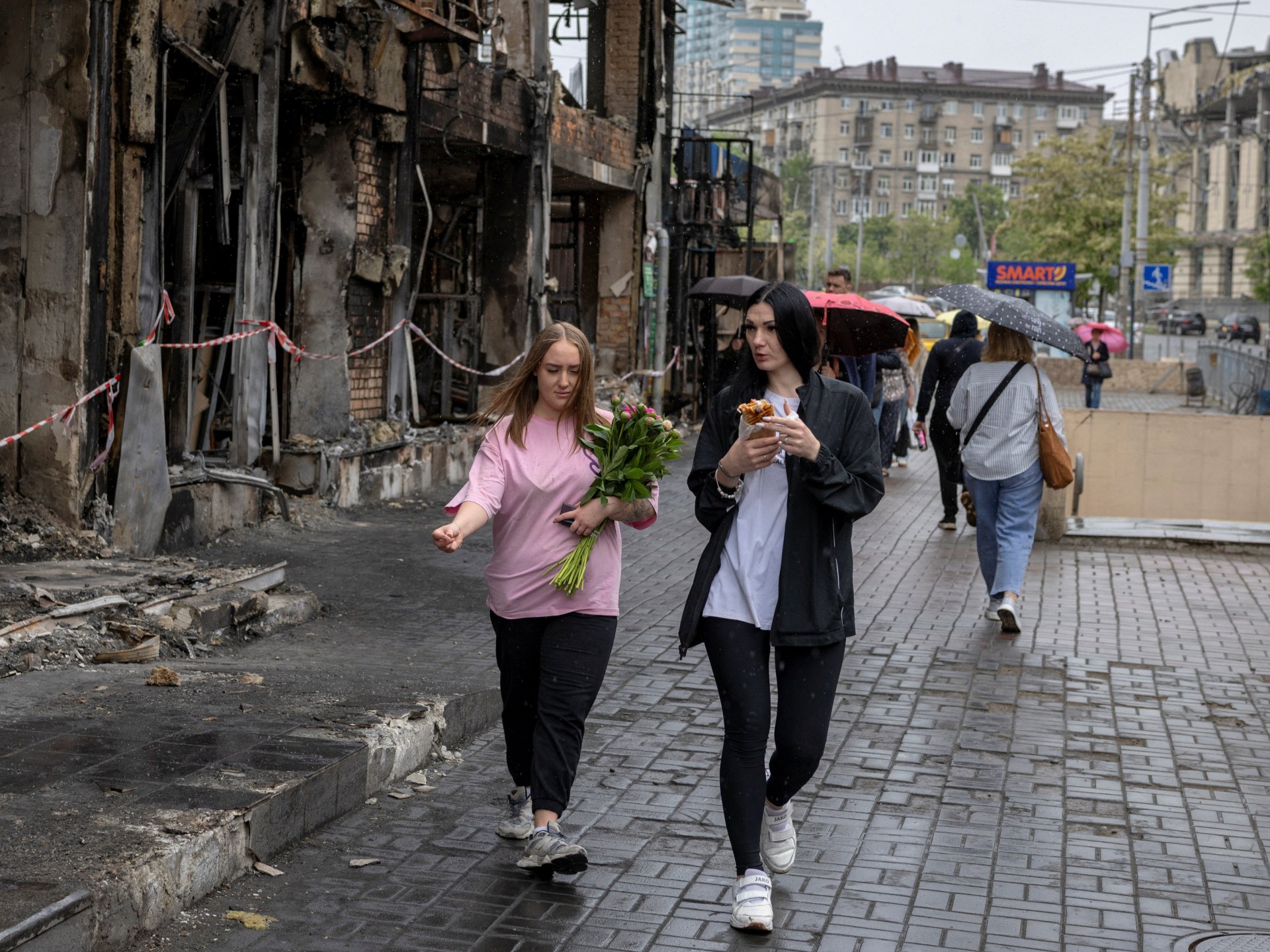
Russia pursued its own aerial tactic of striking Kyiv through massive combined attacks of drones and missiles, which can overwhelm Ukrainian defences.

On May 24, Russia launched 600 long-range drones and 90 missiles against Kyiv and surrounding areas, including 36 ballistic missiles. Ukraine managed to shoot down 91 percent of the drones and 81 percent of the cruise missiles, while 19 missiles likely missed their targets. Those that did hit their targets damaged the Ukrainian foreign ministry and Cabinet of Ministers building, as well as two museums and a food market.

At least 87 people were injured, Zelenskyy said, and two were immediately confirmed to have been killed.

Russia framed the attacks as retaliation for what it said was a strike on a college in occupied Luhansk two days earlier. Russian President Vladimir Putin described that as “a terror attack on a student dormitory of the Starobilsk pedagogical college”, and said it had killed six students and injured 39.

Ukraine’s General Staff said it was a strike on a centre for Advanced Unmanned Technologies run by Rubikon, Russia’s unmanned systems force.

Russia has justified strikes on urban centres in the past as being attacks on military command centres. On May 25, Russian Foreign Minister Sergei Lavrov informed his US counterpart, Marco Rubio, that Russia would begin striking “military sites” in Kyiv in retaliation for Starobilsk.

The Russian foreign ministry described the campaign as “a series of systematic strikes against Ukrainian military-industrial complex facilities in Kyiv,” and implied foreigners would be targeted at “specific sites for the design, production, programming, and preparation for the use of drones employed by the Kyiv regime with the assistance of NATO specialists responsible for supplying components, providing intelligence and guidance.”

Russia said “decision-making centres and command posts” would also be targeted, and warned foreign citizens, including diplomats, to leave.

Moscow also made a point of mentioning that one of the missiles used in the May 24 attack on Kyiv was its newest, the Oreshnik intermediate range missile, which it has also forward-positioned in Belarus.

📰 மூல செய்தி (Source): https://www.aljazeera.com/features/2026/5/29/russian-rate-of-losses-in-ukraine-almost-triples-in-one-year?traffic_source=rss

உலகம்

Senior Sri Lankan monk suspended over child sex abuse allegation

Published

on

Pallegama Hemarathana is accused of abusing an 11-year-old girl in a Buddhist temple in 2022.

Sri Lanka’s Buddhist hierarchy has suspended a prominent senior monk accused of sexually abusing a child, in the religiously conservative nation’s highest-profile case involving a local clergyman.

In rare disciplinary action, 71-year-old Pallegama Hemarathana was stripped of his responsibilities on Saturday as the chief custodian of a highly venerated Ficus plant grown from a sapling of a tree believed to have sheltered the Buddha.

“The Council of Monks of the Malwatte Chapter decided today to suspend Ven. Hemarathana until the conclusion of the legal proceedings against him,” said a statement issued by the chief priests.

Police arrested Hemarathana on May 9 following allegations he sexually abused an 11-year-old girl in 2022 at the venerated Jaya Sri Maha Bodhi temple in Anuradhapura, 200km (125 miles) north of Colombo. Hemarathana was detained during his stay at a private hospital in the capital Colombo, where he had checked in for treatment as the criminal investigation progressed.

Authorities said the victim’s mother had also been arrested for aiding and abetting the monk.

Hemarathana has since been granted bail while a court has barred him from travelling abroad.

The temple draws thousands of people daily who pay homage at the tree Buddhists believe is closely connected to the same Ficus that sheltered the Buddha when he attained enlightenment.

Hemarathana’s suspension came on the same day Sri Lanka celebrated Vesak, the anniversary of the Buddha’s birth, enlightenment and death.

There have been several cases of clergy abusing children in Sri Lanka, but Hemarathana is the most senior monk to be accused of such a crime.

Last month, 22 monks were arrested at Colombo’s international airport after 110kg (242lbs) of cannabis was found hidden in their bags, in what was the biggest drug smuggling discovery ever in the facility. The monks have remained in custody pending prosecution, but have not been suspended from the priesthood.

📰 மூல செய்தி (Source): https://www.aljazeera.com/news/2026/5/30/senior-sri-lankan-monk-suspended-over-child-sex-abuse-allegation?traffic_source=rss

Continue Reading

உலகம்

Indonesia’s Mount Merapi volcano erupts, spewing ash into the sky

Published

on

Indonesia’s Mount Merapi volcano erupts, spewing ash into the sky

Videos show Indonesia’s Mount Merapi spewing a column of ash around 2 kilometres high in West Sumatra’s Tanh Datar District. Authorities have enforced an “exclusion zone” within a 3-kilometre radius around Mount Merapi since an eruption in 2023.

📰 மூல செய்தி (Source): https://www.aljazeera.com/video/newsfeed/2026/5/30/indonesias-mount-merapi-volcano-erupts-spewing-ash-into-the-sky?traffic_source=rss

Continue Reading

உலகம்

‘Opposite visions’: What to know about Colombia’s presidential election

Published

on

Senator Ivan Cepeda is leading two right-wing rivals in the first round of an election dominated by security and economic concerns.

On Sunday, voters in the South American country of Colombia are facing a choice.

Four years ago, they elected the first left-wing president in the country’s modern history, Gustavo Petro. Now, they must decide whether to continue with Petro’s leftist push — or restore the political right to power.

Fourteen candidates will be on the ballot for the first round of voting in Colombia’s presidential election.  The packed field includes contenders from the left, right and centre, who are slated to face off over issues like security and the cost of living.

But Petro will not be among them: Presidents in Colombia are limited to a single four-year term.

The right wing is expected to have the advantage, particularly if the race proceeds to a second round. Petro is struggling with low poll numbers, and voters have expressed frustration with crime and violence, driven in part by the country’s six-decade-long internal conflict.

But leftist candidate Ivan Cepeda has surprised observers, consistently placing at the top of the polls ahead of the first round.

When is the election, who are the candidates, and which issues are top of mind for voters? We look at those questions and more in this brief explainer.

The first round of voting is set to take place on May 31, 2026.

A candidate would need to win more than 50 percent of the vote in the first round to avoid a run-off.

If no single candidate meets that threshold, a run-off will be held between the top two finishers on June 21.

In recent years, across Latin America, long-entrenched left-wing governments have met defeat at the ballot box.

Last year alone, right-wing candidates have been elected to replace left-wing presidents in Bolivia, Chile and Honduras.

But Colombia does not have a long history of left-wing presidents. Petro was the first. That makes this race one to watch, according to Gimena Sanchez, a Colombia expert at the Washington Office on Latin America (WOLA), a human rights nonprofit.

“This is the first election to be held after the first-ever leftist administration in Colombia’s 200-year history,” Sanchez explained.

Colombia now stands at a fork in the road. One of the dominant issues in the election is how to resolve the country’s internal conflict, which forced more than 235,619 individuals from their homes in 2025.

Another 87,069 people were caught up in mass displacement events due to the fighting, according to the International Committee of the Red Cross.

Petro has embraced negotiation as a tool to end the conflict, which has seen government forces, criminal networks, left-wing rebels and right-wing paramilitaries all battling one another.

But the political right has advocated a return to the more militarised approach backed by the United States, according to Sanchez.

“The leading candidates fall into two camps: continuity with the leftist government of Petro and an approach to security that focuses on negotiations with armed groups, and right-wing candidates who very much want to go back to a hardline security model that Colombia had in the past,” Sanchez said.

“You have polar opposite visions for the country.”

Senator Ivan Cepeda has emerged as the primary candidate of the political left, running as the head of the governing coalition, known as Historic Pact.

Cepeda has largely pledged continuity with Petro’s platform, including social and economic policies meant to reduce inequality.

He has also embraced Petro’s “Total Peace” approach, which aims to resolve the country’s internal fighting by negotiating with armed groups and criminal networks, as opposed to solely relying on military force.

Confronting state-backed violence has become a hallmark of Cepeda’s life and career.

His father, who was also a senator, is believed to have been assassinated by a government-backed paramilitary. For years, Cepeda was also embroiled in a legal battle for accusing former President Alvaro Uribe of connections to right-wing paramilitaries.

While Cepeda has become the standard-bearer for the left, the political right has had to contend with a more fractured field of candidates.

Running on the far right is Abelardo de la Espriella, a lawyer for the Defenders of the Homeland Party who has generated comparisons with Salvadoran President Salvador Bukele and Argentina’s Javier Milei.

Like those leaders, de la Espriella has offered a hardline vision for his country’s security. If elected, he says he would end negotiations with armed groups, bomb rebel camps, and resume the aerial fumigation of coca ⁠crops, which produce the raw material for cocaine.

Senator Paloma Valencia, a candidate with the Democratic Centre Party, is running as a more moderate alternative to de la Espriella. She too has promised a stricter approach to crime. Her platform involves expanding the police and armed forces, while cutting taxes and promoting pro-business policies in the economic realm.

Their election-season competition has become a source of acrimony for Valencia and de la Espriella, who have accused each other of paving the way for a leftist election victory.

“There is a more familiar, establishment right, represented by Valencia, and a far right in the form of de la Espriella, who pitches himself as an outsider,” said Sanchez.

Valencia, for her part, has criticised de la Espriella as two-faced, defending criminals in his legal practice but advocating for tighter security on the campaign trail.

De la Espriella, meanwhile, has dismissed Valencia as a member of the country’s political establishment and chided her in a social media post, stating that the presidential election is “not for little games”.

Polls generally show Cepeda ahead of his rivals, with de la Espriella in second place and Valencia in third.

A May 24 poll from the National Consulting Centre (CNC) and the publication Cambio suggested that Cepeda had drawn 33.4 percent of voter support, the most of any candidate.

But de la Espriella was on the upswing with 30.9 percent. Valencia, meanwhile, trailed with 12.6 percent.

The same surveys, however, suggest that Cepeda would struggle to win a run-off against either of the two right-wing candidates, with de la Espriella eking out about three points in a head-to-head contest, and Valencia coming within a percentage point of victory.

Undecided voters could play a key role in deciding the outcome, though. An analysis cited by the Spanish paper El Pais estimates that undecided voters could account for as much as 28 percent of the electorate.

Concerns over crime, security and economic issues like unemployment and affordability have dominated the election.

In a poll from the firm Invamer, the highest proportion of voters — 37 percent — identified security as the top issue facing the country.

Basic needs and unemployment ranked second and third, with 17 percent and 16 percent, respectively. Eleven percent of voters, meanwhile, named corruption as a leading concern.

The threat of violence has lingered over the presidential campaign over the past year.

Two political staffers with de la Espriella’s campaign were killed by gunmen on motorbikes earlier this month. And in June 2025, presidential candidate Miguel Uribe Turbay was shot while leaving a campaign rally. The 39-year-old died two months later from his injuries.

Political violence is a serious concern in Colombia, and all of the frontrunners in the race travel with heavy security.

📰 மூல செய்தி (Source): https://www.aljazeera.com/news/2026/5/30/opposite-visions-what-to-know-about-colombias-presidential-election?traffic_source=rss

Continue Reading

Trending

Copyright © 2024 by 7Tamil Media, All rights reserved.