Connect with us

உலகம்

India is being left to die in the heat

Published

on

Modi has denied climate change for years. Now, as the death toll climbs uncounted, his government offers branding instead of protection.

India is experiencing an extraordinary summer.

Across the country, temperatures have crossed 45 degrees Celsius (113 degrees Fahrenheit), inching towards 46, with Akola in Maharashtra’s Vidarbha region recording the country’s highest temperature of 46.9C on April 26. Census workers have died, as have voters who stepped out in the recently concluded West Bengal election. A man who boarded a bus to attend a wedding died before he reached his destination. On a single day in late April, all of the top 50 hottest cities in the world were located in India.

There is a violence to the light, the kind that makes you shield your eyes – even at 7am. With farmers unable to work outside, livestock under heat stress and crops failing, the United Nations is concerned that the heatwaves are pushing food supply “to the brink”. Even more alarming is that the extreme heat is causing not just heart attacks, but also kidney injury, affecting sleep quality and exacerbating numerous chronic conditions, including diabetes, respiratory illnesses and mental health conditions.

While the newspapers record a few deaths here and there, the majority of heat-related deaths go unrecorded in India. I know, from my decades as a health reporter, that those who die early in any catastrophe – like the HIV patients of the 1980s, or COVID-19 more recently – become numbers. Only after we have a mountain of bodies do we think to raise a flag and give it a name, perhaps even its own day.

In fact, the 16th Finance Commission has recommended that heatwaves be notified as national disasters, but getting funds out of this government to mitigate these deaths, or compensation for the families of victims, comes with red tape that can reduce hardened warriors to tears.

As the climate heats up, the rest of the world looks at green cover – trees, wetlands and biodiversity hotspots – as central to mitigating a warming planet. Not in India. Here, between the government, the courts and private developers, there is an orgy of tree-felling across the worst-affected cities. In Nashik, despite protests, heritage banyan trees that have stood for decades, if not centuries, are being cut down. In Pune, too, old trees are making way for a four-lane highway. In Bengaluru, trees are making way for a metro train and in Kashmir, which has never experienced such heat, mulberry, walnut and chinar trees have to go for wider roads and “smarter” cities.

Back when he came to power in 2014, Prime Minister Narendra Modi alarmed many Indian scientists and researchers by denying climate change. “Climate has not changed. We have changed. Our habits have changed,” he told students.

The heat pummelling India’s megacities is reinforcing longstanding inequalities of caste, class and gender in poor and marginalised communities. Our treeless streets are abandoned, save for the homeless and the street hawkers. The rich travel from their air-conditioned houses in their air-conditioned cars to their air-conditioned offices, malls and schools. The poor are being left to die in a country that keeps inventing new ways of neglecting its most vulnerable populations. Watching this heat, Harvard’s South Asia Institute released a white paper asking an innocuous question: how hot is too hot? Researchers say the human body can only handle so much heat before it can no longer cool itself, and that limit is below a wet-bulb temperature of 35C. Above this limit, even a young, healthy person resting in the shade with access to ample drinking water and skin fully coated in sweat would experience a continual rise in core temperature, leading to death from heatstroke within hours.

The paper grimly adds that nearly 380 million Indians are living in conditions that exceed the capabilities of human physiology.

After making living conditions worse, the Modi administration, characteristically, has done nothing to transparently record annual heat-related deaths. There is growing criticism from scientists, journalists and public health experts that India’s heat data systems are fragmented, inconsistent, slow and opaque. The India Meteorological Department (IMD) is also facing criticism about transparency in temperature readings. In 2024, the IMD blamed a “faulty sensor” for an erroneous recording of 52.9C on May 29.

Each year, the excruciating summer marks a new level of public scrutiny of the IMD system that is long overdue.

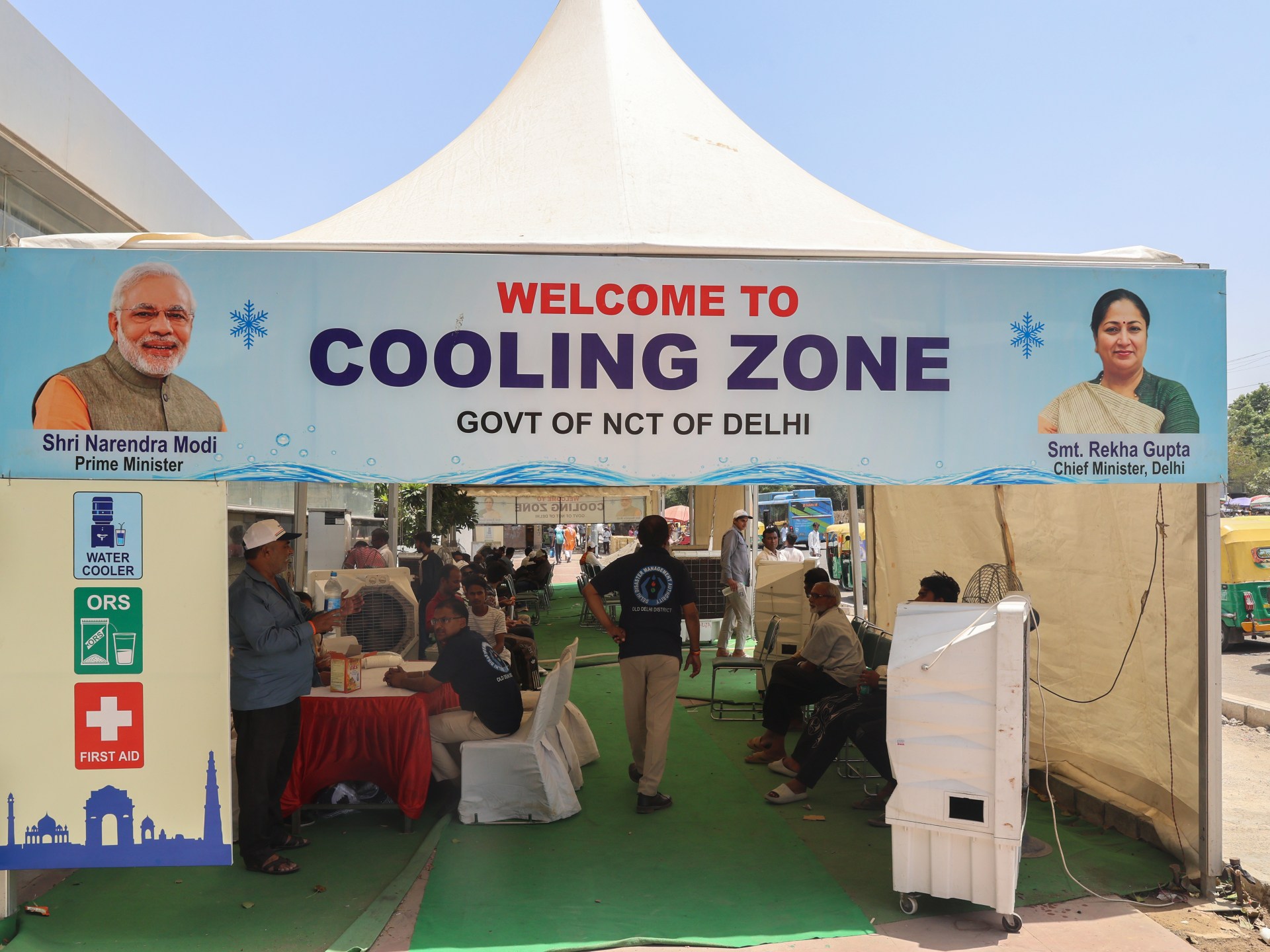
The impacts of this year’s heatwave are still being analysed. But for everyone who lived through it, this was a relentless two-month emergency, with no respite. Well into the heatwave – after temperatures remained above 40C for 40 consecutive days – the Modi government implemented its much-awaited Heat Wave Action Plan. As with every crisis, Modi had turned this deadly heatwave into a branding opportunity. With cameras rolling and citizens queueing up, government officials were seen forcefully wiping faces with towels whose origins were unknown. Much like COVID certificates that carried his photo, India’s newly rolled-out “cooling points” – unveiled across the national capital – were plastered with the prime minister’s face, and the taxpayer-funded heatwave action plan is the latest in a series of loyalty programmes that expect the public to remain indebted to the ruling party.

Meanwhile, the country now has collective wisdom from having survived nationally traumatic events such as demonetisation, the abrogation of Article 370 and COVID-19 lockdowns: we are on our own. If you are looking for some profound meditation on the catastrophe caused by global heating, it will not be found now. That is for the people who come after us. For now, we grapple with this on our own. Just us and these terrible men – for it is mostly men – who fell trees and spend other people’s lives as pocket change.

What I know for certain is that a prime minister who does not believe in climate change will not be an ally in the fight against extreme weather events.

The views expressed in this article are the author’s own and do not necessarily reflect Al Jazeera’s editorial stance.

📰 மூல செய்தி (Source): https://www.aljazeera.com/opinions/2026/5/22/india-is-being-left-to-die-in-the-heat?traffic_source=rss

உலகம்

Hundreds protest Ireland’s ‘George Floyd moment’

Published

on

Hundreds protest Ireland’s ‘George Floyd moment’ after death of Congolese man

Hundreds have protested outside the store where a Congolese man in Dublin died after he was restrained by security guards, with video showing one guard kneeling on his neck or head. Protesters say this is Ireland’s ‘George Floyd moment’.

📰 மூல செய்தி (Source): https://www.aljazeera.com/video/newsfeed/2026/5/22/hundreds-protest-irelands-george-floyd?traffic_source=rss

Continue Reading

உலகம்

Man Utd appoint Michael Carrick as permanent manager

Published

on

Carrick steps up from role as interim coach to replace Ruben Amorim on a permanent basis as Manchester United manager.

Michael Carrick never chased the ⁠spotlight as a player, and he has ⁠not suddenly sought it out as a manager.

In a season when Manchester United needed clarity, calm and conviction, it is Carrick – understated, deeply respected and quietly authoritative – who has come to embody all three.

What has followed since his January appointment as interim manager has been more than a managerial bounce, it has ⁠been a transformation. United’s hierarchy took note, awarding him the permanent manager job on Friday.

When Carrick stepped into the role after Ruben Amorim’s sacking, United were drifting, their campaign defined as much by uncertainty as by underachievement.

Within months, they were reborn, climbing to the brink of a third-place Premier League finish and sealing a return to the Champions League with games to spare.

Results ⁠alone tell only part of the story, though they are striking enough. Carrick has won 11 of his 16 league matches in charge, losing only twice, and his team accumulated more league points than any other side during that spell.

United beat Manchester City, Arsenal, Liverpool and Chelsea, rediscovering a competitive edge that had been sorely absent.

“We had two tough fixtures when Michael came in [against Arsenal and City] and I think everyone was probably looking at them thinking ‘Oh no’,” said United centre back Harry Maguire.

“We managed to get six points and from then on everyone has believed in it and ‌we’ve got confidence.”

For a side who finished 15th the season before, the turnaround has felt dramatic rather than incremental.

Yet those inside Old Trafford point to something deeper. Carrick has not only improved performances, he has reset the environment.

Dressing-room morale stabilised and a sense of purpose returned to a squad that had begun to look fractured.

Kobbie Mainoo, a finalist for the Premier League’s Young Player of the Season award, praised Carrick for “all the confidence he gives all the players. You want to follow him and fight for him and die for him on the pitch.”

Amorim had a blind spot where the young midfielder was concerned, but Mainoo’s performances these past few months have been one of the clearest signs of United’s revival under Carrick.

He restored Mainoo to a central role and instilled in him the trust to play with freedom and authority, a shift reflected in his poise and creativity in big moments, including key contributions in wins that secured Champions League qualification.

Mainoo was named to Thomas Tuchel’s England World Cup squad on Friday.

Players have ⁠spoken of clarity, communication, and of a manager who connects rather than commands.

Maguire, a central figure in the revival, summed up Carrick’s demeanour simply.

“He has been excellent with players, communicates really well,” he said.

Bruno Fernandes, who won the FWA Men’s Footballer of the Year award, has also praised Carrick.

“I’ve always said that Carrick could be a great manager,” Fernandes said recently. “When, as a player, you can see and think about the game like him, you can ⁠also do it from the bench.

“Of course, it’s different, but when you have that calmness, that intelligence, you tell yourself there’s potential. He’s done a fantastic job since he arrived.”

That ability to connect is rooted in Carrick’s personality. He is not a grand or demonstrative figure, but rather ⁠one who influences through calmness, intelligence and empathy.

As a player, he was the midfield metronome, dictating tempo without drama. As ⁠a coach, those traits now define his touchline presence.

And his authority comes from within. Few understand United’s identity better. A five-time Premier League champion during his playing career at Old Trafford, the 44-year-old knows both the expectations and the pressures of the role.

That knowledge has informed his decisions. He reverted to a traditional back four after Amorim preferred three at the back, and was harshly criticised for his refusal to be flexible.

He has also restored key players such ‌as Fernandes to their more natural positions. Amorim played the Portugal international in a deeper role as one of two central midfielders, while Carrick has pushed him into an advanced position.

Fernandes has flourished again at the heart of the side in a season where he tied the league’s record for assists in a season with one game remaining.

The noise that once surrounded the club ‌has ‌also quietened, replaced by a sense of excellence rarely experienced in recent years.

That is perhaps Carrick’s most significant achievement. He has not promised revolution, but he has delivered stability – and in doing so laid the foundation for something more sustainable.

For Carrick, the journey carries a certain symmetry.

A player who spent more than a decade orchestrating United’s midfield has been handed the baton to guide their future.

📰 மூல செய்தி (Source): https://www.aljazeera.com/sports/2026/5/22/man-utd-appoint-michael-carrick-as-permanent-manager?traffic_source=rss

Continue Reading

உலகம்

Gang violence kills at least 25 in Honduras

Published

on

The attacks by gunmen come as the government continues a drive to crack down on organised crime.

Gunmen have killed at least 25 people, including six police officers, in attacks across Honduras.

The attacks marked Thursday as one of the most violent days the country has seen in recent years. They came despite ongoing efforts by the government to rein in organised crime and violence.

Nineteen people were killed as gunmen raided a palm plantation in the municipality of Trujillo in the north of the country.

A leader of one rural group told the AFP news agency that those killed were employees of an armed group controlling a plantation.

However, local media indicated that armed suspects had fired indiscriminately on labourers. They reported that the oldest victim was 61.

Photos showed bodies, some wearing thick rubber boots for work, strewn on the ground outside.

Meanwhile, in the west near the Guatemalan border, six police officers were killed in another shooting in the municipality of Omoa.

Police report that the officers had travelled to the area as part of an operation to quash gang activity. However, they were ambushed.

After the two attacks, the National Police issued a statement, saying it “will proceed immediately with a direct intervention in the affected areas”.

“The state will act firmly to capture those responsible, protect vulnerable communities and guarantee comprehensive justice for all affected victims,” it added.

Honduras is struggling to crack down on gang violence. Until January, many parts of the country were under a state of emergency launched in 2022.

That emergency decree ended, however, with the inauguration of right-wing President Nasry “Tito” Asfura, a close ally of United States President Donald Trump, who has prioritised a hardline approach to security in Latin America.

The attacks will, therefore, raise concerns over security, but also civil liberties.

Laws passed earlier this week will allow authorities to designate gangs and drug cartels as terrorist groups. A new anti-organised crime unit has also been created.

The Trujillo shooting occurred near the Aguan River Valley, where armed groups, involved in narcotrafficking and palm oil extraction, have been fighting over land for decades.

Trujillo police chief Carlos Rojas told local media that the groups occupy and illegally exploit several large African palm plantations, using money from the crops to obtain weapons.

Local farmer groups, however, accuse transnational agribusiness corporations of sponsoring the criminal groups to carry out land occupations and prevent residents from reclaiming disputed lands.

According to Reuters, more than 150 people in the area have been killed or disappeared, with environmental and land rights activists a particular target.

Honduras is one of the most dangerous countries in the world for such activists. Earlier this month, police arrested several individuals, including a mayor, for plotting the assassination of a prominent environmental campaigner in 2024.

📰 மூல செய்தி (Source): https://www.aljazeera.com/news/2026/5/22/gang-violence-kills-at-least-25-in-honduras?traffic_source=rss

Continue Reading

Trending

Copyright © 2024 by 7Tamil Media, All rights reserved.