Connect with us

முக்கியச் செய்திகள்

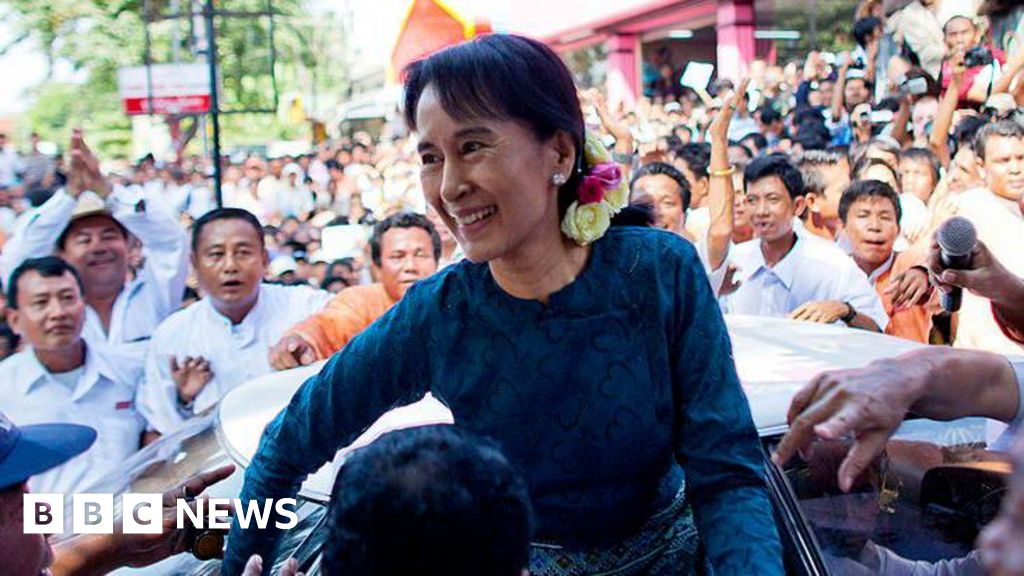
Aung San Suu Kyi: The Myanmar democracy icon detained for years

Published

on

Former Myanmar leader Aung San Suu Kyi, who has been held in detention since a military coup in 2021, has been moved to house arrest, the country's state media reported.

Little has been heard from the 80-year-old Nobel laureate since she was arrested on the day the armed forces ousted her elected government more than five years ago.

She was charged with a raft of criminal offences, including corruption. She denies all of the accusations and rights groups have condemned the series of secret trials as a sham.

Having spent nearly15 years in detention between 1989 and 2010, Suu Kyi was once seen as a beacon for human rights, a principled activist who gave up her freedom to challenge the ruthless army generals who have ruled Myanmar for decades.

Her personal struggle to bring democracy to Myanmar (also known as Burma) made her an international symbol of peaceful resistance in the face of oppression.

But her decision later on to defend Myanmar against charges of genocide over the military's atrocities against Muslim Rohingyas badly tarnished her saint-like international image.

Suu Kyi is the daughter of Myanmar's independence hero, General Aung San.

He was assassinated when she was only two years old, just before Myanmar gained independence from British colonial rule in 1948.

In 1960 she went to India with her mother Daw Khin Kyi, who had been appointed Myanmar's ambassador in Delhi.

Four years later she went to Oxford University in the UK, where she studied philosophy, politics and economics. There she met her future husband, academic Michael Aris.

After stints of living and working in Japan and Bhutan, she settled in the UK to raise their two children, Alexander and Kim, but Myanmar was never far from her thoughts.

When she arrived back in Yangon in 1988 – to look after her critically ill mother – Myanmar was in the midst of major political upheaval.

Thousands of students, office workers and monks took to the streets demanding democratic reform.

"I could not as my father's daughter remain indifferent to all that was going on," she said in a speech in Yangon on 26 August 1988. She went on to lead the revolt against the then-dictator, General Ne Win.

Inspired by the non-violent campaigns of US civil rights leader Martin Luther King and India's Mahatma Gandhi, she organised rallies and travelled around the country, calling for peaceful democratic reform and free elections.

But the demonstrations were brutally suppressed by the army, which seized power in a coup on 18 September 1988. Suu Kyi was placed under house arrest the following year.

The military government called national elections in May 1990, which Suu Kyi's NLD convincingly won – but the junta refused to hand over control.

Suu Kyi remained under house arrest in Yangon for six years, until she was released in July 1995.

She was again put under house arrest in September 2000, when she tried to travel to the city of Mandalay in defiance of travel restrictions.

She was released unconditionally in May 2002, but just over a year later was imprisoned after a government-backed mob set upon her entourage in the north of the country.

She was later allowed to return home – but again under effective house arrest.

At times she was able to meet other NLD officials and selected diplomats, but during the early years she was often in solitary confinement. She was not allowed to see her two sons or her husband, who died of cancer in March 1999.

The military authorities had offered to allow her to travel to the UK to see him when he was gravely ill, but she felt compelled to refuse for fear she would not be allowed back into the country.

During this period, her international stature grew amid widespread sympathy for her predicament and admiration for her advocacy for non-violent protest.

In 1991, Suu Kyi was awarded the Nobel Peace Prize, while still under house arrest, and hailed as "an outstanding example of the power of the powerless".

A film was made about her life by French director Luc Besson, while songs were written in tribute to her courage by bands such as U2.

Suu Kyi was sidelined from Myanmar's first elections in two decades on 7 November 2010.

But six days later the government released her from house arrest, in a move hailed by the international community. Thousands of jubilant supporters celebrated at the gates of her house, where she addressed the crowd calling for unity in Myanmar. Her son Kim was allowed to visit her for the first time in a decade.

As the military-backed government embarked on a process of reform, Suu Kyi and her party re-joined the political process.

They won 43 of the 45 seats contested in April 2012 by-elections, in an emphatic statement of support. Suu Kyi was sworn in as an MP and leader of the opposition.

The following May, she left Myanmar for the first time in 24 years, in a sign of apparent confidence that its new leaders would allow her to return.

In 2015, Suu Kyi led her National League for Democracy (NLD) to a landslide victory in Myanmar's first openly contested election in 25 years, ending decades of military-backed rule.

The landmark win sparked hopes of further reform under the NLD steered by Suu Kyi, who took on the title of state counsellor as she was barred by the constitution from becoming president.

When she was Myanmar's state counsellor, her leadership was partly defined by the treatment of the country's mostly Muslim Rohingya minority.

In 2017 hundreds of thousands of Rohingya fled to neighbouring Bangladesh due to an army crackdown sparked by deadly attacks on police stations in Rakhine state.

Myanmar is now facing a lawsuit accusing it of genocide at the International Court of Justice (ICJ), while the International Criminal Court has investigated the country for crimes against humanity.

Suu Kyi's former international supporters accused her of doing nothing to stop rape, murder and possible genocide by refusing to condemn the still powerful military or acknowledge accounts of atrocities.

A few initially argued that she was a pragmatic politician, trying to govern a multi-ethnic country with a complex history.

But her personal defence of the army's actions at the ICJ hearing in the Hague was seen as a new turning point for her international reputation.

At home, however, "the Lady", as Suu Kyi is known, remains wildly popular among the Buddhist majority who hold little sympathy for the Rohingya.

During her time in power Suu Kyi and the NLD government also faced criticism for prosecuting journalists and activists using colonial-era laws.

While there was progress in some areas, the military continued to hold a quarter of parliamentary seats and controlled key ministries including defence, home affairs and border affairs.

In August 2018, Suu Kyi described the generals in her cabinet as "rather sweet" and Myanmar's democratic transition, analysts said, appeared to have stalled.

Despite some criticism of their performance in government, the NLD remained hugely popular with the people and clinched yet another decisive victory in the 2020 election.

In the early hours of 1 February 2021, just hours before the NLD was due to begin its second term in office, Suu Kyi, along with President Win Myint and other party leaders, was arrested in a military coup.

It triggered widespread demonstrations, leading to a crackdown by Myanmar's military on pro-democracy protesters, activists and journalists. A civil war erupted, which continues to be bitterly fought to this day.

At that time, Suu Kyi faced a series of charges ranging from violating Covid restrictions and illegally importing communications equipment such as walkie-talkies, to voter fraud and corruption, all of which she denied.

The UN called her trial a "sham" that would only "deepen rejection of the coup".

She was found guilty and sentenced to a total of 33 years, which since then has been reduced several times.

On 30 April 2026, the military showed an undated picture

📰 மூல செய்தி (Source): https://www.bbc.com/news/articles/crmp2yw0jkgo?at_medium=RSS&at_campaign=rss

முக்கியச் செய்திகள்

Trump signs bill to end record shutdown over immigration enforcement

Published

on

President Donald Trump has signed a spending bill that officially ended end the 76-day partial government shutdown that caused chaos in US airports.

The House of Representatives earlier on Thursday approved a Senate-passed bill to fund the Department of Homeland Security (DHS), which runs everything from immigration enforcement to airport security.

It comes more than two months after funding lapsed for the department over political disagreements on Trump's immigration crackdown.

The law reopens DHS but doesn't include funds for Immigration and Customs Enforcement (ICE) or parts of Customs and Border Protection (CBP).

The shutdown led to chaos at airports across the US for weeks due to a shortage of security officers, who went unpaid for weeks, as Republicans and Democrats feuded.

Democrats had refused to fund ICE and CBP, demanding they be reformed following two deadly shootings in Minnesota involving federal immigration officers.

Republicans rejected the demands, instead pushing for full funding for the two agencies, resulting in an impasse.

The two agencies could get funding through another bill, which is currently being considered by the House. Meanwhile, immigration enforcement has been funded with $170bn approved by Congress as part of Trump's tax cuts bill last year.

The DHS, which oversees ICE and CBP, has continued to run without routine funds since 14 February, leading to major disruptions and hours-long wait times at airports across the US.

But Thursday's approval cleared the funding deadlock, ensuring security officers at checkpoints can now get paid on time.

In March, after days of long queues at US airports, Trump signed an executive order to pay Transportation Security Administration (TSA) agents, who are considered essential workers and are required to work without pay during a federal shutdown.

While that eased tensions, the Trump administration warned that emergency DHS funds were set to run out later this week.

Calls for action further intensified after Saturday's shooting at the White House Correspondents' Association dinner in Washington, where prosecutors say a man attempted to assassinate Trump.

The White House budget office warned that homeland security operations not involved in Trump's immigration crackdown could run out of money in May for workers employed in presidential and airport security.

House Speaker Mike Johnson, who had resisted bringing the Senate-passed bill to a vote for weeks, calling it inadequate and insisting that immigration enforcement be fully funded, eventually relented.

"We were not going to have lines at TSA. Everybody will get their paychecks now," Johnson told reporters after the vote.

DHS Secretary Markwayne Mullin celebrated the end of the shutdown on X.

"To be clear, this Democrat shutdown NEVER should have happened," he wrote.

Democrats said the shutdown was extended for more than a month by Speaker Johnson for "no reason at all".

"This is the same bill the Senate unanimously passed five weeks ago," said Patty Murray, the top Democrat on government funding in the Senate.

Congressional Republicans now turn their attention to approve up to $70bn in funding for ICE and CBP for the remainder of Trump's term, while Democrats continue to demand tighter oversight and limits on enforcement practices.

Last week, Republicans used a procedural manoeuvre to clear the bill in the Senate that did not require the support of opposition Democrats.

It is unclear when House Republican leaders plan to put the Senate-passed bill to the floor for a vote.

📰 மூல செய்தி (Source): https://www.bbc.com/news/articles/ce3pw5x3z54o?at_medium=RSS&at_campaign=rss
Continue Reading

முக்கியச் செய்திகள்

King arrives in Bermuda after ending US trip with visit to small town America

Published

on

King Charles III has arrived in Bermuda after he and Queen Camilla ended their four-day state visit to the US with a community parade in Virginia.

He made a low-key entrance in Hamilton, the territory's capital, with a ceremonial welcome expected on Friday. The King, who was not accompanied by the Queen, is making his first visit to the island as monarch.

The royal couple had marked their final day in the US in a more relaxed setting of bluegrass music and country rock music in the small town of Front Royal.

It followed days of formalities and diplomatic challenges of Washington DC.

Big cheers greeted the King and Queen when they appeared, which marked their first engagement with the US public as other events were held in tightly sealed security bubbles.

There was high security for this event too, but it looked as though a large part of the population of the town had turned out to watch.

The royal couple watched a marching band and, for the first time on this trip, went on a walkabout to shake hands, which seemed to please the locals out enjoying the Appalachian sunshine.

It was full-on razzamatazz, with bunting and flags, young baseball players and elderly veterans. Cheerleaders were cheering and a parade of classic cars rolled through town.

There was also a demonstration of Appalachian clog dancing, watched keenly by the King and Queen, in a kind of impromptu royal variety show.

This was Front Royal's "block party", a neighbourhood celebration, marking the 250th anniversary of US independence.

There was also a "pot luck" community meal, and in line with tradition, the King and Queen brought their own contributions – a Coronation quiche, a Victoria sponge and honey from the royal hives.

It served as an example of small-town America, with a population of 15,000 and shops with names like Loose Cow Mercantile, Weasel Creek Outfitters and Proctor Biggs Feed Mill.

Bing Crosby sang here once for a fundraiser in 1948. But that landmark occasion could be eclipsed by the royal visitors.

It was a big day for the town, but it also looked like a big relief for the King and Queen – and it was a trip that almost did not happen after the mayor deleted the email containing the proposition, thinking it was a hoax.

It was a cheerful ending for what had proved an unexpectedly successful four days in the US, where the King's speech to Congress had particularly drawn applause.

Before heading to Virginia, and a taste of the countryside, on Thursday morning the King and Queen had said their official farewells at the White House to US President Donald Trump and First Lady Melania Trump.

Then they paid their respects at Arlington National Cemetery, where they laid a wreath at the Tomb of the Unknown Warrior and a gun salute was fired.

The final steps of this carefully choreographed state visit were in Virginia and the countryside of the Shenandoah Valley.

The sounds in Front Royal were not of the chink of glasses in Washington or the small talk of a glitzy reception in New York. Instead, it was the music of a marching band and cheering crowds.

Here was a glimpse of some regular Americans, with plenty of photo opportunities.

But the crowds seemed to love their town's moment in the sunshine. And the royal visitors waved back, perhaps glad that their four-day challenge to rebuild relations with the United States had made such a positive impact.

They got into another convoy of huge black cars, and with lights flashing and a siren wailing, rolled out of town to begin their journey to their next destination – Bermuda.

King Charles arrived at LF Wade International Airport in Hamilton, where he was greeted by an official ensemble of British Governor Andrew Murdoch, Bermuda Premier David Burt and various other dignitaries.

A small guard of honour was formed by the Royal Bermuda Regiment standing attention.

The King will receive a ceremonial welcome of pomp and pageantry featuring a 21-gun salute later on Friday.

Sign up here to get the latest royal stories and analysis every week with our Royal Watch newsletter. Those outside the UK can sign up here.

📰 மூல செய்தி (Source): https://www.bbc.com/news/articles/cdrpjm47jv4o?at_medium=RSS&at_campaign=rss

Continue Reading

முக்கியச் செய்திகள்

New footage shows how Trump dinner gunman charged through security in four seconds

Published

on

A gunman burst out of a hotel doorway and charged through a security checkpoint in just four seconds as President Donald Trump was attending a press gala, according to new footage released by prosecutors.

The CCTV video appears to show a security agent opening fire in the direction of the sprinting gunman, who is carrying a long-barrelled weapon, though it is unclear if he discharges it.

The clip does not show the moment where investigators say the alleged attacker fell over and was arrested at the Washington Hilton on Saturday.

Cole Tomas Allen, 31, is charged with attempting to assassinate President Trump at the White House Correspondents' Association dinner. He has not yet entered a plea.

The US justice department says the video also shows Allen "casing the area" at the hotel on the day before the dinner, when he allegedly checked in as a guest.

He is seen walking down a Washington Hilton corridor on the eve of the gala and popping into the hotel's gym, according to prosecutors.

The defendant is accused of carrying a semi-automatic handgun, a pump-action shotgun and three knives as he ran through a terrace level, one floor above the basement ballroom where the high-profile press gala was unfolding.

Trump, Vice-President JD Vance, cabinet members and other White House officials were rushed from the venue after gunfire rang out.

The new video, posted on X on Thursday by US Attorney for Washington DC Jeanine Pirro, appears to be a higher quality version of a clip shared by Trump on social media in the aftermath of Saturday's incident.

The latest footage shows nearly a dozen security agents gathered around a security checkpoint at the hotel.

A man wearing a long dark coat walks through the corridor and disappears into a doorway.

A moment later the gunman, having shed his coat, re-emerges and sprints through a metal-detector with both hands on what appears to be a gun.

His coat was concealing a 12-gauge shotgun, according to an affidavit filed by prosecutors.

The footage appears to show an officer fire his handgun at the suspect. Prosecutors have said the agent was hit by gunfire, but the alleged assailant was not shot.

A Secret Service spokesman told the BBC on Thursday: "The officer was struck in the ballistic vest, but was not seriously injured."

Ballistics experts have been investigating whether the Secret Service officer was hit by a bullet fired by the suspect, or by other law enforcement at the scene.

Pirro said in Thursday's post on X: "There is no evidence the shooting was the result of friendly fire."

However, a memo filed by prosecutors on Wednesday, asking a judge to hold Allen in custody pending trial, makes no mention of any officer being shot.

It says that as the suspect ran through the checkpoint, a Secret Service officer "observed the defendant fire the shotgun in the direction of the stairs leading down to the ballroom".

Earlier statements in charging documents alleged that one officer was hit in the ballistic vest by a single shot fired by the suspect.

Defence lawyers for Allen have questioned prosecutors' claims that their client opened fire.

On Thursday the director of the US Secret Service told Fox News that the suspect had fired at a Secret Service agent at "point-blank range".

"All the evidence that I've seen, the suspect shot our officer point-blank range with a shotgun," Sean Curran told the network.

"Our officer heroically returned fire while being shot point-blank range in the chest with a shotgun, he was able to get off five shots.

"It appears that the suspect hit his knee, while being engaged by the officer, on one of our magnetometer boxes and began to fall to the ground.

"That's what appears to be, and at that moment is when officers and agents were able to subdue him and pile on top of him."

Allen faces additional charges, including transportation of a firearm between states to commit a felony and discharging a firearm in a crime of violence – both of which have maximum sentences of 10 years.

📰 மூல செய்தி (Source): https://www.bbc.com/news/articles/c4g7rmrlm17o?at_medium=RSS&at_campaign=rss
Continue Reading

Trending

Copyright © 2024 by 7Tamil Media, All rights reserved.