Connect with us

உலகம்

US police officers sue Trump over $1.8bn ‘anti-weaponisation’ fund

Published

on

Officers Harry Dunn and Daniel Hodges say the fund will likely be used to ‘reward’ rioters who attacked the US Capitol.

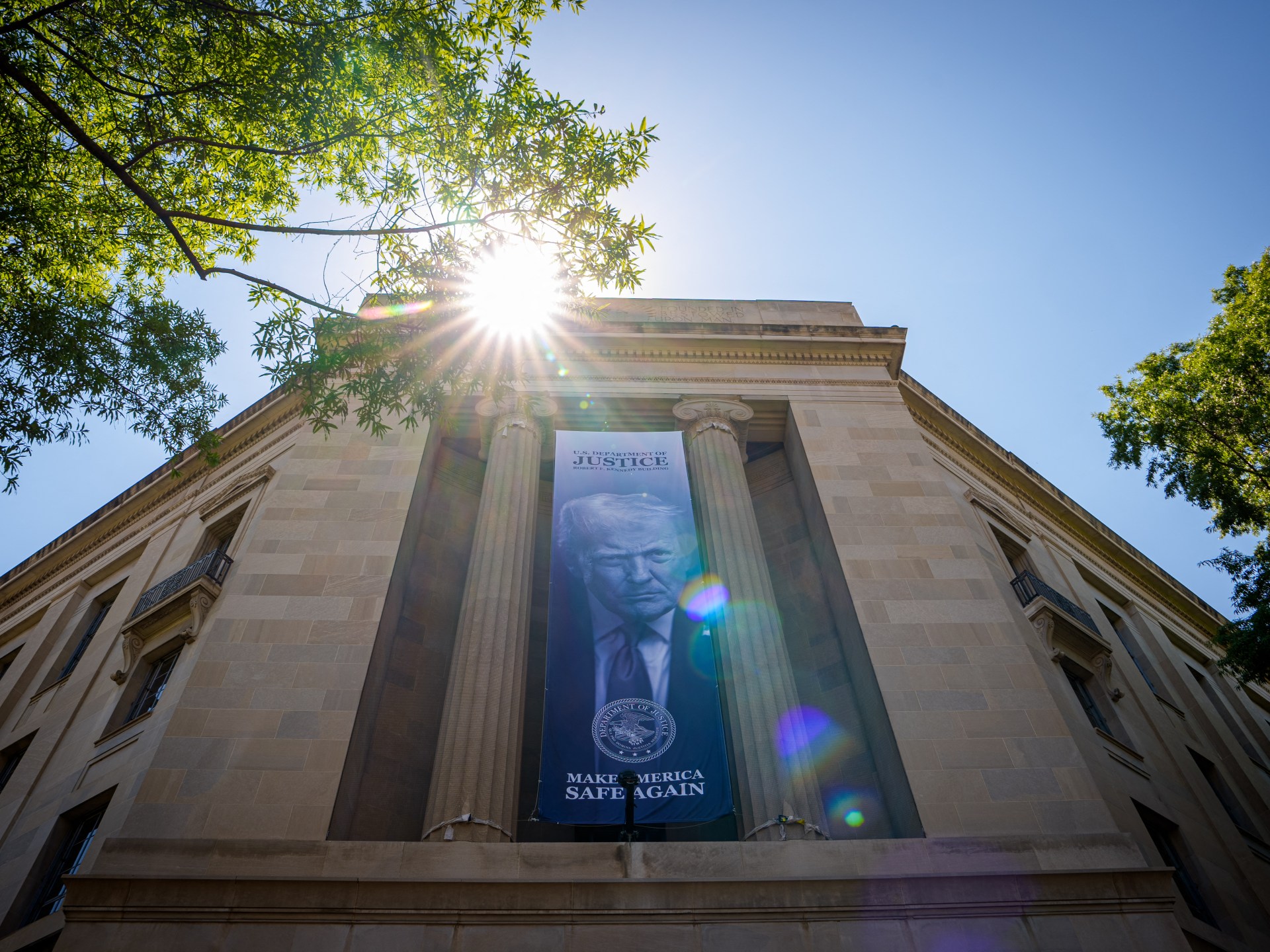
Two police officers in Washington, DC, have sued the administration of President Donald Trump over its decision to establish a $1.776bn fund to compensate victims of alleged government “weaponisation”.

In their lawsuit, filed on Wednesday, officers Harry Dunn and Daniel Hodges call the fund “the most brazen act of presidential corruption this century”.

They are aiming to have the fund dissolved in order to prevent taxpayer money from being disbursed to participants in the attack against the United States Capitol on January 6, 2021.

On that day, thousands of Trump supporters descended on Congress in an apparent effort to prevent the certification of the 2020 presidential election, which Trump lost.

“If allowed to begin making payments, the Fund will directly finance the violent operations of rioters, paramilitaries, and their supporters who threatened Plaintiffs’ lives that day, and continue to do so,” the lawsuit argues.

Both Dunn and Hodges have said they were injured during the attack. Dunn, a member of the US Capitol Police, has since retired.

Hodges, who remains with the Metropolitan Police Department, recalled in the lawsuit being “nearly crushed by rioters” against a Capitol door. Another officer heard protesters threaten to “kill him with his own gun”. The officers feared they would not escape the attack alive.

Their lawsuit argues that Trump has signalled he would like to compensate the January 6 rioters, saying they were “treated unfairly” by the justice system.

The newly created fund, it argues, would allow him to do so with little oversight.

Already, on the first day of his second term, Trump issued a blanket pardon to nearly all the participants in the attack, and he commuted the sentences of 14 others.

According to their complaint, both Dunn and Hodges continue to be the subject of violent threats and harassment as a result of their defence of the Capitol. Compensating their attackers, the two men claim, will encourage further violence.

“The Fund’s mere existence sends a clear and chilling message: those who enact violence in President Trump’s name will not just avoid punishment, they will be rewarded with riches,” the lawsuit says.

“That message, by itself, substantially increases the already sizeable risk of vigilante violence Dunn and Hodges face on a near-daily basis. And it encourages those who are harassing Dunn and Hodges, and sending them death threats, to up the ante.”

The Trump administration has so far refused to rule out paying January 6 participants from the “anti-weaponisation” fund.

That pool of money was set up this week as part of a settlement between Trump and the Justice Department, which falls under his leadership.

In January, Trump had announced that he was suing the Internal Revenue Service (IRS), which also falls under his executive control, over the leak of his tax returns to media organisations like The New York Times and ProPublica.

Alleging harm to himself, his adult sons and his business interests, Trump sought $10bn in damages. Critics, however, quickly pointed out that the lawsuit constitutes a conflict of interest for the sitting president, who holds significant sway over both the IRS and the Justice Department.

Even the judge assigned to the case, Kathleen Williams, appeared sceptical that the two sides were “sufficiently adverse”, noting that the defendants were “subject to his direction”.

There were also serious questions about whether Trump had filed his lawsuit within the statute of limitations, and whether the leak — which was committed by a government contractor, Charles Littlejohn — was truly the responsibility of the IRS.

But Trump’s lawsuit never made it to trial. The case was closed after the settlement was announced on Monday.

As part of the settlement, the Trump administration directed the Justice Department to draw $1.776bn from the Judgement Fund, which is used to settle lawsuits against the government.

That sum was then put aside as an “anti-weaponisation” fund, a pot of money seemingly predicated on Trump’s assertion that he and his supporters are entitled to compensation for unfair treatment under previous administrations.

The settlement (PDF) stipulates that the US government has “no liability whatsoever for the protection or safeguarding of those funds” from fraud.

It also explains that the fund will be managed by five people, appointed by the attorney general and subject to the president’s removal.

On Tuesday, an addendum (PDF) was published to the settlement, forever discharging Trump and his family from legal claims related to his tax returns.

The lawsuit brought by Dunn and Hodges is expected to be one of several legal challenges contesting the settlement’s terms.

Already, there has been widespread outcry, particularly among Democrats, over allegations of self-dealing.

In their complaint, Hodges and Dunn allege that the “anti-weaponisation” fund’s “extraordinary sum” has “no plausible basis in the strength” of Trump’s claims. They also argue the lawsuit against the IRS should never have been brought.

“That lawsuit was frivolous,” they say in their complaint. “Because Trump, as the sitting President, was both the plaintiff and in direct control of all defendants, Trump v IRS lacked adversity.”

“Trump all but conceded the lack of adversity,” the complaint added. “Earlier this year, he described the case as requiring him to ‘work out a settlement with myself’.”

Ultimately, Dunn and Hodges said they fear the anti-weaponisation fund will amount to “the public financing of paramilitary organizations in the United States”, if it is not promptly dissolved.

Their lawsuit has been filed in the US court for the District of Columbia.

📰 மூல செய்தி (Source): https://www.aljazeera.com/news/2026/5/20/us-police-officers-sue-trump-over-1-8bn-anti-weaponisation-fund?traffic_source=rss

உலகம்

What’s the significance of the Russian president’s visit to China?

Published

on

Xi Jinping hosts Vladimir Putin a week after Donald Trump was in Beijing.

Over the years, China and Russia have described their relationship as a friendship without limits.

Russian President Vladimir Putin’s visit to Beijing this week further emphasises the strength of those ties. He and Chinese President Xi Jinping hailed their partnership as “a force of calm among chaos”.

They also warned against a return to the “law of the jungle” – an apparent reference to US President Donald Trump’s actions and policies, which include the war against Iran and sweeping global tariffs.

Will the two leaders succeed in their push for a multipolar world, one in which the US does not dominate?

Andy Mok – Author of The Innovation Machine: How China Creates and Adopts Technology Through Governance

Pavel Devyatkin – Non-resident fellow at the Quincy Institute for Responsible Statecraft

Allen Carlson – Associate professor in the Department of Government at Cornell University, specialising in Chinese foreign policy

📰 மூல செய்தி (Source): https://www.aljazeera.com/video/inside-story/2026/5/20/whats-the-significance-of-the-russian-presidents-visit-to-china?traffic_source=rss

Continue Reading

உலகம்

James Murdoch to acquire New York Magazine and Vox Media Podcast Network

Published

on

The deal, valued at more than $300m, gives Murdoch control of a storied magazine and a podcast division with a reach valued by advertisers.

Media scion James Murdoch has agreed to acquire New York Magazine and the Vox Media Podcast Network in a deal that will significantly expand his portfolio and stands to boost his influence over news and entertainment.

“This acquisition reflects both our interest in the forward edge of culture and our deep commitment to ambitious journalism,” Murdoch, the younger son of media mogul Rupert Murdoch, said in a statement on Wednesday announcing the transaction. His company Lupa Systems will buy both properties from Vox Media.

The deal, valued at more than $300m, gives Murdoch control of a storied magazine known for its coverage of culture, politics and fashion, and a podcast division whose reach, among a demographic coveted by advertisers, rivals that of cable television news networks, according to several people with direct knowledge of the acquisition. The politics news site Vox.com is also included.

Murdoch and his wife Kathryn Murdoch were intimately involved in courting key talent from Vox, specifically Kara Swisher and Scott Galloway, stars of the popular Pivot podcast, as well as several other programmes on the company’s podcast network.

“I like James and Kathryn,” Swisher said in a phone interview. “Unlike many other media owners these days, they’re savvy about the business and willing to take smart risks.”

Vox’s podcast division was valued much higher than New York Magazine in the transaction, two of the people said, spotlighting the importance of making sure top programmes were locked in. Pivot, for example, has three years remaining on its contract, which will continue under Murdoch. Swisher met with the investor and his wife Kathryn several times before the deal came together.

“In a company like Vox, if its talent doesn’t like something, it’s not gonna happen,” Galloway said in an interview. He added, “James is the only Murdoch that this deal could have happened with.”

Several years ago, James was locked in a fierce dispute with his father over the editorial direction and future control of the family’s media empire. In 2019, he founded Lupa after stepping down as chief executive of 21st Century Fox. In 2020, he resigned from the board of News Corp, the publishing arm of the family’s media empire, citing “disagreements over certain editorial content”.

Vox’s podcast and publishing assets will operate as a subsidiary of Lupa Systems, which also owns Art Basel, which hosts annual events in Paris, Miami, Hong Kong, and Doha, and Tribeca Enterprises, the media and entertainment company cofounded by Robert De Niro and Jane Rosenthal.

Vox Media CEO Jim Bankoff will join Lupa Systems and will continue to lead the brands under the Vox Media label, he said in a note to the company’s staff, adding the deal is expected to close in four to six weeks.

New York Magazine’s publications include The Cut, Vulture and Intelligencer, with a digital audience of tens of millions and more than 400,000 paying subscribers currently.

The acquisition does not include other Vox Media brands such as Eater, Popsugar and The Verge. These brands, along with SB Nation and The Dodo, will become an independent company under a new corporate name.

James’s father, Rupert Murdoch, once owned New York Magazine from the late 1970s till he sold it in 1991.

📰 மூல செய்தி (Source): https://www.aljazeera.com/economy/2026/5/20/james-murdoch-to-acquire-new-york-magazine-and-vox-media-podcast-network?traffic_source=rss

Continue Reading

உலகம்

How AIPAC channels millions through shell PACs ahead of US midterms

Published

on

Al Jazeera analyses how the pro-Israel lobby group has relied on shell political action groups with deceptive names to defeat Israel critics.

Washington, DC – For many voters in Illinois, nothing appeared overtly suspicious in the 30-second election advertisement that aired in mid-March.

The video starts with a burst of cheerful music, and a narrator praises congressional candidate Bushra Amiwala as a fighter for “real economic justice” and “the real deal”.

But the video was not part of a genuine effort to get Amiwala elected to the United States House of Representatives. And the candidate quickly disavowed it.

Instead, public records reviewed by Al Jazeera now show the commercial was paid for by a political action committee (PAC) associated with the largest pro-Israel lobby group in the US.

Funding for the advertisement came from the American Israel Public Affairs Committee (AIPAC), which has been pumping tens of millions of dollars into election campaigns in a push to sink candidates critical of Israel.

With the midterm primary season in full swing, advocates say AIPAC is placing its thumb on the scale in many congressional races. Its tactics, they argue, undermine election transparency.

“Every cycle, AIPAC shows just how broken our democracy is and how corrupt our political finance system is,” said Usamah Andrabi, a spokesperson at Justice Democrats, a progressive group.

“Every cycle, they are at the forefront of exploiting those gaps for their right-wing donors and at the expense of voters.”

In Illinois, the advertisement aimed to boost Amiwala in order to syphon off votes from more viable progressive candidates — namely, Palestinian American activist Kat Abughazaleh, who ended up losing the race narrowly.

While the Chicago Progressive Partnership — the group whose name appeared on the Amiwala advertisement — was widely believed to be linked to AIPAC, it did not have to reveal the source of its funding until after the elections, which took place in March.

Now that the vote is over, Federal Election Commission receipts show that the sole funder of Chicago Progressive Partnership was Elect Chicago Women (ECW), another PAC. It contributed $1m to the partnership.

In turn, ECW had raised more than $4m from United Democracy Project (UDP), the election arm of AIPAC, and another $1m from investor Blair Frank, one of UDP’s largest donors.

AIPAC also contributed $1.3m to a third PAC, Affordable Chicago Now, in what critics call an effort to conceal its spending in Illinois.

Palestinian rights advocates say this use of “shell PACs” is evidence of how the pro-Israel group has become “toxic” among the US electorate. They argue AIPAC has taken a Russian doll approach — hiding its spending by funnelling funds from one PAC to another — to hide its involvement in primary races.

“They are so unpopular amongst the Democratic Party that they have to hide themselves,” Andrabi told Al Jazeera. “We have to keep exposing them and looking under every rock to see whether or not this shell PAC or that shell PAC is funded by AIPAC.”

Part of the backlash has come from broader public disillusionment with Israel-backed policies, including the joint US-Israeli war against Iran and the genocidal assault on Gaza, which AIPAC supports.

As a result, Israel has been rapidly losing support among the US public.

Just this week, The New York Times and Siena College released a survey showing that 37 percent of US voters now sympathise with Palestinians, while 35 percent sympathise with Israelis.

That number was even higher among Democratic respondents, 57 percent of whom felt greater sympathy for the Palestinians.

The Pew Research Center suggested an even stronger left-wing backlash. Its survey earlier this year found 80 percent of Democratic respondents said they have unfavourable views of Israel.

For many voters, AIPAC has come to symbolise the oversized influence of campaign spending in US politics, turning the group into a pariah — especially among Democrats.

Some politicians who previously received support from the group are now disavowing it.

Omar Shakir, the executive director of the US-based rights group DAWN, said AIPAC’s use of shell groups is a reflection of that growing repudiation.

Routing funds “through layered PAC structures designed to obscure where the money originates reflects weakness, not strength”, he told Al Jazeera.

“They can’t defend Israel’s genocide, apartheid and ethnic cleansing, so they’re rigging the system outside of public view.”

A 2010 US Supreme Court ruling has allowed corporations and advocacy groups to spend unlimited amounts of money in elections, as long as they do not directly coordinate with the campaigns they are backing.

In many cases, PACs do not have to list all of their donors until after the elections. Some nonprofits that influence elections — known as dark money groups — do not have to reveal their donors at all. And there are few rules about messaging.

Experts say AIPAC has exploited these loopholes to advance its goals. But the lack of transparency is causing confusion in many races.

For example, in a competitive Democratic primary in Pennsylvania, candidate Ala Stanford insisted that she did not receive AIPAC money.

But the largest spender in the race was 314 Action Fund, a PAC that backs Democratic scientists, which supported Stanford, who is a paediatric surgeon.

AIPAC transferred $1m to 314 Action Fund in the last election cycle in 2024, but the extent of the group’s involvement in the Pennsylvania race remains unclear.

Progressive state legislator Chris Rabb, who has condemned Israel’s atrocities in Gaza as a genocide, ended up winning that primary on Tuesday.

In Kentucky, meanwhile, AIPAC and other pro-Israel groups helped defeat Congressman Thomas Massie, a rare Republican critic of President Donald Trump.

It was the most expensive House primary in US history, but the names of the donors of the PAC that spent the most money in that race have not been fully made public.

While it may be difficult to prove AIPAC’s spending in some races, Andrabi said it is not enough for candidates to merely distance themselves from the pro-Israel group.

“We know that AIPAC does not throw money at candidates unless those candidates will rubber-stamp their agenda in Washington,” he said.

“So it’s not just about what they say and whether or not they deny they have AIPAC support. Let’s ask them what policies they will support in Congress. Will they support an arms embargo against Israel? Will they call a genocide a genocide? Will they stop all funding to the Israeli government and military? That’s a good litmus test for us to do.”

Beyond its work with UDP and associated PACs, AIPAC has encouraged individual donors to contribute to the campaigns of 361 legislators, including Republican House Speaker Mike Johnson and Democratic Minority Leader Hakeem Jeffries.

The contingency of AIPAC-backed members of Congress spans the ideological spectrum, from prominent liberals like Ted Lieu to far-right, anti-Muslim figures, including Randy Fine.

In his 2020 memoir, former President Barack Obama acknowledged AIPAC’s influence in Washington, saying that politicians were worried about “crossing” the lobby group.

“Those who criticized Israeli policy too loudly risked being tagged as ‘anti-Israel’ (and possibly anti-Semitic) and confronted with a well-funded opponent in the next election,” Obama wrote.

AIPAC did not respond to Al Jazeera’s request for comment by the time of publication.

Despite its well-documented clout, AIPAC’s organisational structure remains murky, as well as its spending.

On Wednesday, DAWN, the rights group, released a report that relied on LinkedIn disclosures to track the group’s current and former staff members and their professional connections.

It found that many people who worked for AIPAC also held jobs with the US and Israeli governments.

“DAWN’s analysis shows that 66 former AIPAC staffers cu

📰 மூல செய்தி (Source): https://www.aljazeera.com/news/2026/5/20/as-aipac-becomes-toxic-it-is-trying-to-conceal-spending-in-us-elections?traffic_source=rss

Continue Reading

Trending

Copyright © 2024 by 7Tamil Media, All rights reserved.