Connect with us

உலகம்

Food inflation hammers households in war-hit Iran

Published

on

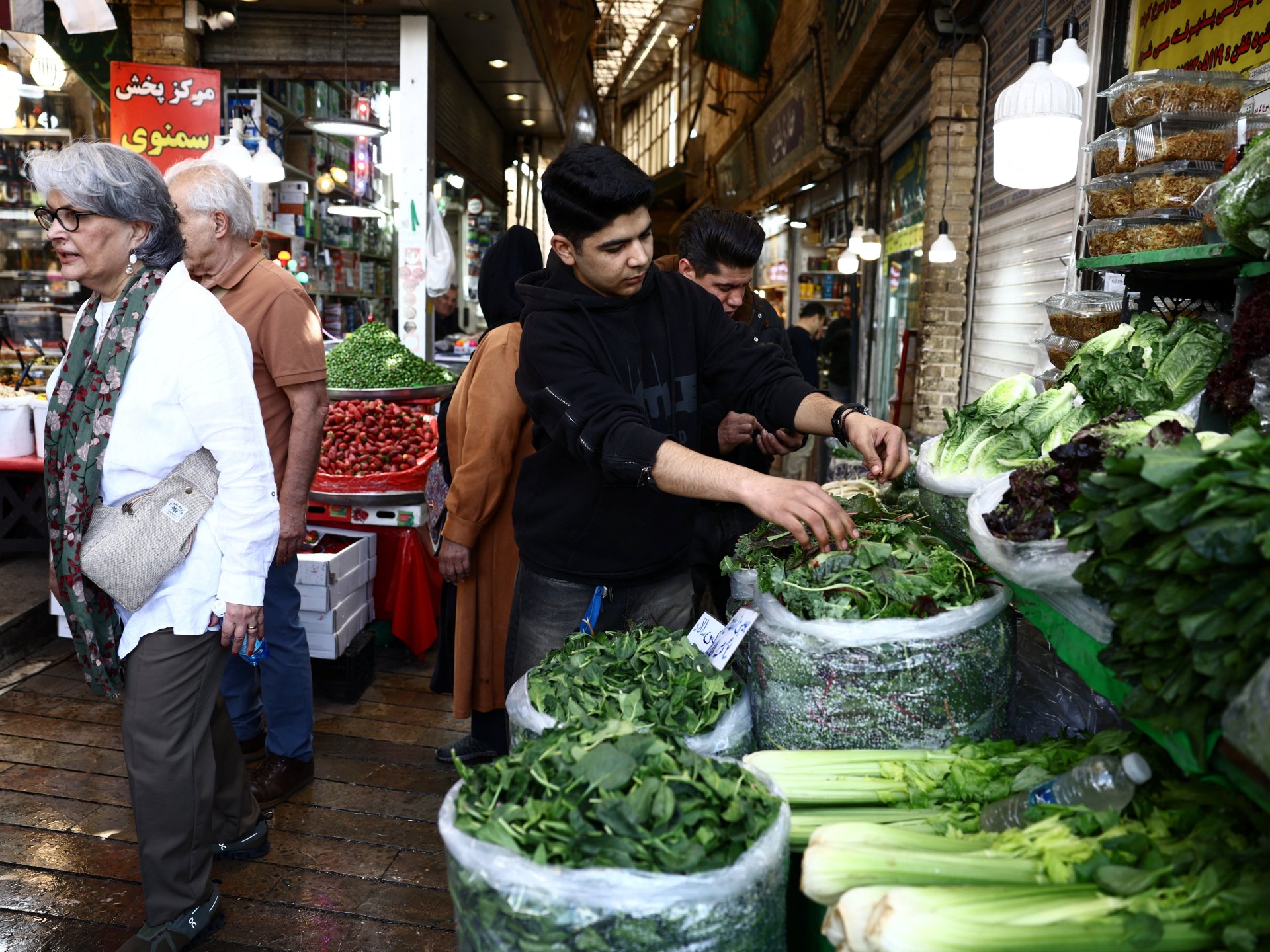
Iranians are faced with skyrocketing food prices as inflation soars and currency plunges amid a US-enforced naval blockade.

Tehran, Iran – Skyrocketing inflation is jeopardising food security among households in conflict-hit Iran, new figures show, as diplomatic efforts to end the war launched by the United States and Israel intensify.

“The people must realistically understand the conditions and restrictions of the country,” President Masoud Pezeshkian told a group of officials who gathered on Sunday to discuss rebuilding structures damaged or destroyed in US and Israeli attacks.

“It is natural that there are difficulties and problems in this path, but through people’s cooperation and reliance on national cohesion, problems can be solved,” he was quoted as saying by state media.

Pezeshkian’s comments came a day after the Statistical Center of Iran (SCI) said Farvardin, the first month of the Persian calendar year that ended on April 20, had an inflation rate of 73.5 percent compared to the same month of the previous year. The SCI also noted that inflation was five percent higher in Farvardin compared to the previous month.

The Central Bank of Iran, which reports figures based on a different method and with different data sets, reported a slightly lower inflation rate of 67 percent for Farvardin compared to a year earlier, and a seven percent monthly increase.

Although not matched, both figures indicate a considerably accelerating pace for general inflation, which has been among the highest in the world over recent years, and is continuously making Iranians poorer.

A Tehran resident told Al Jazeera she could no longer afford some of the items she could just last month.

“And it’s not just me – I think most people in society right now can’t afford many of the things they want,” she said.

Figures from the institutions also showed that food inflation is much higher than headline inflation, meaning that people are increasingly forced to pay an expanding share of their shrinking salaries on basic items.

The SCI reported a staggering 115 percent food inflation rate for the first month of the year, compared to the same period the year before, with several staple items more than tripling in price.

Solid vegetable oil had the highest increase at 375 percent, followed by liquid cooking oil at 308 percent; imported rice at 209 percent; Iranian rice at 173 percent; and chicken at 191 percent. The lowest price hikes were for butter, at 48 percent, followed by infant formula at 71 percent and pasta at 75 percent.

Majid, a young man who works at a liver kebab shop in the capital, said the eatery has increased prices three times in recent months.

“The price of liver has doubled. When we ask suppliers why, they either say there’s a shortage or that sheep are being exported. Honestly, there’s no real oversight,” he said.

The state-run Consumers and Producers Protection Organization said in a directive sent to 31 governors across Iran on Sunday that new price hikes for cooking oil are “illegal” and “must be returned to previous levels”, without saying how officials expected that to happen amid deteriorating economic conditions.

The country’s embattled currency, the rial, has also been registering new all-time lows over the past two weeks. On Sunday afternoon, it stood at about 1.77 million against the US dollar in Tehran’s open market after marginally recovering. The rate was about 830,000 per US dollar a year ago.

The response from the government has included offering subsidies and coupons, while trying to crack down on acts such as hoarding that are perceived to be contributing to price hikes.

But this has not been accompanied by a clear macroeconomic stabilisation package as the US presses on with a naval blockade of Iranian ports.

As Iranian media reported on Sunday that Tehran had sent an official response to the text for an agreement earlier proposed by the US through mediator Pakistan, Pezeshkian said, “If there is talk of negotiations, it does not mean surrender.”

The government hands out monthly cash subsidies and electronic vouchers to buy essential goods at select stores, which together amount to less than $10 each month per person. Authorities are considering raising the amount, but a hefty budget crunch has made that more difficult.

Pezeshkian and Central Bank chief Abdolnasser Hemmati have said they are aware of the price increases, but have blamed the war that began in late February while coordinating with the judiciary to act against price gauging and hoarding.

A number of lawmakers in Iran’s hardline-dominated parliament, as well as state television hosts and outlets linked to the Islamic Revolutionary Guard Corps (IRGC), have said the price surges are suspicious. They have described the runaway prices as being part of an “economic revenge” campaign by enemies who suffered failures in the military arena.

“I want the people of Iran not to be fooled by the enemy-made price hikes,” a guest on state television’s Ofogh network said on Saturday. “Great things have happened, and great things are ahead. The economic achievements of the war are unrivalled by any other period.”

But some of the economic pain continues to be inflicted as a direct result of a near-total internet shutdown now being imposed by Iranian authorities for a 72nd day.

Numerous officials in the government, internet infrastructure firms, telecommunication companies and other state-linked organisations have emphasised that they are against a tiered internet system that is now being implemented. But they have said they bear no responsibility, since the blackout, which is expected to remain in place until the war ends, is ordered by the Supreme National Security Council.

In the meantime, the combined impact of local mismanagement, Western sanctions, blockade, war and the internet shutdown is squeezing people and businesses hard.

“The startup ecosystem of the country is dead, we are searching for a tombstone for it,” the Guild Association of Internet-based Businesses said in a statement on Saturday.

📰 மூல செய்தி (Source): https://www.aljazeera.com/news/2026/5/10/food-inflation-hammers-households-in-war-hit-iran?traffic_source=rss

உலகம்

US Jewish leader, Israel advocate Abe Foxman dies at 86

Published

on

Israeli officials hail Foxman, who led the ADL advocacy group for nearly three decades, as warm and passionate.

Prominent Jewish American leader and Israel defender Abraham “Abe” Foxman has died at age 86.

The Anti-Defamation League, the advocacy group he led for 28 years, confirmed his death on Sunday, calling him an “outspoken, passionate, and tireless advocate for the Jewish people and Israel“.

A Holocaust survivor, Foxman helped shape the conversation around Israel and anti-Semitism in the US for decades.

ADL Board Chair Nicole Munchnik said Foxman helped build the “modern liberal era of America”, describing him as a “longtime adviser” to US presidents and world leaders.

“To those of us who knew him, Abe was a warm friend, adviser, spirited antagonist and hugger – all over lunch,” Munchnik said.

Foxman joined the ADL in 1965 and served as the group’s national director from 1987 to 2015.

Under his leadership, the group – which presents itself as an anti-hate watchdog – became one of the most influential advocacy organisations in the country.

Palestinian rights advocates have long condemned the ADL, accusing it of demonising pro-Palestine activists and conflating criticism of Israel with anti-Semitism.

Since the start of the genocidal war on Gaza, the ADL – under Foxman’s successor Jonathan Greenblatt – has intensified its campaign against Israel’s critics.

Greenblatt, who has supported laws to penalise boycotts of Israel, compared the Palestinian keffiyeh to the Nazi swastika last year.

Foxman also remained a staunch supporter of Israel and defended its conduct during the genocidal war on Gaza.

“What is happening in Gaza is tragic. But it is not Genocide. And it is not illegal,” he wrote on X in July 2025 as Israel imposed a hunger crisis on the territory.

“War is hell and inhumane, destructive and ugly. And nations must take all possible care to avoid civilian harm. And Israel has and is doing that. Having said this, Israel still needs to act with all deliberate speed and skill to provide maximum humanitarian aid to lessen the loss of innocent civilian lives.”

Weeks before his death, Foxman backed the US-Israel war on Iran, voicing gratitude to US President Donald Trump and Israeli Prime Minister Benjamin Netanyahu for attacking the country.

“Thank you President Trump and Prime Minister Netanyahu for standing up to evil and jihadist extremism. The world hopefully will be a better and safer place in the future,” he said in a social media post on February 28 after the war broke out.

In March, Foxman warned about what he described as the rise of anti-Semitism on the right and left of the political spectrum in the US, hitting out at liberal politicians publicly distancing themselves from the American Israel Public Affairs Committee (AIPAC).

“If a politician doesn’t want to take money from AIPAC, don’t take money from AIPAC, but don’t make taking money from AIPAC a morality test – because that continues to build the conspiracy theory that there is a Jewish lobby that controls America,” he told the Jewish Standard.

AIPAC, which backs the war on Iran, has been spending millions of dollars on ad campaigns to defeat Israel’s critics in US elections.

Last year, Foxman sounded the alarm about the dwindling support for Israel in the US, underscoring the importance of the alliance between the two countries for Israel.

“We’re in a propaganda war, and to an extent, we’re losing the propaganda war, and I worry about losing America,” Foxman told Times of Israel.

“It’s scary, looking at the polls, the Sunday television shows, the major newspapers – there is so much out there that is anti-Israel.”

Despite his assertion, rights advocates often decry the absence of Palestinian perspectives on TV shows in the US media.

In 2021, Foxman announced that he was cancelling his New York Times subscription after the newspaper published a front page featuring the photos of dozens of Palestinian children killed by Israel in Gaza.

“Today’s blood libel of Israel and the Jewish people on the front page is enough,” he said at that time.

Tributes in Israel and the US poured in for Foxman on Sunday.

Israeli Foreign Minister Gideon Saar said he was “deeply saddened” by the death of Foxman.

“A towering voice against antisemitism, Abe devoted his life to defending the Jewish people and strengthening the bond between Israel and Jewish communities worldwide,” Saar said on X.

Israel’s President Isaac Herzog also called Foxman a “legendary leader of the Jewish people”.

“He was a passionate Zionist, a humanist, and an outspoken, wise friend,” Herzog said.

📰 மூல செய்தி (Source): https://www.aljazeera.com/news/2026/5/10/us-jewish-leader-israel-advocate-abe-foxman-dies-at-86?traffic_source=rss

Continue Reading

உலகம்

Israeli weapon fires tiny metal cubes into people in Lebanon, like Gaza

Published

on

Israeli weapon fires tiny metal cubes into people in Lebanon, like Gaza

The same tiny tungsten cubes that spray out of Israeli bombs, causing devastating internal injuries to people in Gaza are being found in wounded civilians in Lebanon, war surgeon Dr Tahir Mohammed says. He draws parallels between what Israel is doing in both places and describes the weapons as “indiscriminate”.

📰 மூல செய்தி (Source): https://www.aljazeera.com/video/newsfeed/2026/5/10/israeli-weapon-fires-tiny-metal-cubes-into-people-in-lebanon-like-gaza?traffic_source=rss

Continue Reading

உலகம்

Trump to discuss Iran with Xi Jinping during China visit: Officials

Published

on

Official says US president will likely ‘apply pressure’ on China over Beijing’s purchase of Iranian oil amid war.

Donald Trump is set to arrive in Beijing on Wednesday evening to discuss the Iran war and other issues with his Chinese counterpart President Xi Jinping.

White House Principal Deputy Press Secretary Anna Kelly said an opening ceremony and meeting will be on Thursday morning, and the trip will conclude on Friday. The US plans to host the Chinese leader during a reciprocal visit later this year.

Kelly said that this week’s trip would be of “tremendous symbolic significance” and focus on “rebalancing the relationship with China and prioritising reciprocity and fairness to restore American economic independence”.

Trump’s visit, initially scheduled for earlier this year but postponed in March due to the US-Israel war on Iran, comes as the US president struggles to contain the fallout from the war, both at home and abroad.

A senior administration official told news outlets in an anonymous briefing on Sunday that Trump could “apply pressure” to China on Iran in areas such as oil sales and Tehran’s purchase of potential dual-role military-civilian goods.

US Treasury Secretary Scott Bessent last week accused China of “funding” Iran.

“Iran is the largest state sponsor of terrorism, and China has been buying 90 percent of their energy, so they are funding the largest state sponsor of terrorism,” Bessent told Fox News.

Iran closed the Strait of Hormuz in response to US-Israeli attacks, restricting passage through a key artery of global energy transport.

China has said that it wants to see the war end and hosted Iranian Foreign Minister Abbas Arraghchi last week. At the same time, Beijing has refused to recognise Washington’s “unilateral” sanctions on Iran’s oil sector.

Disruptions stemming from the war have disrupted the global economy, with Asian states that depend on imports from the Middle East especially hard hit.

Trump could also bring up China’s support for Russia during the talks, along with trade and rare earth minerals, a vital resource for the US tech sector. Business executives from aerospace manufacturer Boeing and a handful of agricultural companies are set to travel with the US delegation.

The anonymous administration official said that no change was expected regarding the US stance on Taiwan, a main sticking point in relations between Washington and Beijing. China considers the self-ruling island a part of its territory, but the US has deep security and economic commitments to Taiwan.

📰 மூல செய்தி (Source): https://www.aljazeera.com/news/2026/5/10/trump-to-discuss-iran-with-xi-jinping-during-china-visit-officials?traffic_source=rss

Continue Reading

Trending

Copyright © 2024 by 7Tamil Media, All rights reserved.