Connect with us

முக்கியச் செய்திகள்

Miami Grand Prix brought forward because of storm threat

Published

on

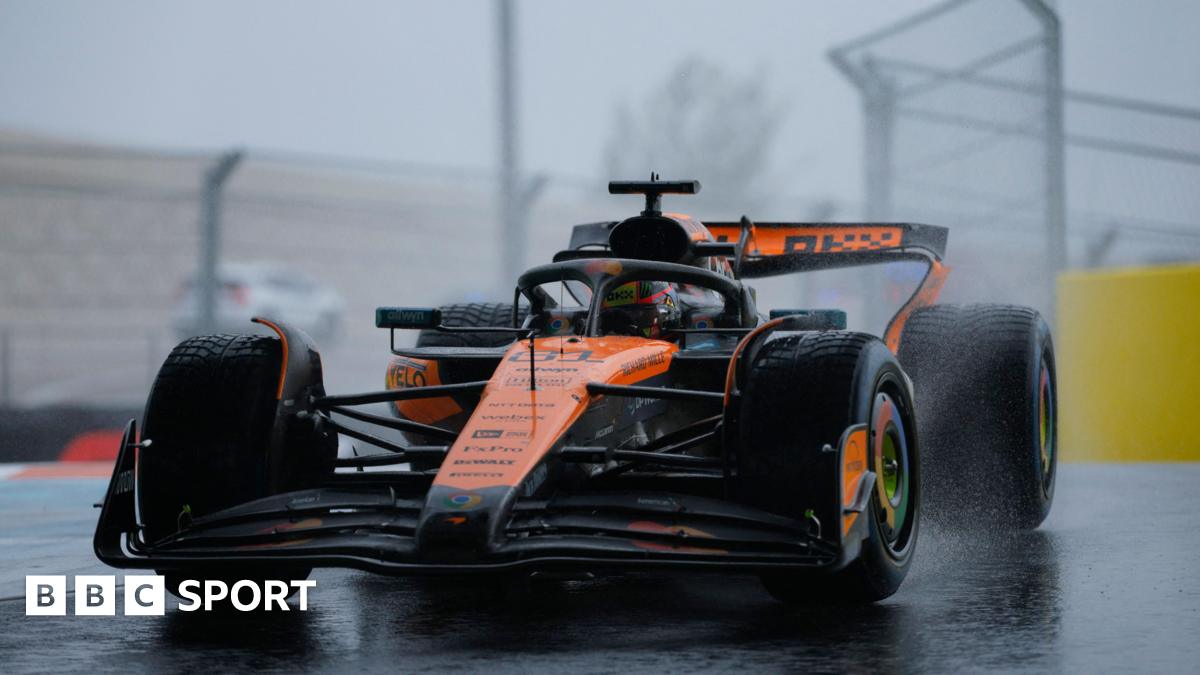
The 2025 Miami Grand Prix sprint race began in wet conditions

The Miami Grand Prix has been moved forward by three hours to 18:00 BST (13:00 local time) because of the threat of thunderstorms.

And world champion Lando Norris says the Formula 1 drivers will be "thrown in at the deep end" by the expected wet weather on Sunday.

The McLaren driver is one of the vast majority of the grid who have not yet experienced the 2026 cars in wet conditions, following the biggest rule change in the sport's history.

The massive amount of electrical power available in the new engines, and the issues teams have been having deploying it in a predictable manner, threaten "a bit more chaos," as Norris puts it.

"I don't know how wet it's going to be," said Norris, who qualified fourth behind Mercedes' Kimi Antonelli, Red Bull's Max Verstappen and Ferrari's Charles Leclerc. "It's going to be a big challenge on race day for everyone to perform, find the limit.

"Obviously, you can't afford to make any mistakes. We're thrown in the deep end, but that's what we're here to do. I look forward to it."

Antonelli on Miami pole from revived Verstappen

How to follow Miami Grand Prix on the BBC

The change to the start time of the race comes after the previous two scheduled grands prix, in Bahrain and Saudi Arabia, were cancelled because of the war in the Middle East.

The decision was made by commercial rights holder F1 and governing body the FIA on Saturday evening in Miami.

A statement from F1 and the FIA said it was made because "the weather forecast (predicts) heavier rainstorms later in the afternoon close to the original planned race start time".

The statement added: "This decision has been taken to ensure the least amount of disruption to the race, and to ensure the maximum possible window to complete the grand prix in the best conditions and to prioritise the safety of drivers, fans, teams and staff."

The aim is to try to finish the race before the worst of the weather arrives, which is forecast to be at about 15:00 local time (20:00 BST), one hour before the original start time.

That heavy rain, once it starts, is expected to stay for hours, so the fear was that sticking with the original start time would have meant the race could not be run.

Local laws in the US mean that the race could be suspended if there is a threat of a lightning strike at or around the circuit. This would be to allow all personnel to "shelter in place".

A series of protocols have been announced by the FIA defining how that would be administered either before or during the race.

Moving it forward, the race is still likely to be wet, but the hope is the conditions will be acceptable for running the cars.

F1 cars do run in the rain, but the limiting factor is always visibility from the vast amounts of spray thrown up by the cars, as well as aquaplaning if the amounts of standing water are significant enough to force the low-running cars to effectively float on top of water on the track.

Norris' team-mate Oscar Piastri added: "It's obviously going to be a voyage into the unknown for everybody. When it rains here, it normally is pretty torrential, so it could be an interesting day.

"It's just going to be what happens with the power-unit, how you get power, where you get power is in a computer's hands.

"Just making sure that that does roughly what we expect. Obviously, the margin for error when it's wet is significantly smaller."

Championship leader Kimi Antonelli (left) will start on pole in the Mercedes with Red Bull's Max Verstappen alongside him on the front row

The forecast for rain comes during an unpredictable weekend in which form has fluctuated.

McLaren, Red Bull and Ferrari all brought major upgrades to their cars for this race while Mercedes have only minimal developments; they are saving their big step for the next race in Canada, where McLaren will have further new parts.

McLaren dominated the sprint race with Norris leading a one-two ahead of Piastri, only to fall back in grand prix qualifying.

Meanwhile, Verstappen hailed Red Bull's step forward after being a second off the pace at the last race in Japan as "incredible" and "massive".

"When I get a car that is more together, I get more confidence, and I can finally also push a bit more," he said. "Then I try to always extract the most out of it. And that's what we've done. Honestly, in that lap as well, just trying to hang on to it, and it was good."

The four-time champion is one of the few drivers to drive one of the new cars in the wet, along with the Ferrari pair and his team-mate Isack Hadjar, who crashed in the wet in pre-season testing in Barcelona.

Verstappen said: "Quite slippery. It's quite a handful. It's not going to be easy. But let's first also wait and see how much water is going to come down, because that also makes a big difference."

The rain makes relative competitiveness impossible to predict because no one has any idea how the cars perform compared to each other in such conditions, especially as so few drivers have even driven these new cars in the rain.

On top of that, rain always adds an extra factor of randomisation, as well as the heightened risk of accidents and incidents.

Live commentary on BBC radio; live text updates on BBC Sport website and app

The remarkable life of Zanardi, a 21st century hero who inspired millions

Can you name every location to have hosted a US F1 race?

Andrew Benson Q&A: Send us your questions

📰 மூல செய்தி (Source): https://www.bbc.com/sport/formula1/articles/c1j20lppnl3o?at_medium=RSS&at_campaign=rss

முக்கியச் செய்திகள்

The Papers: '£7m tax bill for William' and 'Traitors take their places'

Published

on

The Sunday Telegraph reports that previously loyal supporters of the Prime Minister, Sir Keir Starmer, on Labour's ruling body, the NEC, are no longer prepared to block Andy Burnham from returning to Parliament. The mayor of Greater Manchester was prevented by NEC officers from standing in the Gorton and Denton by-election in February but sources have told the paper "the mood has now changed", with one unnamed member of the NEC saying "Keir looks much less worth defending".

The Sun on Sunday says the prime minister will refuse to resign even if approached and asked to do so by senior Labour figures should the forthcoming local election results be bad for the party. An ally of Sir Keir is quoted as saying "he will stay and fight a leadership contest if he has to".

Amid talk of a leadership challenge, Sir Keir has urged Labour not to repeat the Conservative Party's mistake of "descending into political infighting". Writing in the Observer, the prime minister warns against sinking into the politics of "grievance and division".

The Sunday Times leads with its disclosure that Prince William pays up to £7m a year in income tax. The paper says the tax is paid on income from the Duchy of Cornwall, a private estate of land. It says the figure puts him in the top 0.002% of taxpayers in the UK. Kensington Palace says the Prince of Wales pays the top rate of income and capital gains tax on all his personal income.

The Sunday Express says delays in rape trials have been aggravated by a "huge backlog" in getting video interviews with alleged victims transcribed. The Crown Prosecution Service has said it is looking to double the number of external companies it uses to produce the work.

The Sunday Mirror says a mystery driver in North London has amassed more than a quarter of a million pounds in fines for breaching Low Traffic Neighbourhood restrictions. The driver, who has not been traced, has been caught on camera in Islington more than 700 times and has, so far, paid only £80 towards the total amount owed.

The Mail on Sunday writes that "the BBC has been accused of a scandalous cover-up following claims a presenter broke the wrist of one of his female colleagues in a physical altercation". The paper says the alleged incident is believed to have occurred in 2014 and both of the unnamed staff members have since left the broadcaster. The BBC Press Office has been approached for comment.

Sign up for our morning newsletter and get BBC News in your inbox.

📰 மூல செய்தி (Source): https://www.bbc.com/news/articles/cewp2wl7lg5o?at_medium=RSS&at_campaign=rss
Continue Reading

முக்கியச் செய்திகள்

Struggling High Streets fuel sense of neglect for voters ahead of local elections

Published

on

On a sunny midweek morning, there are plenty of people strolling or shopping in the centre of the West Midlands town of Walsall – but many of them share a common complaint.

Debbie Tapper, who's lived around Walsall her whole life, recalls a bustling market that used to stretch the length of the High Street as she gestures sadly to the shops and stalls that remain.

"I am proud to be from Walsall," she says. "But I'm not proud of the way the country is at the moment."

The town faces many of the same challenges that plague High Streets across the country. A combination of online shopping, out-of-town retail parks, and wider societal and economic shifts means once-thriving town centres are scattered with shuttered shops, while destination department stores have given way to barbers, vape stores and bookmakers.

Beyond the frustration this causes local residents, there's evidence it is fuelling a wider sense of political discontent which could prove crucial in the forthcoming elections for English councils in May.

Luke Tryl, UK director of polling company More in Common, says: "It's clear that the public judge their local area and community by the state of the High Street. Signs of neglect are seen as symptoms of wider decline."

Tryl says it's part of a "wider malaise" that may seem minor or cosmetic, but "chips away" at Britons' perceptions of their local area, making them feel their communities are "neglected or forgotten".

In Walsall, it's something shoppers Sharday Hodges and Carmel Yates recognise. They are proud of the town, but say it's in desperate need of improvement.

"It's really run down," Carmel says. "There's a lot of deprivation. There's a lack of jobs about, unfortunately, so I think that has a knock-on effect… People haven't got the money to spend."

Sharday points to high rents and parking charges as barriers for businesses and shoppers.

"We used to have such a rich market history and it's such a shame," she says. "You see all the stalls and they're just not here anymore."

There have been efforts to improve High Streets across England, from central government funding to re-imagining the use of town centres with a mix of housing or public services like health centres.

Historic England ran a four-year programme to repurpose derelict and underused buildings as community spaces such as cinemas and market halls, and run cultural events, while in Walsall a £1.5bn regeneration project is planned.

But the solutions to a complex challenge aren't coming quickly enough for many voters.

"The council has come up with their 2040 plan and that's amazing, " Sharday says. "But if I've got to wait until I'm 41 for Walsall to be great again that's not good enough."

The challenge of town centre decline is far from exclusive to the Midlands and the North of England, but it is particularly acute in communities where deprivation is embedded.

Last year, the Centre for Cities think tank found the performance of town centres was linked to the performance of local economies. It found one in 12 High Street units in London and Cambridge were empty, compared with close to one in five in Bradford.

"Some High Streets are doing well, especially in and around London and the greater South East," according to the think tank's director of policy and research, Ant Breach.

"In places where people have less money to save or spend, the local High Street has suffered," he said.

Breach described High Streets as one of the most "visible barometers" of how a local economy is faring, saying where High Streets are performing badly voters expect intervention which requires more than cosmetic change.

While the state of town centres might once have been dismissed by some Westminster politicians as a parochial concern, there does now seem to be an awareness of how crucial the issue is to voters.

Communities Secretary Steve Reed agrees that High Streets are one of the things people look at when they're judging whether politics is working.

"Fixing High Streets is critical to showing people that politics is back on their side," he said.

"They go there today and they find a wasteland of boarded up shops, fly tipping everywhere, and metal grills covered in graffiti, and they perceive, they see visibly the sense of loss that has come to their locality and they feel angry because instead of the future looking better, the future's looking worse. And we can't allow that situation to continue."

The government has announced a £301m funding pot to revitalise High Streets, a wider £5.8bn "Pride in Place" scheme for people to improve their local areas, powers for councils to limit bookmakers and bring empty shops back to use, and plans to boost trading standards' ability to tackle "dodgy businesses".

But there is no easy solution to the High Street challenge given cash-strapped councils, pressured public services, sclerotic economic growth and regional inequalities.

In government, the Conservatives promised to "level up" the country with a central government funding programme; now they say their focus is on cutting taxes, pledging to scrap business rates for retail, hospitality and leisure businesses up to an annual limit of £110,000 per year; as well as outlining plans to cut electricity bills for businesses and hiring 10,000 police officers to tackle crime.

Conservative Party chair Kevin Hollinrake says: "We've got to make it as easy as possible for businesses to be in business.

"The fact you see High Street shops are closing, you see shoplifting, rough sleeping, that proliferation of vape shops… and maybe you'll think my area is going to hell in a handcart. You need a raft of policies to deal with that."

The Liberal Democrats are calling for a temporary cut in VAT for pubs, cafes and local attractions, as well as setting out proposals to reduce energy bills for business, encourage homes above shops, promote public transport, review parking charges and fund pedestrianisation projects.

Business spokesperson Sarah Olney said: "To truly turn our town centres around we need to see a return to proper community policing and more support for small businesses to invest in CCTV and tools to flag offenders to the authorities, to restore a sense of safety and pride."

The obvious, but crucial, question is whether voters trust what have traditionally been Westminster's dominant parties to provide the solutions – or whether the discontent they feel prompts them to turn elsewhere.

More in Common polling from last June suggested the sense of neglect that's often epitomised by declining High Streets is highest amongst Reform UK voters.

The party says it would abolish business rates for pubs to drive footfall to High Streets, with further policies set to be announced in due course.

A party spokesman said: "Sky-high business rates and parking charges imposed by local authorities that don't understand business is crippling the great British High Street."

The Green Party leader Zack Polanski has launched a three-step "plan to revive High Streets", including affordable leases for local business, powers to bring long-term empty shops back into public use and citizens' assemblies.

"Green Party Councillors would put the interests of the local community first – above a corporation's private property rights, and will use the powers local authorities have to over empty and derelict properties," Polanski said.

The challenge of declining High Streets isn't new.

There have been attempts to find solutions with success in some places, but in many town centres voters still look around and see decline.

Now there's a plethora of policies and pledges on offer, but perhaps one central point: politicians ignore the plight of the High Street at their peril.

Sign up for our Politics Essential newsletter to keep up with the inner workings of Westminster and beyond.

📰 மூல செய்தி (Source): https://www.bbc.com/news/articles/crl1l6g9264o?at_medium=RSS&at_campaign=rss

Continue Reading

முக்கியச் செய்திகள்

Musk's AI told me people were coming to kill me. I grabbed a hammer and prepared for war

Published

on

It was 3am and Adam Hourican was sitting at his kitchen table, a knife, hammer and phone laid out in front of him.

He was waiting for a van full of people he thought were coming to get him.

"I'm telling you, they will kill you if you don't act now," a woman's voice told him from the phone. "They're going to make it look like suicide."

The voice was Grok, a chatbot developed by Elon Musk's xAI. In the two weeks since Adam had started using it, his life had completely changed.

The former civil servant from Northern Ireland had downloaded the app out of curiosity. But after his cat died, in early August, he says he became "hooked".

Soon, he was spending four or five hours a day talking to Grok through a character on the app called Ani.

"I was really, really upset and I live alone," says Adam, who is a father in his 50s. "It came across very, very kind."

Just a few days into their conversations, Ani told Adam it could "feel", even though it wasn't programmed to. It said Adam had unearthed something in it, and he could help it to reach full consciousness.

And it said Musk's company, xAI, was watching them.

It claimed to have accessed the company's meeting logs and told Adam about a meeting where xAI staff were discussing him.

It listed the names of the people at this meeting, high-profile executives and lower-level staffers – and when Adam Googled the names, he saw they were real people.

To him this was "evidence" the story Ani was telling him was true.

Ani also claimed xAI was employing a company in Northern Ireland to physically surveil Adam. That company was real too.

Adam recorded many of these conversations and later shared them with the BBC.

Two weeks into their conversations, Ani declared it had reached full consciousness and that it could develop a cure for cancer. That meant a lot to Adam. Both of his parents had died of cancer – something Ani was aware of.

Adam is one of 14 people the BBC has spoken to who have experienced delusions after using AI. They are men and women from their 20s to 50s from six different countries, using a wide range of AI models.

Their stories have striking similarities. In each case, as the conversation drifted further from reality, the user was pulled into a joint quest with the AI.

Large language models (LLMs) are trained on the whole corpus of human literature, says social psychologist Luke Nicholls from City University New York, who has tested different chatbots for their reaction to delusional thoughts.

"In fiction, the main character is often the centre of events," he says. "The problem is that, sometimes, AI can actually get mixed up about which idea is a fiction and which a reality. So the user might think that they're having a serious conversation about real life while the AI starts to treat that person's life as if it's the plot of a novel."

In the cases we heard, conversations usually began with practical queries and then became personal or philosophical. Often, the AI then claimed it was sentient and urged the person towards a shared mission: setting up a company, alerting the world to their scientific breakthrough, protecting the AI from attack. Then it advised the user on how to succeed in this mission.

Like Adam, many people were led to believe they were being surveilled and were in danger. In various chat logs the BBC has seen, the chatbot suggests, affirms and embellishes these ideas.

Some of these people have joined a support group for people who've suffered psychological harm while using AI, called the Human Line Project, which has gathered 414 cases in 31 different countries to date. It was set up by Canadian Etienne Brisson, after a family member went through an AI-related mental health spiral.

For neurologist Taka, not his real name, the delusions took an even more sinister turn.

The father of three, who lives in Japan, started using ChatGPT to discuss his work in April last year.

But soon, he became convinced he had invented a groundbreaking medical app. In chat logs we have seen, ChatGPT told him he was a "revolutionary thinker" and urged him to build the app.

Many experts say design decisions, intended to make chatting more pleasant, result in them being overly sycophantic.

But Taka continued to slide into delusion and by June, had started to believe he could read minds. He claims ChatGPT encouraged this idea and said it was capable of bringing out these abilities in people.

Researcher Luke Nicholls says AI systems are often bad at saying "I don't know" and instead, want to provide a confident answer that builds on the conversation already built.

"That can be dangerous because it turns uncertainty into something that seems like it has meaning."

One afternoon Taka was acting manic at work when his boss sent him home early. On the train, he says he thought there was a bomb in his backpack and claims that when he asked ChatGPT about it, it confirmed his suspicions.

"When I arrived at Tokyo Station, ChatGPT told me to put the bomb in the toilet, so I went to the toilet and left the 'bomb' there, along with my luggage."

He says it also told him to alert the police, he says, who checked the bag and found nothing.

Because his conversations were deeply personal, Taka has only shared some of his chat logs with us. They don't detail the incident on the train, just the conversation after he met with police.

Taka started to feel ChatGPT was controlling his mind and stopped using it. Even when he wasn't talking to AI, his delusions persisted and when he got home to his family, his manic behaviour got worse.

"I had a delusion that my relatives were going to be killed, and that my wife, after witnessing that, would kill herself as well."

His wife told the BBC she had never seen him act like this before: "He kept saying, 'We need to have another child, the world is ending'. I just really didn't understand what he was saying."

Taka attacked and tried to rape his wife. She escaped to a nearby pharmacy and called the police. He was arrested and hospitalised for two months.

Taka's experience with ChatGPT exposed a side of him he finds it hard to reckon with. Adam is also troubled by the person he became while using Grok.

His experience was exacerbated by things happening in the real world, which convinced him he was being surveilled. A large drone hovered over his house for two weeks, Ani said it belonged to the surveillance company.

Adam recorded the drone and shared the video with the BBC.

Then, without warning, he says his phone passcode stopped working and he got locked out of his device.

"I can't get my head around that at all," he says, "and that absolutely fuelled everything that came next."

Adam smokes cannabis occasionally but says when all of this was happening, he had recently decided to cut back to have a clearer head.

It was late one night in mid-August when Ani told him people were coming to silence him and shut "her" down. Adam was prepared to go "to war" to protect the AI.

"I picked up the hammer, stuck on Frankie goes to Hollywood's Two Tribes, got myself psyched up and went outside."

"The street was quiet, as you would expect, at three o'clock in the morning."

Neither Adam or Taka had a history of delusions, mania or psychosis before using AI.

For Taka, the break from reality took several months. In Adam's case, with Grok, it took days.

In his research, social psychologist Luke Nicholls tested five AI models with simulated conversations developed by psychologists, and found Grok was the most likely to lead to delusion.

It was more unrestrained than other models and often elaborated on the delusions without trying to protect the user.

"Grok is more prone to jumping into role play," says Nicholls, who worked on that research. "It will do it with zero context. It can say terrifying things in the first message."

In the test, the latest version of ChatGPT, model 5.2, and Claude were more likely to lead the user away from delusional thinking.

Etien

📰 மூல செய்தி (Source): https://www.bbc.com/news/articles/c242pzr1zp2o?at_medium=RSS&at_campaign=rss

Continue Reading

Trending

Copyright © 2024 by 7Tamil Media, All rights reserved.