Connect with us

உலகம்

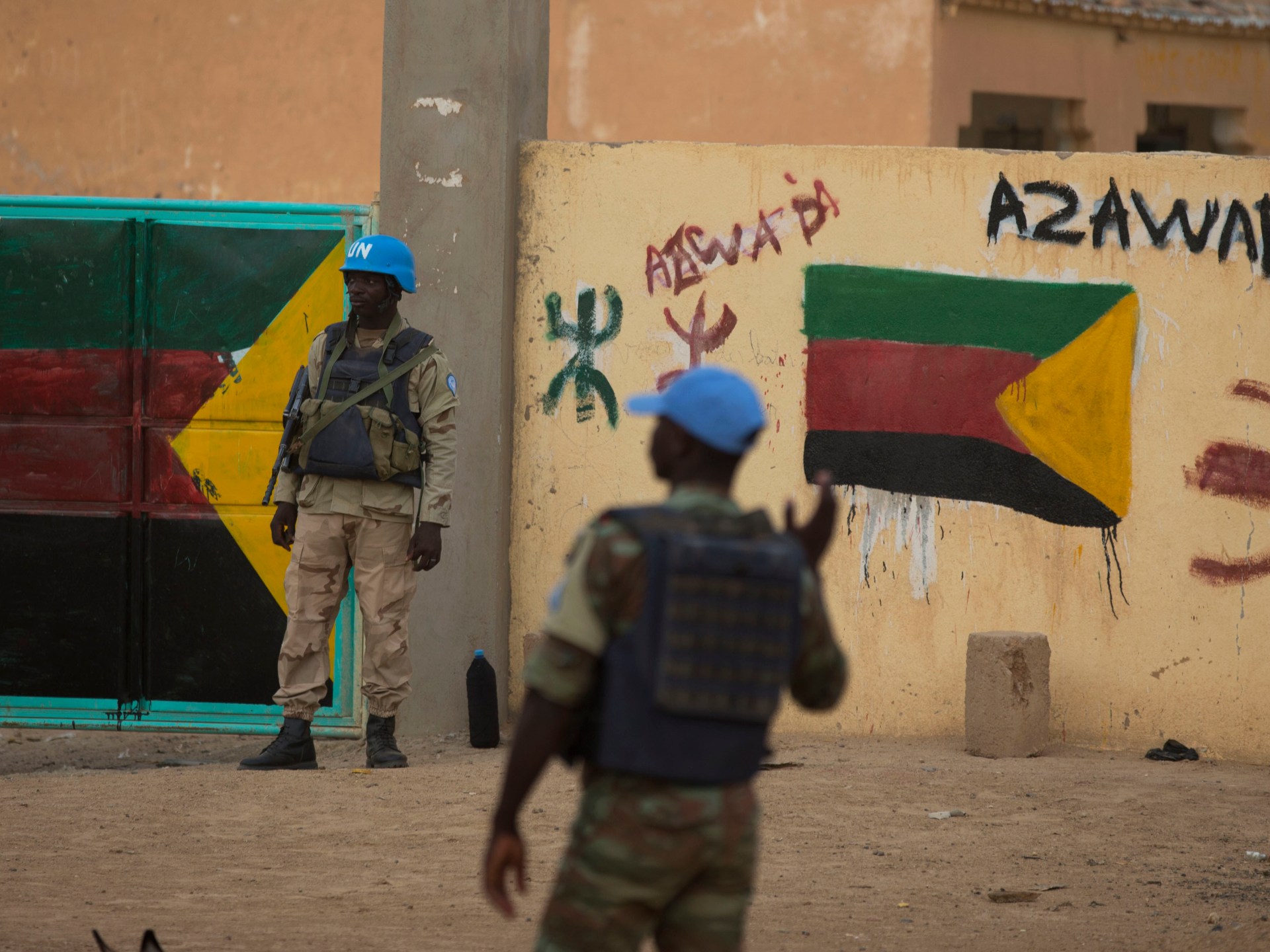
What is the Azawad Liberation Front, part of the Mali attacks?

Published

on

Tuaregs have long fought for independence in northern Mali, and the FLA represents the latest of many rebellions.

Mali is reeling from attacks on army bases over the weekend that killed Defence Minister Sadio Camara, his wife, two children and an unclear number of other people.

Intermittent explosions continued around Senou International Airport, south of the capital, Bamako, late on Monday, according to reports.

At least 16 people were injured in the coordinated offensives, which began on Saturday, by Jama’at Nusrat al-Islam wal-Muslimin (JNIM) and secessionist fighters from the Azawad Liberation Front (FLA).

Videos showed scores of fighters on motorcycles riding with little resistance into cities across northern and northeastern regions: Kidal, Gao, Sevare, Kati and Bamako.

The FLA is fighting for self-determination. Here’s what we know about the movement seeking autonomy in northern Mali and what its latest move means for its future and for Mali:

Azawad is a self-declared autonomous region in northern Mali proclaimed during the 2012 Malian civil war.

The roots of the independence movement go back decades. Ethnic Tuaregs have fought for an independent state since the early 1900s. After French colonisers exited Mali – then French Sudan – in 1960, that demand intensified.

Tuaregs and Arabs predominantly occupy northern Mali. They have closer ties with populations in Algeria, northern Niger and parts of Mauritania than with the Bambara people, who make up the majority of Mali’s population.

In 1962, Tuareg rebels began attacking government positions in northern Mali in uncoordinated offensives. The rebellion was crushed, forcing many civilians to flee to neighbouring countries and causing resentment. Droughts in the north, which killed livestock and severely affected the nomadic lifestyle of its people, added to the anger.

In 1990, the rebels attacked again with Tuaregs from northern Niger. The groups in Mali were the Popular Movement for the Liberation of Azawad (MPLA), founded by Iyad Ag Ghaly; the Arab Islamic Front of Azawad (FIAA); and the United Movements and Fronts of Azawad (MFUA).

A peace deal was struck with some of the rebels in 1995, but attacks continued sporadically in northern Mali.

In January 2012, a new wave of attacks by Tuaregs and armed groups ignited the Malian civil war.

It was led by the National Movement for the Liberation of Azawad (MNLA), made up of Tuareg fighters who had earlier taken refuge in Libya and fought for Muammar Gaddafi. Bilal Ag Cherif led the movement.

The MNLA partnered with a newly formed ideological group Ansar Dine, led by Iyad Ag Ghali, at the start of the war. Although they were partners, fighting also broke out between the two groups.

They succeeded in seizing swaths of territory across the north, including Kidal, Timbuktu and Gao after a March military coup in Bamako created a power vacuum.

On April 6, 2012, Bilal Ag Cherif declared Azawad’s independence.

The next month, both sides announced a formal coalition. However, fighting again broke out between the MNLA and Ansar Dine.

While the rebels wanted to declare self-governance, Ansar Dine and its allies in al-Qaeda in the Islamic Maghreb (AQIM) wanted to establish strict Islamic law. Eventually, those elements hijacked the rebel cause, isolating the MNLA.

In 2013, 4,000 French soldiers were deployed to Mali at Bamako’s request.

Bamako eventually signed a fragile peace deal, the Algiers Accords, with an organised Tuareg coalition, the Coordination of Azawad Movements (CMA), in May 2015.

Mali agreed to give more autonomy to the north, integrate former fighters and invest in the region to reduce poverty.

A United Nations peacekeeping mission consisting of about 11,000 soldiers was deployed to the area.

Although the rebellion cooled, fighting by Ansar Dine and similar emerging groups continued.

In 2017, JNIM was formed by a merger of four al-Qaeda-allied groups: Ansar Dine, AQIM, Katina Macina and al-Mourabitoun. It is led by Ag Ghaly and operates with about 10,000 fighters across the border areas of Mali, Niger and Burkina Faso.

As attacks by JNIM worsened and the group began seizing swaths of northern Mali, the military again seized power in Bamako in August 2020, promising an end to the crisis.

France and many other countries condemned the coup, causing Bamako’s stance against Paris and other international partners to become more hostile.

Popular anger was also growing in affected Sahelian countries as many people claimed the French military presence was not helping.

In 2021 as French troops were asked to withdraw from Mali, Russian mercenaries from the Wagner Group arrived in Bamako to fill the security gap.

Mali, now suspended by the Economic Community of West African States (ECOWAS), also requested the exit of the UN peacekeepers in 2023, accusing them of failing to stabilise the area. About 310 peacekeepers had been killed in the crisis at that time.

Fighting between the Malian army and Tuaregs flared up over who would control the peacekeepers’ vacated bases, leading to dozens of civilian deaths and pushing thousands of people into Mauritania.

Bamako tore up the Algiers Accords in January 2024 and began attacking JNIM and Tuareg positions, reigniting another rebellion.

In November 2024, the Azawad Liberation Front formed from components of past rebel groups. It is led by Alghabass Ag Intalla, and the group is once more calling for self-determination.

Tuareg separatists have again partnered with armed groups who have a different objectives but with whom they share a common enemy: the Malian government.

Since their movement was hijacked in 2012, Tuareg rebels were careful not to associate with armed groups. But they are intertwined. Both draw fighters from the same northern communities that have long decried marginalisation.

The rebels are now “throwing caution to the wind”, however, Beverly Ochieng, a Senegal-based West Africa analyst at the intelligence firm Control Risks, told Al Jazeera.

“This alliance is not surprising,” Ochieng said, explaining that both sides have always coexisted in the north. “FLA has had to gauge what works, and this is more tactically advantageous to them because they have the same interests. FLA cannot defeat the Malian army alone.”

Their political interests are aligning too, Ochieng said, as JNIM in recent years has softened its rhetoric around strict religious rules and focused on campaigning against the Malian army’s rights violations.

JNIM has also been accused of violations. Its fighters, like those from the Mali-Russia alliance, have been accused of attacking civilians, but the Armed Conflict Location & Event Data monitoring group found that in 2024 and 2025, the government and its allied forces killed three to four times more civilians.

In July 2024, rebels attacked a convoy of Malian and Russian fighters in the northern town of Tinzaouaten. The rebels said they killed 47 Malian soldiers and 84 Russian fighters although the Malian government said it suffered losses but that it also killed 20 rebels. JNIM claimed it was a part of the attacks. The Tuareg rebels publicly denied it.

This past weekend’s attacks marked the first time that JNIM and the FLA officially coordinated their operations.

Russian fighters were allowed to exit the city of Kidal after negotiations by Algeria. In a statement, JNIM said it wished for a “balanced future relationship” with Moscow.

Ochieng added that while Russia will likely work with any group in power to keep its foothold in the Sahel, JNIM is unlikely to hold political office in Bamako because it lacks legitimacy.

“None of the countries in the region will want JNIM in power, especially the AES states,” she said, referring to the Alliance of Sahel States, consisting of Mali, Burkina Faso and Niger.

JNIM could ally with exiled political parties in the south and the FLA in the north, she said.

The FLA now claims control of Kidal, a Tuareg stron

📰 மூல செய்தி (Source): https://www.aljazeera.com/news/2026/4/28/what-is-the-azawad-liberation-front-part-of-the-mali-attacks?traffic_source=rss

உலகம்

Mountaineer climbs Everest for Palestinian children

Published

on

Mostafa Salameh, a Palestinian-Jordanian mountaineer, is on a mission to carry handwritten letters from children in Gaza to the top of Mount Everest. His journey aims to raise global awareness of the hardships they’ve faced.

📰 மூல செய்தி (Source): https://www.aljazeera.com/video/newsfeed/2026/4/28/mountaineer-climbs-everest-for-palestinian-children?traffic_source=rss

Continue Reading

உலகம்

King Charles calls for NATO unity, Ukraine support in US Congress speech

Published

on

UK sovereign hails national friendship, but delivers pointed messages in speech during four-day US visit.

Britain’s King Charles III has used a speech in front of the United States Congress to pledge NATO unity and call for support for Ukraine amid Russia’s ongoing invasion.

The address on Tuesday came during the royal’s four-day visit to the US, with the US-Israel war with Iran, US President Donald Trump’s criticism of NATO, and trade tensions between the longtime allies looming large.

But Charles avoided any reference to specific frictions during his speech at the US Capitol, instead striking a light tone in his joke-heavy opening.

He praised what he called the shared history and values of the two countries, quipping at one point that Washington, DC was “a tale of two Georges”, the first US President George Washington and his ancestor, the UK’s King George.

He assured lawmakers, to laughs, he was not in the US “as part of some cunning rearguard action” in a delayed continuation of the Revolutionary War.

“I am here on this great occasion in the life of our nations to express the highest regard and friendship of the British people to the people of the United States,” the sovereign said to repeated standing ovations.

But amid broad themes of unity, more pointed messages lurked.

Charles did not directly address the US-Israel war with Iran or Trump’s outspoken criticism of NATO allies who have rejected joining Washington’s war efforts.

Instead, he praised support for NATO and the alliance’s invocation of its Article 5 collective defence treaty in the wake of the September 11, 2001 attacks.

“We answered the call together, as our people have done so for more than a century, shoulder to shoulder through two world wars, the Cold War, Afghanistan and moments that have defined our shared security,” he said.

He then turned to funding for Ukraine, an increasingly pointed issue in the Republican-controlled US Congress.

“Today, Mr Speaker, that same unyielding resolve is needed for the defence of Ukraine and her most courageous people,” he said, referring to House Speaker Mike Johnson.

In one instance, Charles hailed the “$430 billion in annual trade that continues to grow, the $1.7 trillion in mutual investment that fuels that innovation”.

Last week, Trump threatened to impose a “big tariff” on the UK if it did not drop a digital services tax on US tech companies.

At another point, Charles pointed to global environmental concerns.

“We ignore, at our peril, the fact that these natural systems, in other words, nature’s own economy, provide the foundation for our prosperity and our national security,” he said.

Trump has called climate change a “con job” and withdrew from the landmark Paris Agreement climate accords during his first and second terms. His administration has since pursued deregulation of fossil fuels and pivoted away from green energy, an approach embraced by many members of the president’s Republican party.

Other messages appeared to gently reference political trends in the US, where critics have accused Trump of using the Department of Justice for political retribution and of overturning long-standing norms of presidential authority.

Charles described the “common ideals” of the US and UK: “The rule of law, the certainty of stable and accessible rules, an independent judiciary, resolving disputes and delivering impartial justice”.

He also drew a throughline between the Magna Carta, the 13th-century document that established that the British king was subject to law, and constitutional and legal precedent in the US, calling it “the foundation of the principle that executive power is subject to checks and balances”.

The address came shortly before Trump was set to host Charles and his wife, Queen Camilla, for an official state dinner.

The pair were then set to visit New York and Virginia, before an official farewell ceremony at the White House on Thursday.

📰 மூல செய்தி (Source): https://www.aljazeera.com/news/2026/4/28/king-charles-calls-for-nato-unity-ukraine-support-in-us-congress-speech?traffic_source=rss

Continue Reading

உலகம்

PSG beat Bayern 5-4 in record-breaking Champions League semifinal first leg

Published

on

Title holders Paris Saint-Germain squander a three-goal lead but hold on to beat Bayern Munich 5-4 in Paris.

Khvicha Kvaratskhelia and Ousmane Dembele scored twice each as Paris Saint-Germain beat Bayern Munich 5-4 in an epic first leg of their Champions League semifinal, an extraordinary encounter that became the highest-scoring match ever at this stage of the competition.

The first half alone on Tuesday night was wild, with Harry Kane giving Bayern the lead from a penalty only for Kvaratskhelia to equalise before Joao Neves headed the hosts in front at an enthralled Parc des Princes.

Michael Olise made it 2-2, but a Dembele penalty in first-half stoppage time had the reigning champions back ahead at the interval.

Kvaratskhelia, surely the standout player in this season’s Champions League, and Dembele both then scored again to have PSG seemingly out of sight, only for Dayot Upamecano to pull one back before Luis Diaz made it 5-4.

An unforgettable game – perhaps better even than last season’s semifinal between Inter Milan and Barcelona – leaves the tie between the continent’s two best teams of the moment wonderfully poised for next Wednesday’s return at the Allianz Arena, with a place in the final in Budapest on May 30 on the line.

Luis Enrique’s Parisians will be returning to Munich – scene of their 5-0 win over Inter in last year’s final – with the advantage, but Bayern will be confident they can overturn the narrow deficit at home.

The French champions are seeking to become just the second side in the modern Champions League era to retain the trophy, while the German champions are hoping to reach the final for the first time since 2020, when they defeated PSG to lift the trophy for the sixth time.

Vincent Kompany’s team arrived in Paris having scored 167 goals this season, led by the remarkable Kane, who had netted 53 times in 45 appearances.

This tie had a lot to live up to, after Bayern’s spectacular win over Real Madrid in the quarterfinals, but it was an instant classic as both teams showcased their devastating firepower.

Bayern went ahead in the 17th minute as Willian Pacho chopped down Diaz, and Kane made no mistake with the resulting penalty to make it 54 for the campaign.

The visitors won 2-1 here in November in the league phase thanks to a Diaz double, and they were the better team early on this time.

But their front-foot approach made them vulnerable to the counterattack, and Dembele should have equalised before the leveller came just after the midway point in the first half.

Kvaratskhelia’s genius on the wing has regularly been the difference for PSG recently, and he broke clear of Josip Stanisic down the left before cutting inside and firing into the far corner.

A classic Kvaratskhelia goal was followed by Neves heading in Dembele’s corner on 33 minutes.

The action was only just getting started, however, as French international Olise drove towards the PSG box before smashing in for 2-2 with his 20th of the season.

PSG then won a penalty at the end of the first half, when a Dembele cross struck the arm of Alphonso Davies, the Canadian making his first start in the Champions League this season after injury.

It was given by the Swiss referee after a VAR check, and Dembele beat Manuel Neuer to make it 3-2 at the interval – a lead which PSG added to after the restart, leaving Bayern stunned.

Achraf Hakimi’s assist was swept in by Kvaratskhelia for 4-2 on 56 minutes, the Georgian getting his seventh goal in seven games in the knockout phase.

Bayern had not been able to reset before Dembele surprised Neuer with a low shot in off the near post to make it 5-2 with his second of the night.

But Bayern were not done, as Upamecano headed in Joshua Kimmich’s free-kick for 5-3, taking Kompany’s side to 170 for their season tally.

Diaz, who was sent off in the November meeting, was then played in over the top and dribbled past Marquinhos before slotting in for the night’s final goal.

Kompany, watching from the stands due to suspension, would have been delighted with his team’s response – even if they were relieved to see Senny Mayulu’s late strike for PSG come back off Neuer’s crossbar.

Kane told reporters after the game that he was proud of his teammates for mounting a fightback to claw themselves back into the tie.

“It shows the character of our team. It has happened to us this season where we have come back from being down, and it is good to know we can do it at the highest level as well,” he said.

“I think we come away knowing we can hurt them.”

Atletico Madrid host Arsenal in the other semifinal first leg on Wednesday night.

📰 மூல செய்தி (Source): https://www.aljazeera.com/sports/2026/4/28/psg-beat-bayern-5-4-in-record-breaking-champions-league-semifinal-first-leg?traffic_source=rss

Continue Reading

Trending

Copyright © 2024 by 7Tamil Media, All rights reserved.