Connect with us

உலகம்

Iran war: What’s happening on day 54 as Trump extends ceasefire?

Published

on

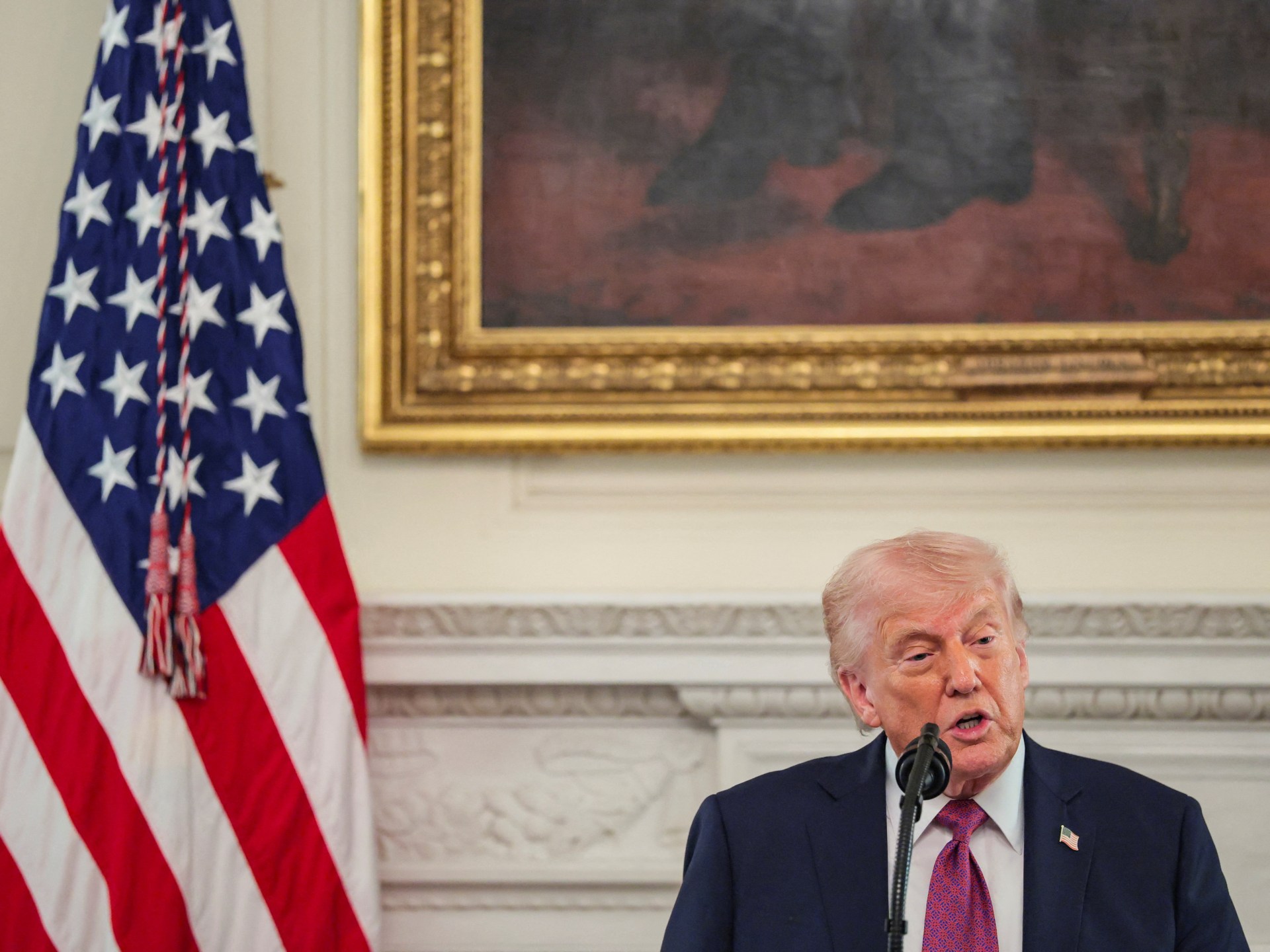
President Trump said the US would extend the ceasefire until Iran presents a proposal and talks are concluded, but a naval blockade of its ports continues.

Iran sets conditions as ceasefire extended, tensions persist

President Donald Trump said the United States is extending the ceasefire until Tehran submits its latest proposal with conditions for ending the war, and until negotiations conclude, keeping diplomacy open while maintaining pressure on Iran.

However, Trump said the US naval blockade on Iran would remain. Iran has insisted that the blockade represents a violation of the ceasefire, and has said it will not negotiate under the “shadow of threats” or while the blockade remains in place, underscoring the fragile and uncertain path to talks.

Meanwhile, violence continues across the region, with Israeli settlers killing two people, including a child, in the occupied West Bank, and Israeli strikes in southern Lebanon wounding civilians and damaging homes despite a 10-day ceasefire.

📰 மூல செய்தி (Source): https://www.aljazeera.com/news/2026/4/22/iran-war-whats-happening-on-day-54-as-trump-extends-ceasefire?traffic_source=rss

உலகம்

LIVE: Burnley vs Manchester City – Premier League

Published

on

Follow our live build-up, with full team news coverage, ahead of our text commentary stream as City target EPL top spot.

📰 மூல செய்தி (Source): https://www.aljazeera.com/sports/liveblog/2026/4/22/live-burnley-vs-manchester-city-premier-league?traffic_source=rss

Continue Reading

உலகம்

How Israel is destroying Lebanon’s water infrastructure

Published

on

Israel is ‘deliberately’ attacking Lebanon’s water, experts say, aiming to displace or kill southern Lebanon’s population.

Beirut, Lebanon – Israel is attacking Lebanon’s water infrastructure, using similar tactics to its genocidal war on Gaza, uprooting local populations.

Experts say that Israel’s strikes on crucial water infrastructure and near sites being repaired after prior damage have effectively turned access to water into a weapon – and that has become a pattern.

“The impunity Israel enjoyed in Gaza as it committed water war crimes is again on full display,” Bachir Ayoub, Oxfam’s Lebanon country director, said in a report published by the charity in late March. “The world has shown Israel can do what it wants, whenever it wants, without repercussion and again it is civilians who are paying the ultimate price for this inaction.”

Israel intensified its war on Lebanon for the second time in less than two years on March 2. Hours earlier, Hezbollah had fired rockets at Israel, breaking a 15-month period of not responding to Israeli attacks and the more than 10,000 ceasefire violations.

Hezbollah’s attack was also in retaliation for the killing of Iran’s Supreme Leader Ayatollah Ali Khamenei two days later. Over the next few days, Israel would displace more than 1.2 million people in Lebanon in a bombing campaign across the country.

Israel has killed journalists, medical workers, and devastated southern Lebanon’s medical infrastructure. Experts told Al Jazeera that those acts, along with the destruction of Lebanon’s water infrastructure, are part of a concerted effort to create an uninhabitable buffer zone in southern Lebanon.

Israel is currently occupying dozens of villages in southern Lebanon and preventing thousands from returning home. Prime Minister Benjamin Netanyahu said earlier in April that Israeli forces “are remaining in Lebanon in a reinforced security buffer zone”.

“This is a security strip 10 kilometres [6.2 miles] deep, which is much stronger, more intense, more continuous and more solid than what we had previously,” Netanyahu said. “That is where we are, and we are not leaving.”

One way to prevent Lebanese from returning is by striking Lebanon’s water infrastructure.

“Israel has declared its intent on raising [towns and villages] to the ground and preventing people from going back there,” Rami Zurayk, professor and chairperson of the Department of Landscape Design and Ecosystem Management at the Faculty of Agricultural and Food Sciences, American University of Beirut, told Al Jazeera. “Every drop of water that Israel steals is a drop of the water that is taken from the local population … Israel uses water in order to displace people, and it displaces people in order to steal the water.”

Israel damaged six water facilities in southern Lebanon during previous attacks on Lebanon since 2023, and in the first four days of the renewed conflict this year, “damaged at least seven critical water sources including reservoirs, pipe networks and pumping stations that supplied water to almost 7,000 people in the Bekaa area alone”, according to Oxfam International. Key infrastructure has been damaged in areas like Britel and Nabi Chit in the Bekaa Valley, and in Marjayoun, in southern Lebanon.

Lebanon’s water infrastructure is being “directly and indirectly attacked and on purpose”, asserted Nadim Farajalla, an environmental engineer and chief sustainability officer at the Lebanese American University in Beirut. “We saw it in 2024 and now in 2026.”

The indirect attacks hit things such as the electricity infrastructure, so that pumping stations cannot work to move water or sewage. The direct attacks have hit the pumping stations, as well as municipal workers operating water wells.

The aim behind these attacks is “to force people to leave”, Farajalla said. “Without electricity, you can stay in the dark and cook with gas, but without water, how will you live?”

Israel has denied that its attacks are a deliberate attempt to weaponise access to water, instead framing its operations as necessary for national security.

Even before the war, the Lebanese state had failed to deliver a number of basic services, including the supply of water, to its population for decades.

“The water supply situation in Lebanon must be understood against a backdrop of pre-existing vulnerabilities that have been exacerbated by recent hostilities and the ongoing economic crisis,” Imad Chiri, International Committee of the Red Cross’s (ICRC) water and habitat coordinator, told Al Jazeera.

Southern Lebanon, like many of the country’s peripheries, has been particularly neglected by the state. In October 2025, the ICRC conducted a water insecurity study in southern Lebanon’s Bint Jbeil and Marjayoun districts. Chiri explained that 91 percent of households were found to be experiencing moderate-to-high water insecurity – insufficient to meet daily needs. For 57 percent of households, the situation was bad enough for them to be classified as highly water insecure.

During times of conflict, water infrastructure comes under even more pressure, particularly for areas hosting displaced people. And even basic damage to water infrastructure can lead to compounding difficulties.

“There are two issues at hand that you have to be aware of,” Farajalla said. “There are attacks on infrastructure, and there is the burden on infrastructure due to displacement.”

“Water sources and networks are often located in frontline or high-risk zones, yet they continue to supply populations who have chosen to remain,” Chiri said. “Identifying contractors willing to operate under such conditions is already challenging. Even when they agree, operations require meticulous planning, limited time on site, and continuous adaptation to a highly volatile security environment.”

International Humanitarian Law (IHL) “obliges parties to a conflict to take constant care to spare water resources and water infrastructure,” Tadesse Kebebew, a legal researcher and project manager at the Geneva Water Hub, wrote for the ICRC in 2025.

Israel ratified the Geneva Convention – the basis for IHL – in 1951. But Zurayk said that “Israel has never paid attention to any of those conventions.”

In Gaza, for example, Israel controls Palestinians’ access to water. Israel has impeded Palestinians’ access to water in the West Bank, too.

“The use of water as a weapon has also been going on in Lebanon for a long time,” Zurayk said, citing Lebanon’s accusation that Israel had obstructed access to water from the Wazzani River, which crosses the Blue Line that separates Lebanese and Israeli territory, including the bombing of pumping stations.

And destroying Lebanon’s already insufficient water infrastructure directly contributes to illness and death.

“Not only is this about destroying access to water, it’s actually inducing waterborne diseases, the highest cause of infant mortality in developing countries, and inducing this in the population,” Zurayk said. “So it’s an indirect biological weapon. It is a chemical weapon because instead of dousing, which Israel has done, the region with the harmful chemicals, what you do is you withdraw an essential chemical.”

Still, Israel has never been held accountable.

“The international community stood by in Gaza and watched Israel’s weaponisation of water and its catastrophic consequences to men, women and children there,” Ayoub said in the Oxfam report from March. “The same devastation must not be allowed to play out again in Lebanon. Israel must be held to account for its violations and must not be allowed to occupy more land, deny more civilians of their basic rights, and continue to abuse international law without consequence.”

📰 மூல செய்தி (Source): https://www.aljazeera.com/features/2026/4/22/how-israel-is-destroying-lebanons-water-infrastructure?traffic_source=rss

Continue Reading

உலகம்

Ukraine restarts Russian oil to Europe, unblocking 90-billion-euro EU loan

Published

on

Resumption of oil deliveries enables Hungary to lift veto, with EU’s 27 members now on track to formally approve loan.

The European Union is expected to sign off on a 90-billion-euro ($106bn) loan for Kyiv after a months-long standoff over the stalled operations of a war-damaged pipeline transporting Russian oil via Ukraine to Europe.

EU diplomats meeting in Brussels gave their preliminary approval for the loan on Wednesday, their move coinciding with the resumption of Russian oil deliveries through the Druzhba pipeline to Hungary and Slovakia.

The two EU countries, which had accused Ukraine of dragging its feet over repairs, are expected to receive the first shipments by “tomorrow at the latest”, according to Hungarian oil group MOL, which said Wednesday that Kyiv had confirmed the oil was flowing.

Slovakia’s Economy Minister Denisa Sakova said on Facebook that the first deliveries were expected in the early hours of Thursday.

The development, already signalled on Tuesday by Ukrainian President Volodymyr Zelenskyy, who has said the pipeline was damaged by Russian attacks in late January, allowed Hungary to finally lift its longstanding veto on the EU loan, with the bloc’s 27 member states now expected to formally sign off on it by Thursday.

The EU agreed to the loan last year to maintain Ukraine’s liquidity through 2026 and 2027, but outgoing Hungarian Prime Minister Viktor Orban, who has maintained cordial relations with Russia since it invaded Ukraine in 2022, and the Slovak government had blocked it.

Ukraine’s prospects of receiving the loan had already improved when Orban lost Hungary’s parliamentary election on April 12. The leader of the winning party, Peter Magyar, has said he will no longer block the EU funds for Kyiv, though he is only expected to formally take power next month.

Resolving the deadlock should enable Brussels to start paying out the loan soon, throwing a financial lifeline to Ukraine more than four years into a costly pushback against Moscow’s full-scale invasion, as Washington withdraws its support and eases pressure on the Kremlin.

Slovak Prime Minister Robert Fico, who has repeatedly clashed with Kyiv and Brussels, said on Wednesday that he “would not be surprised if the 90-billion loan were unblocked and then oil supplies were cut off again”.

Alongside the loan, EU countries are also looking to approve a new round of sanctions on Russia that had also been stalled by both Hungary and Slovakia over the pipeline row.

The new round of economic penalties on Moscow,  the 20th from the EU since the war started in 2022, includes measures targeting Russia’s energy, banking and trade sectors.

The capacity of Druzhba, which in Russian means friendship, is 1.2 million to 1.4 million barrels of oil a day, with the possibility to increase to up to 2 million barrels a day.

📰 மூல செய்தி (Source): https://www.aljazeera.com/news/2026/4/22/ukraine-restarts-russian-oil-flows-to-europe-unblocking-90bn-eu-loan?traffic_source=rss

Continue Reading

Trending

Copyright © 2024 by 7Tamil Media, All rights reserved.